Acuity Posts Record Annual Profit as Smart-Building Unit Outgrows Legacy Lighting
The Atlanta-based industrial technology company's intelligent-buildings division, built around its 2025 acquisition of audiovisual maker QSC, grew sales 45 percent for the year while its original lighting business contracted, lifting full-year net income to a record $531 million.
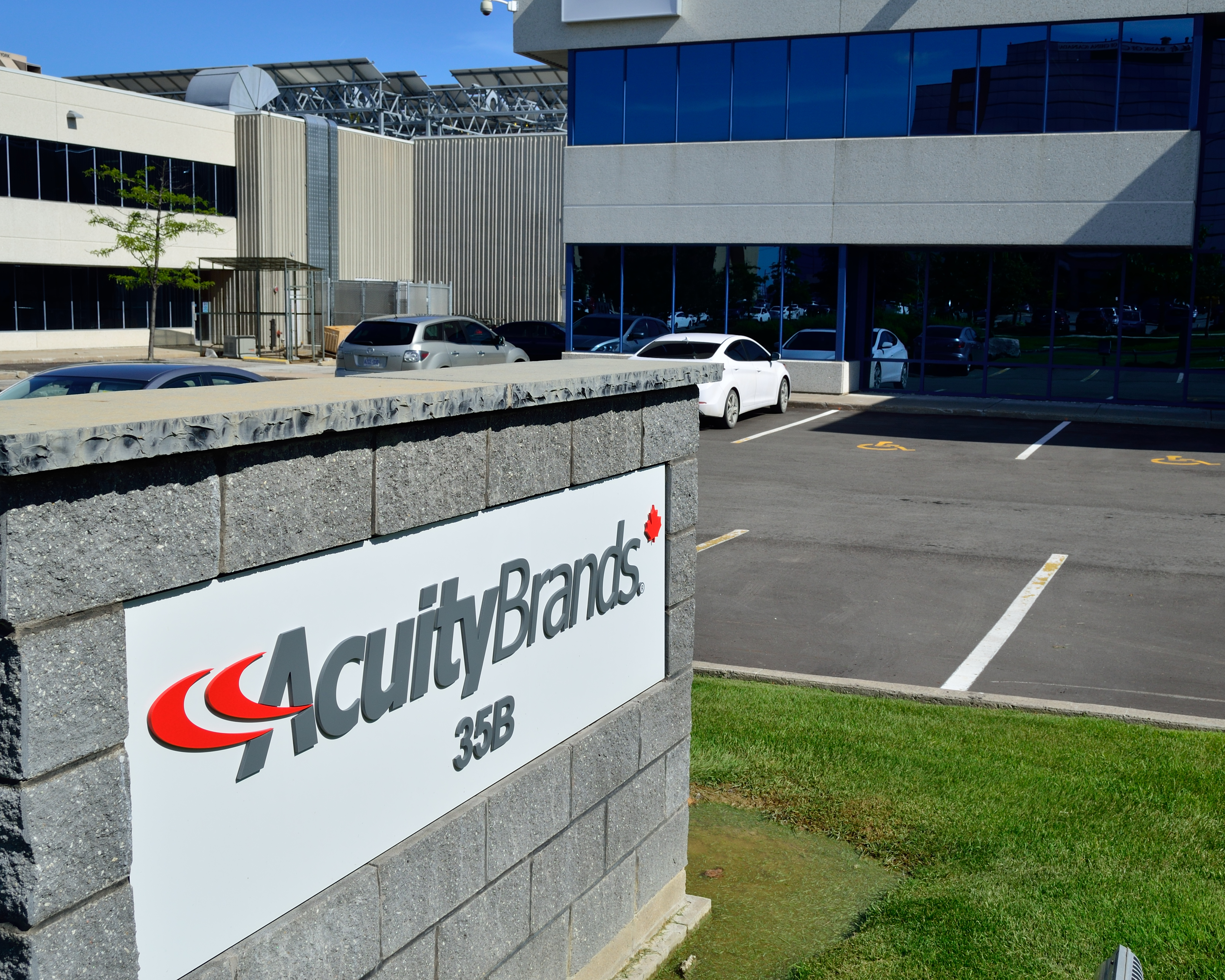
Acuity Inc., the Atlanta-based industrial technology company formerly known as Acuity Brands, reported record full-year profit on Thursday, as rapid growth in its smart-building and audiovisual software business offset a shrinking core lighting operation. The fiscal 2026 results, covering the year ended August 31, mark the first full year in which the company's 2025 acquisition of audio-visual platform maker QSC fully showed up in its books, and they illustrate a broader shift underway at the 13,000-employee company: away from manufacturing light fixtures and toward selling the sensors, controls and cloud software that run buildings.
Net income for the year rose 34 percent to $531.3 million, and diluted earnings per share climbed 36.1 percent to $17.05, according to results filed with the Securities and Exchange Commission, also posted on the company's investor relations site. Adjusted diluted earnings per share, which strips out acquisition costs, special charges and a one-time tariff refund, rose 10.5 percent to $19.90. The company does not expect its outside auditors to sign off on the figures until it files its annual report on Form 10-K, so Thursday's numbers are technically preliminary.
The numbers behind the split
Full-year net sales rose 6.8 percent to $4.64 billion, but that growth was uneven across Acuity's two divisions. Acuity Brands Lighting, the legacy fixtures and lighting-controls business that still accounts for most of the company's revenue, saw sales slip 1.0 percent to $3.58 billion. Acuity Intelligent Spaces, the newer division built around building-management software, sensors and the QSC audiovisual platform, grew sales 44.8 percent to $1.11 billion and more than doubled its operating profit, which rose 145.1 percent to $186.5 million.
- Full-year operating profit: $713.7 million, up 26.6 percent; margin expanded to 15.4 percent from 13.0 percent.
- Fourth-quarter net sales: $1.24 billion, up 2.9 percent; fourth-quarter diluted EPS: $5.63, up 56.0 percent.
- Full-year operating cash flow: $825.6 million, up 37.3 percent; free cash flow: $747.9 million, up 40.3 percent.
- Cash on hand: $636.3 million at year-end, up from $422.5 million a year earlier.
Results in the latest quarter were flattered by a one-time item: Acuity booked $44.9 million in tariff refunds, which it excluded from its adjusted figures. It also took $17.8 million in special charges, mostly tied to cuts to its lighting segment's product lines, supply chain and factory footprint, plus a smaller facility writedown in the intelligent-spaces unit.
How a lighting company became a software company
The lopsided growth traces back to October 2024, when Acuity agreed to buy QSC, a maker of cloud-managed audio, video and control systems, for $1.215 billion in a deal disclosed to the SEC and funded partly with a new $600 million term loan. The acquisition, which closed in early 2025 and was covered at the time by trade press covering the audio and lighting industries, folded QSC's Q-SYS platform into the Intelligent Spaces division alongside Distech Controls, a building-automation business, and Atrius, Acuity's data-analytics layer for buildings. This is the first fiscal year in which that combination operated for all twelve months, which explains much of the division's near-45 percent sales jump; the comparison also still includes a $1.19 billion acquisition-related cash outflow in the prior year that will not repeat.
Chairman, President and Chief Executive Neil Ashe framed the year as evidence the strategy is working even as the traditional lighting business contracts.
"We demonstrated solid execution in the fourth quarter of fiscal 2026. We grew sales and expanded our adjusted operating profit and adjusted operating profit margin. We increased our adjusted diluted earnings per share, generated strong cash flow and allocated capital effectively," Ashe said in the earnings release. "Throughout fiscal 2026 we strengthened Acuity Brands Lighting while continuing to scale Acuity Intelligent Spaces, building the operating and financial capacity needed to compound growth and value over time."
By comparison, Acuity's third-quarter release, issued in June, showed net sales up only 2 percent and adjusted earnings per share up 4 percent, underscoring how much of the full-year acceleration came in the final quarter as the lighting restructuring and tariff refund landed together.
Who is affected
The restructuring charges in the lighting segment point to continued cost-cutting inside Acuity's oldest and still-largest business by revenue, even as that revenue shrinks. Shareholders were the most direct beneficiaries of the year's cash generation: Acuity raised its dividend 18 percent, to an annualized $0.77 per share, repurchased more than 940,000 shares for $287.2 million, and used free cash flow to pay down debt, cutting long-term borrowings to $497.4 million from $896.8 million a year earlier even as it drew $200 million on a credit agreement. For customers, the shift means Acuity is increasingly selling building owners a bundled package of lighting, HVAC controls and audiovisual systems rather than fixtures alone, a strategy aimed at commercial real estate, schools, government buildings, offices and other large occupied spaces.
What comes next
Acuity did not issue specific financial guidance for fiscal 2027 in Thursday's release, a departure from some prior quarters, leaving investors to wait for additional commentary from Thursday morning's conference call and the eventual Form 10-K filing, which will carry the audited version of these results. The company's bet is that Intelligent Spaces, now running at a $1.1 billion annual sales pace and growing far faster than the core business, continues to narrow the gap with lighting rather than simply offsetting its decline. Whether that momentum holds will depend partly on commercial construction and renovation spending, which has been uneven, and partly on how quickly Acuity can integrate QSC's software fully with Distech and Atrius into the single data platform executives have described as the point of the acquisition. For now, the fourth-quarter numbers give Acuity a comparatively strong position from which to make that case: more cash, less debt, and a second business line that, for the first time, is nearly a third the size of the one the company was built on.

KKR clears key antitrust hurdle in $5.7 billion Integer Holdings buyout

Micron's Quarterly Revenue Nearly Quadruples as AI Memory Shortage Deepens

Paramount clears final legal hurdle in $110 billion Warner Bros. Discovery takeover
