USDA orders recall of 167,639 pounds of meat sold under a fake inspection stamp
Federal inspectors say a North Carolina company shipped pork, beef and goat products bearing a counterfeit USDA mark nationwide, in a Class I recall the agency calls its highest health risk.
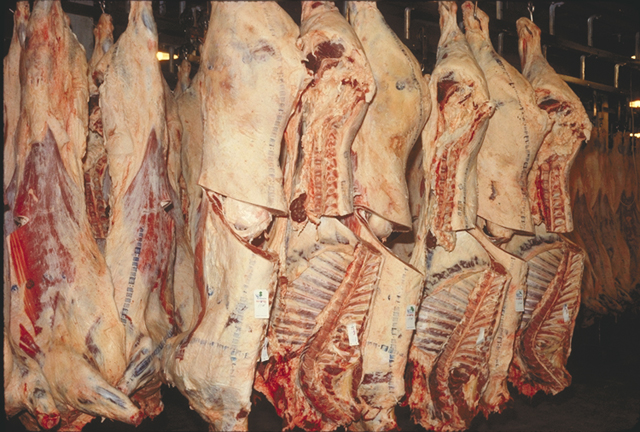
Federal inspectors have ordered a North Carolina meat company to recall approximately 167,639 pounds of raw pork, beef and goat products after finding they were sold under a fabricated U.S. Department of Agriculture inspection mark, the agency's Food Safety and Inspection Service announced this week.
Star Meat Delivery Inc., based in Lucama, North Carolina, produced the recalled items without federal inspection and stamped them with a false establishment number, "EST. 1363," which carries no federal grant of inspection, according to the agency's recall notice, as also reported by Today.com. FSIS classified the recall Class I, its highest health-risk category, defined as a situation with "a reasonable probability that the use of the product will cause serious, adverse health consequences or death."
The numbers
The recall covers 23 separate products produced on various dates before Sept. 22, 2026, including ground pork, chorizo, pork chops, pork feet, pork ribs, Boston cuts, pork hock, menudo mix, beef ribeye, beef chuck, beef oxtail, beef feet and shanks, and several cuts of goat. The meat was shipped in bulk, vacuum-sealed in cardboard boxes, to A&D Foods, a distributor in Duluth, Georgia, which supplied it onward to retailers and restaurants nationwide. Because individual retail packages may carry a retailer's own price and safe-handling stickers rather than A&D Foods branding, FSIS said consumers may have difficulty identifying whether meat in their freezer is part of the recall. No illnesses or injuries have been confirmed in connection with the products so far, and the problem was discovered during routine FSIS surveillance rather than a complaint or illness report.
Why it matters
Federal law requires meat sold across state lines to carry proof of USDA inspection, a system meant to catch contamination and undeclared ingredients before products reach store shelves. "Food produced without inspection may contain undeclared allergens, harmful bacteria, or other contaminants that put consumer health and safety at risk," the agency said in its notice. FSIS said any product bearing the false "EST. 1363" mark should be considered misbranded and unsafe to eat, regardless of how it appears or how it was stored. The case is at least the second in 2026 involving a counterfeit or nonexistent USDA establishment number; New Jersey-based Sabrositos Hondurenos LLC recalled roughly 32,000 pounds of chorizo, pork chops and ribs earlier this year after a similar false "EST. 1785" mark was discovered, according to coverage of that separate case. Taken together, the two cases point to a gap in the supply chain that federal inspection is designed to close: once meat leaves a producer without a legitimate establishment number, nothing in the normal retail packaging process is built to catch it before it reaches a store shelf or a restaurant kitchen.
Who is affected
The recall's reach is broad but not fully mapped: FSIS has not published a list of specific retail chains that received the product, and the re-labeling at the distributor level means a shopper could have purchased recalled meat without ever seeing the Star Meat Delivery or A&D Foods names on the package. That uncertainty places the burden on consumers and restaurants to check product codes and dates against the FSIS notice directly, or to contact sellers with questions. Restaurants and retailers who received the shipments have been told not to serve or sell any remaining product. For households that bought bulk or specialty cuts such as goat meat or menudo mix from an independent butcher or small grocer rather than a national chain, the recall is a reminder that even long-established local suppliers sit somewhere in a longer chain that inspectors, not the retailer, are responsible for policing.
"Star Meat Delivery has never operated by sourcing meat from unapproved or unknown sources," the company said in a statement reported by Boston.com, adding that "the meat involved in this recall was sourced from a USDA-inspected supplier" and that the issue arose while the company's approval process for its Georgia distributor "was still underway."
Reaction
A&D Foods, the Georgia distributor, said in its own statement, carried by the Cobb County Courier, that it "quickly coordinated with the agency and notified our customers to ensure all recalled products are identified and removed from commerce as quickly as possible." Local coverage from North Carolina's WRAL and the ABC affiliate WCTI in New Bern has focused on the company's home-state ties, while national outlets including Boston.com carried the fullest version of the company's own defense of its sourcing.
What happens next
FSIS is directing consumers who may have purchased the recalled products to throw them away or return them to the place of purchase, and has set up its Meat and Poultry Hotline, 888-674-6854, for questions. The federal recall-classification system treats Class I cases as its most urgent, meaning FSIS is expected to continue monitoring for any illness reports tied to the affected lots even though none have surfaced yet. The agency has not said whether it is pursuing further action against Star Meat Delivery beyond the recall itself, and state health guidance on what retailers must do during a recall puts the immediate responsibility on stores and restaurants to pull remaining product from shelves and coolers.
No congressional or state agriculture-agency statement had been issued on the case as of this writing, and it remains unclear how many of the 23 recalled products actually reached consumers before the false inspection mark was discovered. FSIS's own classification system anticipates exactly this kind of gap between a recall's announcement and full public accounting of its reach, which is why the agency continues to update recall notices as more distribution information becomes available.

Mezzetta Recalls Greek Peperoncini Lot After Viral Video Shows Pest in Jar
Salmonella Outbreak Tied to Idaho Broccoli Sprouts Grows to 32 Cases in Six States

Raw Milk Cheddar Recalled Nationwide After E. coli Outbreak Hospitalizes Children in Nine States
