Hubble confirms a new haul of gravitational lenses as NASA rehearses for its next dark-matter hunter
A freshly released Hubble Space Telescope image of a warped, distant galaxy is part of a broader survey that has used archival sky-survey data and machine learning to flag thousands of candidate gravitational lenses — a dress rehearsal for the Nancy Grace Roman Space Telescope, which is now being commissioned in orbit.
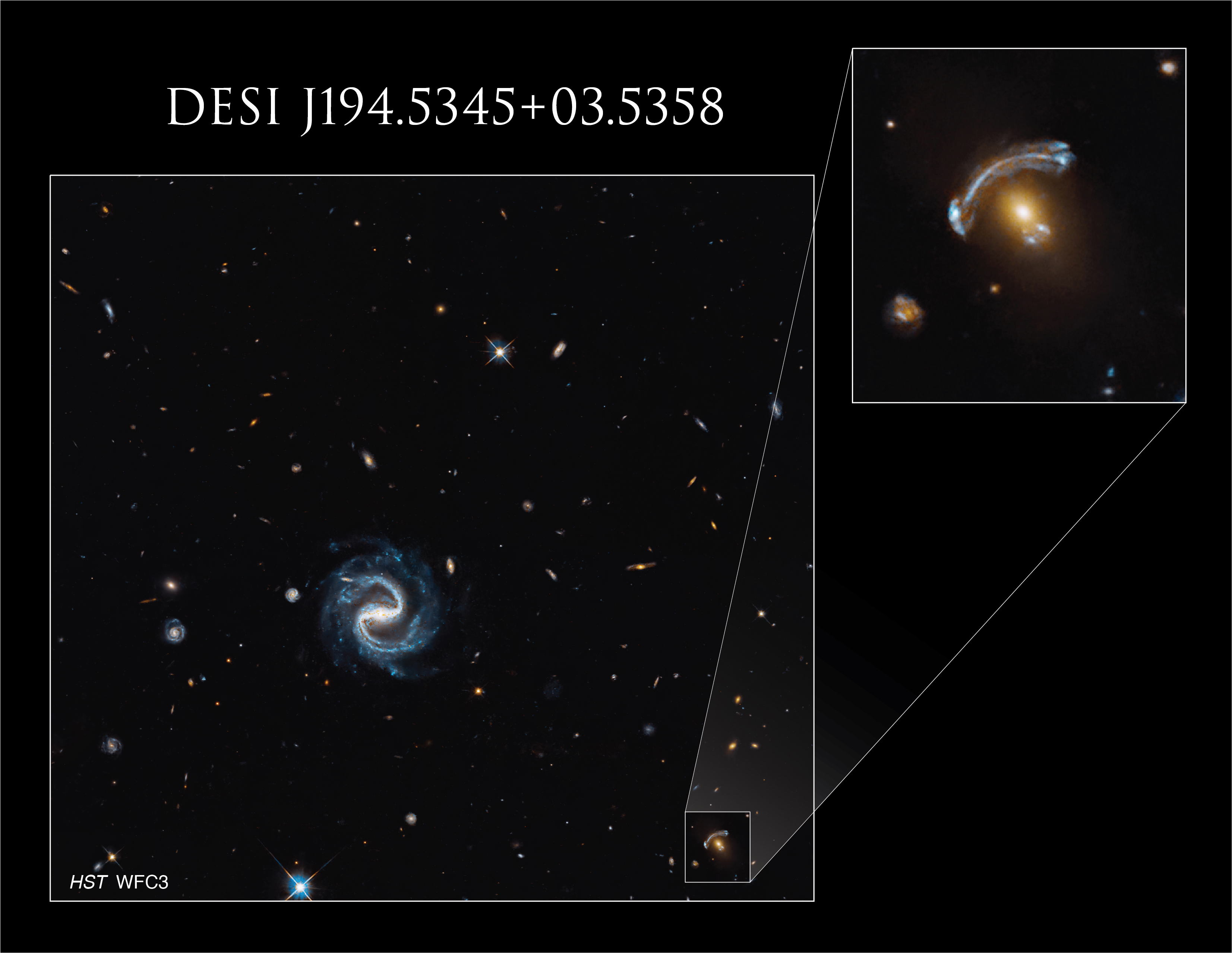
NASA on Thursday released a new Hubble Space Telescope image of a gravitational lens known as DESI J194.5345+03.5358, in which a foreground elliptical galaxy bends and magnifies the light of a much more distant galaxy behind it into a pair of warped arcs. The agency's Goddard Space Flight Center, which manages Hubble, published the image as part of an ongoing survey designed explicitly to prepare for the Nancy Grace Roman Space Telescope, which reached orbit in late August and is now going through its final rounds of in-space testing.
In the image, the foreground elliptical galaxy sits about 4.5 billion light-years from Earth. Its gravity distorts the light of a background galaxy roughly 8 billion light-years away into a large arc and a smaller, flipped counter-arc — the signature of what astronomers call strong gravitational lensing. The same field of view also captures a barred spiral galaxy roughly the size of the Milky Way, with what may be a small satellite galaxy beside it.
A machine-learning haul of lens candidates
The image is one product of the DESI Strong Lens Foundry, a survey led by astronomer Xiaosheng Huang, formerly of the University of San Francisco, with dozens of collaborators from the Dark Energy Spectroscopic Instrument (DESI) collaboration. The team trained a residual neural network to sift through the DESI Legacy Imaging Surveys, flagging roughly 3,500 candidate gravitational lenses in ground-based sky-survey data too blurry to confirm them outright.
To check the most promising candidates, the team turned to Hubble's sharper optics. In a paper published in February in The Astrophysical Journal — "DESI Strong Lens Foundry I: HST Observations and Modeling with GIGA-Lens" — the researchers reported observing 51 of the candidates with Hubble.
"All of them were confirmed to be strong lenses," the authors wrote in the paper's abstract.
The team also demonstrated a new analysis pipeline, called GIGA-Lens, that models a lens system's mass distribution using a fully Bayesian, GPU-accelerated method — fast enough, they argue, to keep pace with the much larger volume of lenses a wide-field survey telescope should turn up.
Why astronomers care about bent light
Gravitational lensing is a direct consequence of general relativity: the more mass a foreground galaxy has, the more it bends and distorts light passing near it. Because the visible stars in a galaxy cannot account for the degree of distortion seen in most lenses, astronomers use the mismatch to estimate how much invisible, unaccounted-for mass — dark matter — the foreground galaxy actually holds. The DESI team's stated ambitions, laid out in the paper, include using large lens samples to probe low-mass dark matter halos that are otherwise difficult to detect, and to use lensed supernovae, monitored over time, as an independent way of measuring the universe's expansion rate.
Rehearsal for a much bigger telescope
The exercise matters now because NASA's next flagship observatory, Roman, launched August 30 from Kennedy Space Center and is working through a commissioning period expected to run into early 2027, when its first images are due. Unlike Hubble, which observes largely in visible and ultraviolet light and can study only one lens system at a time, Roman carries a wide-field infrared instrument NASA describes as covering more than 100 times the sky area Hubble can capture in a single image. Once operational, Roman is expected to find vastly more lens candidates than ground-based surveys like DESI's can on their own, and the modeling tools the Huang team built on Hubble data are intended to be applied directly to that flood of new detections.
NASA says Hubble will continue to serve as Roman's follow-up instrument, confirming and sharpening the picture of any particularly interesting lenses the wider telescope turns up once its survey work begins.
What's next
Roman's commissioning is ongoing, and NASA has not yet verified in orbit the image quality of its Wide Field Instrument or the performance of its coronagraph, according to mission updates. The DESI Strong Lens Foundry collaboration has continued publishing follow-up papers through 2026, including spectroscopic redshift measurements of lensed sources using the Keck Observatory, as it works through the broader catalog of roughly 3,500 candidates the neural network flagged.

Japan launches spacecraft to bring home the first-ever samples from a moon of Mars

Dutch engineers build a soft robot arm powered by living algae and light

Glaciers ending in lakes and oceans drive more than half of global ice loss, study finds
