Physicists Watch a Quantum "String" Snap Into New Matter
A 13-ion device at Duke recreated, in miniature, the process by which a stretched field of energy converts into new particle pairs — a snap otherwise glimpsed only inside colliders and in the instant after the Big Bang.

Physicists at Duke University have used a chain of 13 trapped atoms to recreate, on a laboratory bench, one of the most violent processes in nature: the snapping of a stretched field of energy into a shower of new matter. The experiment, described this week in a paper in Nature Physics, is among the first controlled demonstrations of "string breaking," a phenomenon normally associated with the innards of a particle collider or the first fractions of a second after the Big Bang, as independent science coverage of the release has since noted.
The process being modeled is confinement, the rule that keeps quarks — the particles that make up protons and neutrons — bound so tightly to one another that they can never be isolated. Pull two confined particles apart and, rather than separating, they stay linked by a taut filament of energy, sometimes described as a "string." Stretch that string far enough and the energy stored in it becomes so large that, following Einstein's mass-energy equivalence, it converts directly into a new pair of particles, which appear at the point where the string parts. No free quark is ever produced; instead, two new bound pairs are.
Thirteen Ions, One Snapping String
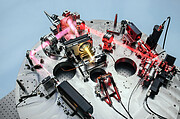
To watch this happen, the team, led by Duke physicist Christopher Monroe, built an analog version of the process using 13 ytterbium ions held in an electromagnetic trap, with each ion's internal quantum states standing in for the spins of a simplified lattice model of the interaction. Finely tuned laser pulses pushed the system out of equilibrium and tracked, ion by ion, how the simulated "string" evolved and where new particle pairs appeared over time. The team cross-checked the quantum results against a classical numerical simulation of the same model, according to the university's account of the findings.
The result that surprised the researchers was not that the string broke — that was expected — but where. Theoretical treatments of simplified confinement models generally predict that new charge pairs should nucleate roughly evenly along the length of a stretched string. Instead, the Duke team found an "edge-driven" pattern: pairs formed preferentially near the two ends of the simulated string and then spread inward, rather than appearing uniformly throughout its length.
A Problem Three Different Machines Are Now Attacking
The Duke result is not standing alone. Lattice gauge theories — the mathematical framework describing how quarks and the force-carrying gluons that bind them behave — are notoriously difficult for ordinary supercomputers to simulate once a system evolves in real time, because the calculation runs into what physicists call the sign problem, where the numbers needed to track probabilities stop behaving like probabilities at all. That has made quantum simulators, which are themselves quantum systems, an increasingly serious tool for the job, building on earlier work such as a 2024 demonstration of string-breaking dynamics on a different quantum simulator platform using neutral atoms arranged in optical tweezers.
In the past year, separate teams working with superconducting qubits at Lawrence Berkeley National Laboratory using IBM hardware, and with neutral-atom arrays at QuEra Computing, have each independently reproduced related string-breaking or confinement signatures on their own, architecturally distinct machines, according to reporting on the parallel efforts. That three different qubit technologies — trapped ions, superconducting circuits and neutral atoms — are converging on the same class of result is, to the researchers, evidence that the approach is becoming a genuine physics tool rather than a hardware-specific curiosity.
Why Physicists Outside Quantum Computing Are Watching
The audience for this work extends well beyond the small community that builds trapped-ion machines. Nuclear and particle theorists have spent decades trying to understand how the quark-gluon plasma that filled the universe in its first instants cooled and organized itself into the protons and neutrons that make up ordinary matter today — a process that involves exactly this kind of string-breaking dynamics playing out across trillions of particles rather than 13 ions. Real-time, non-equilibrium versions of these calculations are largely out of reach for classical computers, which is precisely the gap quantum simulators are being built to fill, according to a research summary from the Joint Center for Quantum Information and Computer Science, a University of Maryland institute whose physicists co-authored the study alongside collaborators at Oxford, Caltech, Cornell and KU Leuven.
"As a physicist, it is incredibly exciting to investigate the conditions of the early universe in an atomic-level computing machine," said Zohreh Davoudi, a University of Maryland physicist and co-author of the study. "Even the slightest insights from an out-of-equilibrium physics model will guide us in the future."
Monroe, who directs the Duke Quantum Center and also co-founded the trapped-ion computing company IonQ, framed the appeal of the approach in similar terms in the university's release: quantum simulation, he said, offers the best available platform for probing questions about how matter first formed, "short of having witnessed the Big Bang itself." The paper's first author, Arinjoy De, a former doctoral student in Monroe's lab, said the aim was to open "new pathways for experimental investigations into the behavior of matter at its most fundamental level."
What Happens Next
The model used in the Duke experiment is still a deliberately simplified, one-dimensional stand-in for the much richer three-dimensional gauge theory that governs real quarks and gluons, known as quantum chromodynamics. Thirteen ions is also a modest system by the standards of what full-scale lattice quantum chromodynamics eventually demands. The immediate open question is whether the unexpected edge-driven pattern of pair production holds up as the simulated string is made longer, and whether it survives the jump to more complex, higher-dimensional versions of the model that more closely resemble the real strong force.
Scaling is the crux of the field's own justification for the work. As the number of simulated particles grows, the classical calculations needed to check a quantum simulator's output become exponentially harder, and researchers expect that within a few years only a quantum device, not a classical supercomputer, will be able to track these systems at all. Trapped-ion groups, including Monroe's, are already working to extend the ion chains involved from the tens into the hundreds, a scale at which this kind of confinement physics would move from a demonstration that classical computers can still double-check into one they cannot.
Nature Physics — Observation of string-breaking dynamics in a quantum simulator
Duke Pratt School of Engineering — Quantum Device Simulates Matter Popping Into Existence
UMD Joint Center for Quantum Information and Computer Science — research summary
ScienceDaily — Quantum computer simulates matter "popping into existence"

NASA's Crew-13 astronauts arrive in Florida ahead of Thursday launch to space station
Astronomers Find a Planet Orbiting Its Star Backward, With No Culprit in Sight

Scientists Describe Two New Sea Spider Species Found in the Salish Sea
