Radio Images Show Betelgeuse's Hidden Companion Disturbing the Supergiant's Atmosphere
New observations from two U.S.-backed radio observatories show the red supergiant's outer atmosphere has largely recovered from its 2019-2020 "Great Dimming," while the faint companion star Siwarha appears to be stirring its gas from close range.
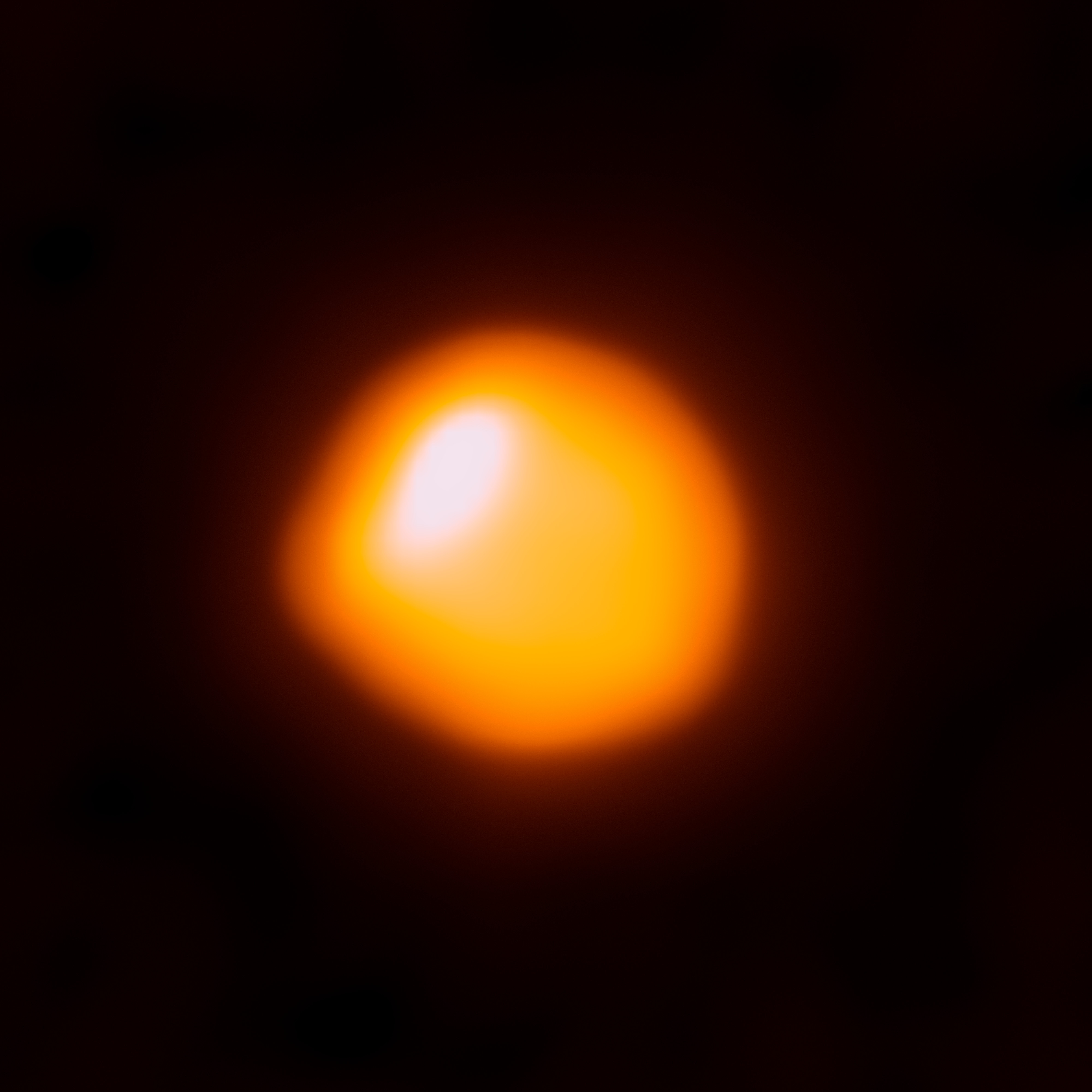
Astronomers using two major radio telescope arrays have produced the most detailed radio maps yet of Betelgeuse, the red supergiant marking the shoulder of Orion, and found evidence that a faint, previously hidden companion star is disturbing the giant's outer atmosphere from close range. The same data show that Betelgeuse's extended atmosphere has largely recovered from the unusual cooling that preceded its famous 2019-2020 "Great Dimming."
The findings come from a team led by Lynn D. Matthews of the MIT Haystack Observatory, working with astronomers at the Center for Astrophysics | Harvard & Smithsonian, the University of Manchester's Jodrell Bank Centre for Astrophysics, and the European Southern Observatory. The results were published in The Astronomical Journal and announced in a press release from the National Radio Astronomy Observatory.
What the data show
The team observed Betelgeuse at seven radio and millimeter frequencies, spanning 22 to 485 gigahertz, using the National Science Foundation's Karl G. Jansky Very Large Array in New Mexico and the Atacama Large Millimeter/submillimeter Array in Chile, gathering data between 2021 and 2026. Because different radio frequencies probe different depths of a star's atmosphere, combining them let the researchers build a layered picture extending several times beyond the visible surface.
Brightness temperatures, which stood unusually low in 2019 just before the Great Dimming, have since returned to more typical levels, reaching roughly 3,500 kelvin at a radius about 2.7 times that of the star itself. Moving inward, the team confirmed a long-suspected "temperature minimum," a cooler shell sitting between the star's visible surface and its hotter chromosphere: at roughly 1.2 stellar radii, temperatures drop to about 2,220 kelvin, more than 1,000 degrees cooler than the photosphere below. That layer coincides with the so-called MOLsphere, a shell of molecular gas previously inferred mainly from infrared observations. Across more than two decades of observing frequency, the global radio spectral index held steady at 1.35, within a margin of 0.03, indicating no significant change in the underlying physics driving the emission.
A companion stirring the atmosphere
The more striking result concerns Siwarha, the companion star whose existence astronomers proposed in 2024 to explain a roughly 2,100-day brightening and dimming cycle in Betelgeuse's light. Because Siwarha is estimated to be tens to hundreds of times too faint to detect directly at radio wavelengths, the team instead tracked changes in the apparent shape, or ellipticity, of Betelgeuse's radio disk across multiple observing epochs. The atmosphere appeared more elongated when the companion was near its widest apparent separation from the star, and rounder when it passed in front of or behind it, a pattern the researchers say correlates with the companion's orbital phase at roughly 2.3 stellar radii.
- Seven radio frequencies observed, from 22 to 485 gigahertz, using data collected 2021-2026
- Atmospheric brightness temperature recovered to about 3,500 kelvin at roughly 2.7 stellar radii
- Confirmed temperature minimum of about 2,220 kelvin near 1.2 stellar radii, over 1,000 degrees cooler than the photosphere
- Companion star Siwarha's orbit, at about 2.3 stellar radii, correlates with changes in the star's measured shape
"It was the combination of the incredible data from the NSF VLA and ALMA that gave us a convincing result here," said Matthews, principal research scientist and assistant director at MIT Haystack Observatory, in the NRAO release.
"This companion is orbiting so close to the star that it actually passes through its extended atmosphere," Matthews said.
Siwarha, whose name derives from Arabic and means "her bracelet" — a complement to Betelgeuse's own name, commonly translated as "the hand of al-Jawza" — was first proposed based on brightness cycles and later supported by direct imaging and spectroscopic work, including an earlier study from the Center for Astrophysics that detected a trailing "wake" of disturbed gas using the Hubble Space Telescope and ground-based observatories.
Why it matters for stellar astronomy
Betelgeuse, roughly 548 light-years from Earth, is one of the closest and best-studied red supergiants, massive, short-lived stars nearing the end of their lives before an eventual supernova. Its 2019-2020 Great Dimming, during which the star's southern hemisphere faded dramatically after ejecting an estimated billion tons of surface material, drew global attention and briefly fueled speculation the star might be nearing collapse. Subsequent research attributed the event to an ordinary mass-ejection episode followed by dust formation, not an imminent explosion.
Understanding how a close companion might perturb a supergiant's outer layers matters beyond Betelgeuse itself: binary interactions of this kind can influence how such stars shed mass, shape their eventual supernova remnants, and evolve toward their final collapse. Researchers studying stellar winds, mass loss and the physics of evolved stars are the most direct beneficiaries of the new measurements, as are theorists modeling how low-mass companions can survive — at least for a time — while orbiting inside a giant star's puffed-up outer atmosphere.
What comes next
Matthews said the resolution achieved by the VLA and ALMA working together is itself notable. "The fact that we can use these facilities to actually resolve the disks of nearby stars is amazing," she said in the release. The research team cautions that confirming and refining the companion's influence will require additional observations spanning a fuller range of Siwarha's orbit, particularly at radio frequencies not yet well sampled. Siwarha's next favorable viewing window, when it reaches its greatest apparent separation from Betelgeuse and becomes easier to study with imaging and spectroscopy, is expected around 2027.
Looking further ahead, the NRAO release notes that the planned Next Generation Very Large Array, a proposed successor to the current VLA, is expected to make this kind of resolved stellar imaging routine rather than exceptional, opening the door to similar studies of other nearby evolved stars.

Risk-taking tracks leadership in both humans and chimpanzees, study finds
Physicists Achieve First Clear Demonstration of "Helicon" Current Drive in a Fusion Reactor

New dinosaur species identified from fossils dug at a Surrey brickworks a quarter-century ago
