Robot submarine finds the ocean's deepest known explosive volcanic rock near Challenger Deep
A research cruise that sent the deep-diving ROV Jason along the trench wall above the world's lowest point has recovered pyroclastic rock from more than 6,000 meters down, the deepest such material yet documented, and found the forearc splitting apart in two different ways at once.
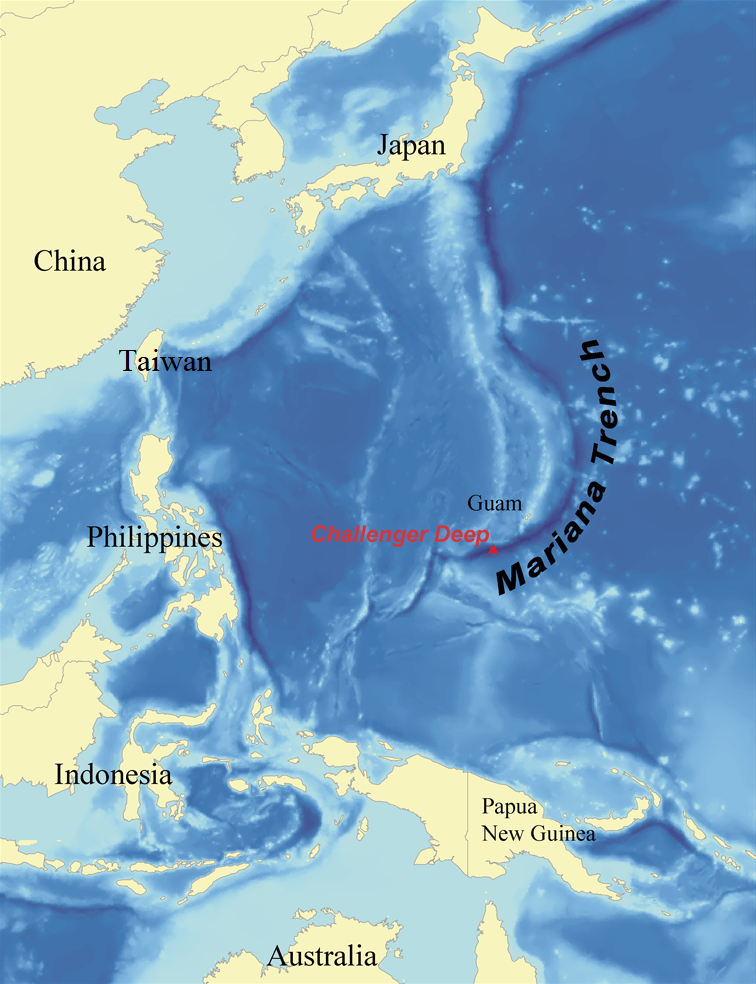
A remotely operated submersible lowered onto the wall of the Mariana Trench has brought up rock fragments from an explosive volcanic eruption that occurred deeper in the ocean than any other such deposit yet documented, according to a study published this week in Frontiers in Earth Science. The rock was recovered from more than 6,000 meters down, on the trench wall directly above Challenger Deep, the deepest known point in any ocean on Earth.
The sampling was done during a three-week cruise in November 2024 aboard the research vessel Thomas G. Thompson, using the tethered vehicle ROV Jason and its support sled Medea, built and operated by the National Deep Submergence Facility at Woods Hole Oceanographic Institution. According to a first-hand account from one of the study's co-authors, published by the Scripps Institution of Oceanography, Jason had not worked this deep at this exact location since 2003.
Challenger Deep has drawn public attention for decades through a short list of manned descents: Swiss and US Navy crew aboard the bathyscaphe Trieste first reached its floor in 1960, filmmaker James Cameron piloted a solo submersible there in 2012, and financier Victor Vescovo's Five Deeps Expedition logged more than a dozen dives to the bottom in 2019. None of those missions, however, surveyed the trench's upper walls the way the tethered Jason did on this cruise, which is why the rock recovered from the slope above the deep itself, rather than the deep's floor, is the focus of the new paper.
A transect above the world's lowest point
The expedition, led by chief scientist Ignacio Pujana of the University of Texas at Dallas, worked an east-to-west transect on the inner trench wall near Challenger Deep, within the Mariana Trench Marine National Monument roughly 320 kilometers southwest of Guam. Jason, tethered by a 10-kilometer fiber-optic cable, dove repeatedly to between 6,500 and 6,066 meters, with each dive lasting about 12 hours and researchers collecting rock samples every 50 to 100 meters along the slope. Challenger Deep itself bottoms out near 10,935 meters, well beyond what the vehicle could reach on this cruise.
The research team, led by geoscientist Robert J. Stern of the University of Texas at Dallas, includes 12 or more co-authors from Woods Hole Oceanographic Institution, Scripps Institution of Oceanography, the University of Tennessee, the Geological Survey of Japan, Nagoya University, Japan's Hydrographic and Oceanographic Department, Queen's University in Canada, and the CRPG-CNRS laboratory in France.
Explosive rock where none was expected
The paper's central finding concerns rock fragments identified as pyroclastic deposits — debris ejected during an explosive eruption — recovered from below 6,000 meters of water. That is deeper than any other explosive volcanic deposit yet recorded from the seafloor. At such depth, the surrounding water pressure is immense, which ordinarily should suppress the kind of gas-bubble expansion that drives explosive eruptions on land or in shallow seas. The authors attribute the activity instead to supercritical fluids, a state of matter that behaves partway between a liquid and a gas, producing eruptions the paper describes as less violent than their shallow-water counterparts but still capable of fragmenting rock.
The location itself is unusual. The deposits sit close to the trench axis, in a part of the subduction zone where standard models predict the overriding plate should be too far from the mantle's melting zone to generate fresh magma. The paper's authors call the area, known as the Challenger Deep Forearc Segment, "a unique tectonic environment characterized by rapid extension, high relief and the absence of a volcanic arc."
Two kinds of stretching, side by side
Beyond the pyroclastic rock, the survey revealed the forearc segment is deforming in two distinct ways along its length:
- The eastern half exposes older mantle peridotite, rock that originates far below the crust, which the authors interpret as evidence of mechanical extension — the crust simply stretching and thinning until deeper material is laid bare.
- The western half is dominated by younger volcanic rock, pointing to magmatic extension, in which new melt rises to fill the gap as the crust pulls apart.
Taken together, the team concludes that "the CDFS is a tectonically unstable and magmatically active zone," a description that cuts against the assumption that forearcs near mature, long-running subduction zones are geologically quiet. The paper links this instability, along with weak mechanical coupling between the subducting Pacific plate and the overriding plate, to the broader question of why Challenger Deep reaches the depth it does.
Who the findings affect, and what comes next
The results matter most directly to geophysicists who model subduction zones, the boundaries where one tectonic plate sinks beneath another and which generate the planet's deepest trenches and many of its largest earthquakes. A forearc that is actively erupting and splitting apart by two different mechanisms complicates assumptions used in hazard and heat-flow models elsewhere in the Pacific "Ring of Fire." The findings could also interest biologists studying the hadal zone, the extreme-depth ecosystems that depend partly on the chemistry of the seafloor they sit on.
"The Challenger Deep is intriguing because it lies near the oldest Pacific oceanic crust that is currently subducting beneath the Philippine Plate, a subducting crust that dates from the Jurassic Period (200 to 140 million years ago)," said Emily Chin, an associate professor at Scripps Institution of Oceanography and a co-author of the study, describing the appeal of the research site.
The rock samples collected on the 2024 cruise are still being dated and analyzed in laboratories in Texas, Tennessee and France, work the authors say is needed to pin down exactly when the eastern and western segments formed and how recently the explosive eruptions occurred. Because Jason could not descend far enough to sample Challenger Deep's absolute floor, the team has said it hopes to return with a vehicle capable of reaching the full depth of the trench.
New imaging method reveals hidden structures in brain wiring maps

UK-Built X-ray Telescope Opens Its Eyes for the First Time as Mercury Probe Nears Arrival
New Theory Predicts the Power Fusion Reactors Need to Reach Peak Efficiency
