Quantum Computing Startup Infleqtion Hits Milestone With 30 Entangled Logical Qubits
Infleqtion says it built 30 stable logical qubits from just 80 physical atoms on its Sqale system, an SEC-disclosed milestone the company frames as a step toward computers that can outperform classical machines.
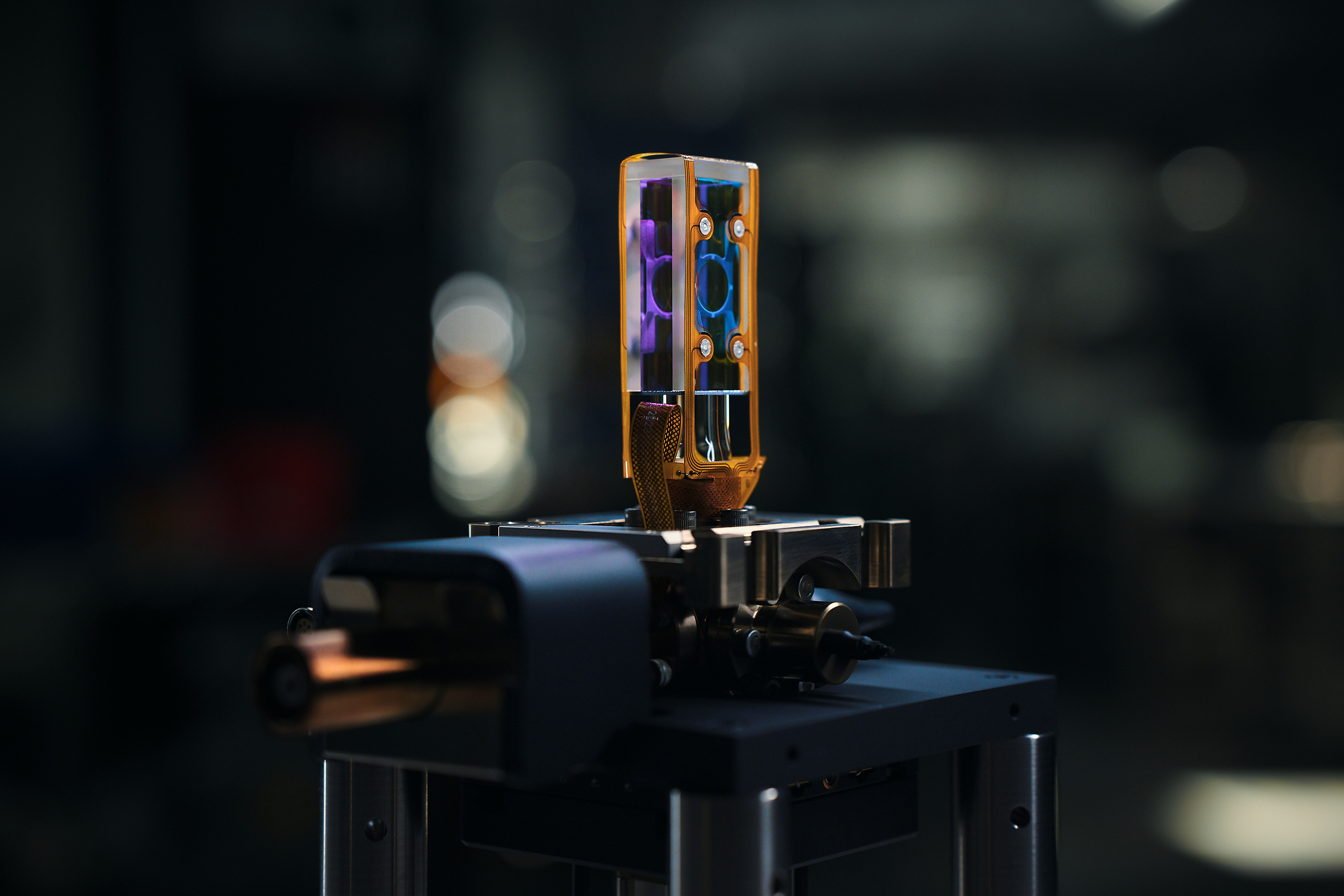
Infleqtion, a publicly traded quantum computing company based in Colorado, said this week that it had entangled 30 "logical" qubits using only 80 physical atoms on its Sqale quantum computer, a result the company says is the first time any commercial neutral-atom system has reached that threshold. The announcement, made in a regulatory filing and at the Quantum World Congress conference on September 24, is among the more concrete markers yet in a field that has spent years promising more reliable quantum computers without always specifying how soon, or how cheaply, that reliability would arrive.
The company disclosed the result in a press release filed as an exhibit to an SEC filing, describing an experiment that ran roughly 1,000 physical operations, known in the field as a "kiloQuOp," with a measured signal about 1,000 times stronger than the surrounding noise. Shares of Infleqtion, which trades on the New York Stock Exchange under the ticker INFQ, rose more than 3 percent on the day of the announcement and continued climbing in after-hours trading, with retail sentiment on the stock-discussion platform Stocktwits shifting to "extremely bullish."
The measure of a milestone
Quantum computers built from physical qubits are notoriously error-prone; a single stray photon or vibration can scramble a calculation. The industry's answer has been to bundle several imperfect physical qubits into a single, more stable "logical" qubit using error-correcting code, at the cost of needing far more hardware than the number of logical qubits a computer can usefully run. Infleqtion's chief technology officer, Pranav Gokhale, said in the company's announcement that "a core accelerant for our work was the AI-assisted discovery of a new entangling operation between logical qubits that performs a key operation with half as many physical gates as was previously known," adding that "every gate can introduce an error, so doing the same work with fewer gates matters as we build toward longer computations."
That detail, an AI system used to help design part of the experiment that then advanced the case for building bigger quantum computers, has drawn attention from trade publications that track the sector closely. The company says it now intends to reach 100 logical qubits by 2028 and 1,000 by 2030, a roadmap that, if met, would move neutral-atom hardware toward the scale physicists generally believe is necessary before quantum computers can outperform classical ones on real-world problems.
From cold atoms to a public listing
Infleqtion traces its roots to ColdQuanta, a company spun out of cold-atom physics research at the University of Colorado Boulder and founded in 2007. It rebranded as Infleqtion in 2022 and went public in February through a merger with the special-purpose acquisition company Churchill Capital Corp X, a deal that valued the combined business at roughly $1.8 billion. Its neutral-atom approach, which traps individual atoms with lasers rather than using superconducting circuits or trapped ions, is one of several competing hardware strategies, alongside those pursued by Google, IBM, IonQ, Quantinuum and QuEra, in a race to build a quantum computer whose usefulness exceeds its cost. Several of those rival companies have reported their own logical-qubit demonstrations over the past year, using different error-correcting codes and physical platforms, and much of the sector's investor attention now centers on which architecture can scale fastest without a proportional explosion in hardware complexity.
Beyond the hardware milestone, Infleqtion pointed to early commercial interest, saying three customers are already running logical-qubit circuits on Sqale, including researchers working under the Wellcome Leap Quantum for Bio program, a philanthropically funded effort to test whether quantum computing can accelerate biomedical research, who used a 12-logical-qubit version of the system to model biomarker discovery.
A milestone with fine print
Independent of Infleqtion's own framing, the result comes with technical caveats the company itself effectively acknowledges. The demonstration relied on discarding runs that showed detectable errors rather than correcting them in real time, a technique known as post-selection, and it has not yet shown the repeated, continuous error-correction cycles that most physicists consider the hallmark of a fully fault-tolerant machine. The system also ran roughly a thousand operations in this demonstration, several orders of magnitude short of the million-plus operations researchers generally say will be needed before quantum computers can tackle commercially meaningful problems.
"Getting 30 logical qubits to work together is hard, and our team has done it," Infleqtion's chief executive, Matt Kinsella, said in the company's announcement, framing the result as a step rather than an endpoint on the path to a larger machine.
Coverage of the announcement has generally treated it as a genuine, if incremental, advance for neutral-atom hardware specifically, rather than a claim that Infleqtion has leapfrogged rival approaches built on different physics.
What happens next
Infleqtion says its next public checkpoints will track the same roadmap it has held to since going public: demonstrating deeper, longer computations on the existing 30-logical-qubit system before scaling toward 100 logical qubits by 2028. The company's Sqale platform has also been installed at Britain's National Quantum Computing Centre, giving outside researchers a chance to test the hardware independently of Infleqtion's own benchmarks. For investors and rivals alike, the coming months are likely to bring more attempts by competing hardware makers to claim their own logical-qubit milestones, a pattern that has repeated through 2026 as the field moves, gradually and by contested increments, toward computers that do more than prove a physical principle.
For the biomedical researchers working through Wellcome Leap, and for the government and university labs that have begun renting time on neutral-atom hardware, the practical question is narrower than the industry's broader hype cycle: whether a system like Sqale can run a long enough, clean enough calculation to answer a question classical computers cannot. Infleqtion's own account of this week's result stops short of claiming that, but treats it as the clearest evidence yet that the company's particular bet on trapped atoms is on a workable path toward that goal.

Microsoft Rebuilds Copilot as a Unified "Super App" for Business Customers
Canada Warns Hackers Are Actively Exploiting a Roundcube Webmail Flaw Patched Months Ago

Bitget hack exposes $351 million to suspected North Korean hackers, largest crypto theft of 2026
