Another no-name baby bath seat is pulled from Amazon, and regulators say it won't be the last
The federal government recalled its third nearly identical infant bath seat of 2026 this week, highlighting a persistent loophole in which unsafe, Chinese-made products reappear on Amazon under new throwaway brand names faster than regulators can act.
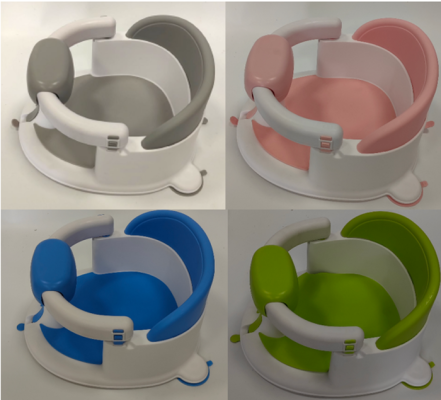
The U.S. Consumer Product Safety Commission on October 8 recalled about 2,140 infant bath seats sold under the brand name ONTHEWEI, saying the product is unstable, can tip over during use and violates the mandatory federal safety standard for the category. It is a familiar announcement: the third time in 2026 that regulators have pulled a bath seat, sold almost exclusively through Amazon, for the identical defect under a different unfamiliar brand name.
No injuries have been linked to the ONTHEWEI seats, according to the official recall notice. But the repetition is what has safety advocates and the agency itself describing a structural problem: a rotating cast of small, often anonymous overseas sellers appears able to list noncompliant infant products on Amazon, sell a batch, and disappear, only for a near-identical product to surface under a new name once regulators catch up.
The latest in a string of nearly identical recalls
The recalled ONTHEWEI seats — sold in gray, pink, blue and "mist green" for $40 to $50 on Amazon.com in April 2026 — have detachable restraint arms and suction cups on the underside, according to the CPSC. The agency says they fail to meet the mandatory federal performance standard for infant bath seats, which requires products in the category to resist tipping and to restrain a child adequately. The manufacturer is listed as Hubei Youhong Trading Co., doing business as ONTHEWEI, of China; the recall notice lists no U.S. phone number or address for the company, only an email address for refund requests.
That profile matches two other 2026 recalls for the same underlying defect. In January, the CPSC recalled about 1,430 seats branded NFSVLB, made by a different Shenzhen trading company, for the same tip-over and entrapment risk. In February, roughly 2,380 seats branded Trankerloop, from yet another Shenzhen-area exporter, were recalled on identical grounds. All three were sold only on Amazon, all were manufactured in China, and in all three cases the agency reported no injuries at the time of the recall.
"The recalled bath seats are unstable and can tip over during use, posing a risk of serious injury or death to children from drowning." — U.S. Consumer Product Safety Commission, ONTHEWEI recall notice, October 8, 2026
Why a bath seat still needs a federal standard
Infant bath seats have been regulated since 2010 under a mandatory rule codified at 16 CFR Part 1215, which Congress directed the CPSC to write under the Consumer Product Safety Improvement Act of 2008. The standard, built on an ASTM International test method, requires bath seats to meet minimum stability, restraint and labeling requirements — including a permanently affixed label listing the manufacturer or importer's name, a U.S. address and phone number, and the date of manufacture. Current production is supposed to comply with the 2024 version of that standard as of January 2025.
The rule exists because of a documented death toll. When the CPSC moved toward a mandatory standard, agency data compiled during that rulemaking and summarized by the Consumer Federation of America tied bath seats and bath rings to 174 deaths and roughly 300 non-fatal incidents between 1983 and November 2009, overwhelmingly drownings that occurred when an infant was left briefly unattended, even for a minute, in a seat that tipped or allowed the child to slip. That history is why the current notices stress stop-use instructions rather than treating the hazard as hypothetical, even though none of the 2025–2026 recalls has yet been linked to a reported injury.
Who is affected, and what to do
Parents who bought an ONTHEWEI seat — identifiable by a label on the back reading "Model No: MY002" and "Date of manufacturer: 2026/1/10" — are told to stop using it immediately and contact the company by email for a refund, a process that requires marking the seat "RECALLED," removing the restraint arms and cutting the suction cups, then emailing photo proof before a refund is issued. Owners of the earlier NFSVLB and Trankerloop seats face similarly seller-run refund processes rather than a retailer-run one, since none of the three was sold under a storefront brand with a customer-service record.
Under federal law, it is illegal for any retailer — including a marketplace listing — to continue selling a product once it is subject to a Commission-ordered recall, a point the CPSC notice reiterates explicitly. In practice, enforcement against third-party marketplace sellers who ship directly from overseas, often under a brand name invented for a single product run, has been one of the most persistent gaps in U.S. product-safety regulation; the full universe of active bath-seat and bath-ring recalls is tracked on the CPSC's baby bathtub seats and rings recall list.
What to watch for
None of the three 2026 recalls so far has been tied to a reported death or injury, and the CPSC's public incident data for bath seats has not shown a spike since the 2010 standard took effect. But the near-identical specifications, price points and distribution channel across ONTHEWEI, NFSVLB and Trankerloop — three different shell-like trading companies in or near Shenzhen, each selling a noncompliant seat for a few months before being pulled — suggest the underlying supply is not slowing down even as individual listings are removed. Consumer-safety researchers who track the category have long argued that recalls alone cannot close the gap when a new, unregistered seller can simply relist a similar product under a fresh name within weeks of the last one being pulled, leaving parents with no reliable way to tell, before buying, whether a listing is one of the next names on that list.

Lidl recalls gelato sold in 10 East Coast markets over possible Listeria contamination

FDA Flags 4.3 Million Tubes of Imported, Character-Branded Toothpaste Over Manufacturing Violations

Safety Regulators Tell Owners to Stop Using Tristar Pressure Cookers After 24 Burn Reports
