Prepared Hero Recalls 31,000 Fire Spray Canisters That Can Rupture Instead of Putting Out a Fire
Federal regulators say the aerosol canisters, marketed as a no-training alternative to a fire extinguisher, can deteriorate in storage and fail exactly when a household needs them.
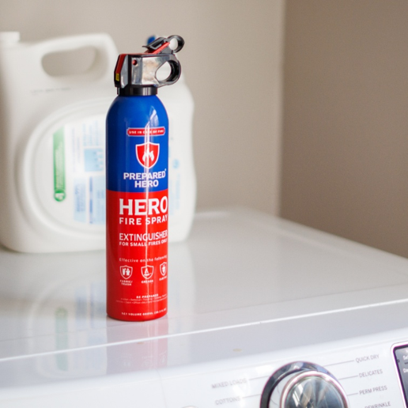
The Consumer Product Safety Commission on Thursday announced the recall of about 31,000 canisters of Hero Fire Spray, an aerosol device sold as an easy-to-use, no-training alternative to a traditional fire extinguisher, after the manufacturer received nine reports that the canisters can deteriorate, rupture and fail to work when needed.
The recall notice, issued jointly with the product's maker, Prepared Hero of Sheridan, Wyo., covers a single manufacturing batch of the company's 20-fluid-ounce Hero Fire Spray canister, identified by a "09/2024" date code stamped on the base of the container. The agency said the defect poses a risk of serious injury or death from fire and burn hazards, since a canister that ruptures or fails to discharge cannot be relied on in an actual fire. No injuries have been reported.
The numbers
Roughly 31,000 of the canisters are subject to the recall, according to the CPSC filing, numbered 26-755. Prepared Hero told regulators it has received nine reports of canisters exploding or otherwise deteriorating while sitting in storage, none of which resulted in injury. The affected units were sold exclusively online, at PreparedHero.com and on Amazon.com, from October 2024 through January 2026, at prices ranging from about $18 to $30. The canisters are packaged in red-and-blue or all-red housings, roughly 2.6 inches in diameter and 11.4 inches tall, bearing the "HERO Fire Spray" name and a black plastic release tab on top.
How a safety product ended up on the recall list
Hero Fire Spray belongs to a small but growing category of compact, aerosol-based fire suppressants pitched to households as a lighter, simpler substitute for a mounted or under-sink extinguisher — something any family member could grab and use in a kitchen or car fire without training. The product is rated by the company for use on ordinary combustibles, flammable liquids, electrical fires and cooking-oil fires, the same broad range typically covered by a multipurpose dry-chemical extinguisher.
That convenience pitch is also the source of the current problem: unlike a metal extinguisher cylinder built to hold pressure for years, the recalled canisters were found to break down over time, according to the recall filing, which can cause the container to rupture or simply fail to discharge when a consumer needs it in an emergency. Prepared Hero has marketed the spray as requiring only two steps — pulling a tab and aiming — to operate under stress, without the pin-and-lever sequence or annual pressure-gauge checks that traditional extinguishers require. That same simplicity means a slowly degrading canister can sit unnoticed on a kitchen shelf or in a glove compartment for months, with no gauge to signal that it has failed.
The CPSC's public recall listings show the agency handles dozens of similar failure-to-perform actions on safety equipment each year, from smoke alarms to pepper-spray canisters, underscoring that products meant to protect consumers are themselves subject to routine safety monitoring. Traditional fire extinguishers sold in the United States are also subject to periodic recalls when pressure seals or discharge mechanisms fail, a reminder that any device relying on stored pressure carries some long-term risk of degradation regardless of category.
Who needs to check their canister
The recall applies only to canisters purchased between October 2024 and January 2026 that carry the "09/2024" date code on the bottom of the unit; Prepared Hero has said canisters from other production batches are not affected. Because the product was sold only through the company's own website and Amazon rather than in brick-and-mortar stores, the household population most likely to own one is relatively narrow but was reached almost entirely through online purchase records, which the company can use to notify past buyers directly.
Consumers are being told to stop using the spray immediately and to keep it away from any open flame or source of heat while it awaits disposal. The recalled units cannot go in household trash or curbside recycling because they remain pressurized; instead, owners are directed to drop them off at a municipal household hazardous waste collection facility.
What the company and regulators are saying
Prepared Hero's own recall and registration page echoes the CPSC's hazard language, telling customers that "the fire spray canister can deteriorate over time, causing it to rupture and fail to operate during an emergency." The company is asking affected customers to register their canister online, including photographs showing the date code, in order to receive a free replacement, with return shipping costs covered. "Consumers should immediately stop using the Fire Spray Canister," the notice states, adding that to date "no injuries or deaths have been reported in connection with this hazard."
Additional reporting on the recall, summarized by regional news outlets, confirmed the same unit count, incident total and disposal guidance published by the CPSC. Consumers who believe they were harmed by a defective canister, or by any other consumer product, can also file a report directly with the government through the SaferProducts.gov database, which regulators use to help identify emerging hazards.
What happens next
Prepared Hero, which markets a broader line of emergency-preparedness gear through its consumer website, said the free-replacement program is already open to registered owners. The company can be reached at 888-457-2672, weekdays from 9 a.m. to 5 p.m. ET, or by email at [email protected], for questions about eligibility or the disposal process.
The CPSC does not have the authority to unilaterally order recalls of most consumer products; the agency typically works with manufacturers to negotiate a voluntary action, as it did here, once it determines a defect poses a substantial risk of injury. The case is likely to draw scrutiny to the broader category of compact aerosol fire suppressants as they gain shelf space alongside conventional extinguishers, since the failure mode identified in the recall — a canister that quietly degrades in storage until the moment it is called upon — is difficult for an ordinary consumer to detect without a formal recall notice or periodic inspection.

Salmonella outbreak tied to Idaho broccoli sprouts sickens 22 across four states

Measles outbreak in southwestern Wisconsin grows to 159 cases as school year begins

Clorox recalls 6.3 million bottles of Mistolin and Lestoil cleaners over bacteria risk in Puerto Rico, Virgin Islands
