Opinion: Washington is trading Venezuela's democracy for its oil
Nine months after U.S. forces removed Nicolas Maduro, the Nobel laureate who did the most to end his rule has walked back into a country still run by his hand-picked successor — and still waiting for a vote.
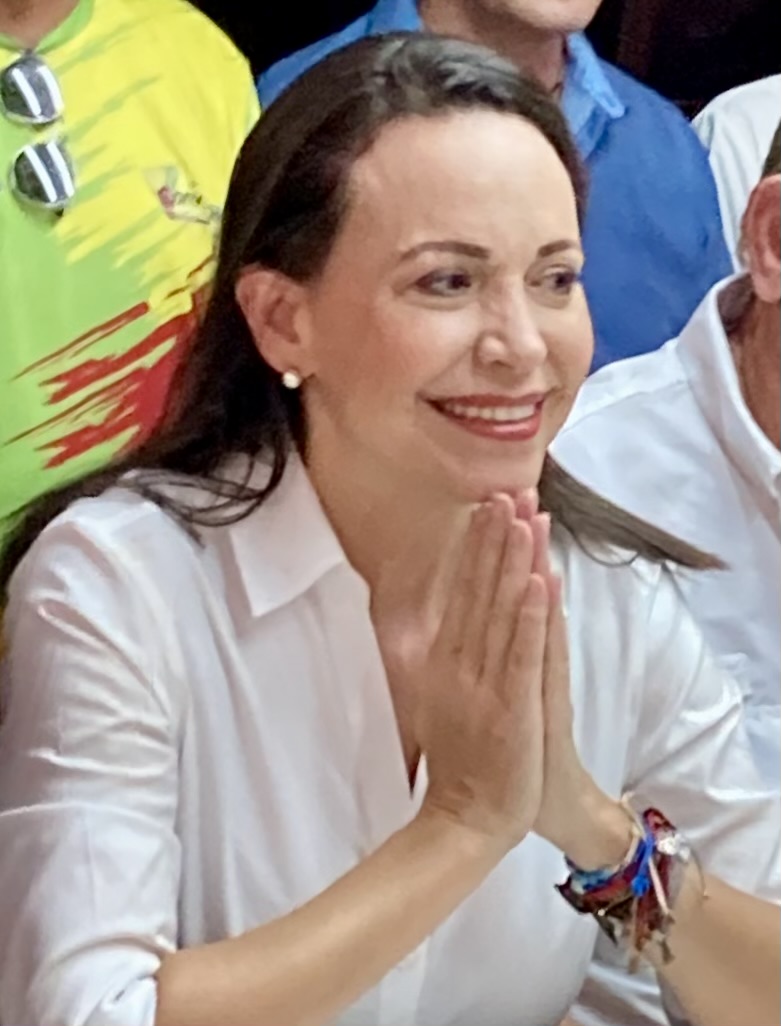
María Corina Machado walked back into Venezuela on Sunday for the first time in ten months, appearing before supporters at a church in the western state of Lara before setting off by caravan toward Caracas. The Nobel Peace Prize laureate, who had been living in exile in Panama City after repeated attempts to re-enter the country were blocked, posted two words on social media: "I am here." It was a moment calibrated for maximum symbolism — and it landed, awkwardly, in the middle of a Venezuelan transition that the United States has spent the better part of a year trying to manage without her.
Nine months earlier, American forces had carried out the most consequential U.S. military action in the hemisphere in a generation, seizing Nicolás Maduro and flying him to New York to face trial on narco-terrorism charges. Secretary of State Marco Rubio laid out a three-phase plan afterward: stabilize the country, rebuild its economy and political institutions, then hold a genuine transition. Washington has delivered pieces of each phase. It has not delivered the plan's stated purpose. Venezuela still has no presidential election date, and the figure the Nobel committee honored "for her tireless work promoting democratic rights for the people of Venezuela" remains outside the negotiating room Washington itself convened.
A government built on an oil deal, not a mandate
In Maduro's absence, his former vice president and oil minister, Delcy Rodríguez, was installed as acting president within forty-eight hours, under a chain of authority that runs back to the same ruling party apparatus Maduro led. The Trump administration has treated her as a workable partner, and in August announced what the president called the biggest oil deal in history: U.S. control, through a joint venture, of roughly 65 billion barrels of Venezuelan crude across seventeen fields, with the Pentagon reportedly taking a direct equity stake and the State Department securing rights to buy oil at cost. The U.S. Treasury had already cleared the way with a sanctions license issued days after Maduro's capture authorizing established American companies to resume dealing in Venezuelan-origin oil, a license since amended and expanded five times. Chevron, already the largest Western operator in the country, followed with its own announcement that it would invest more than $7 billion over five years to roughly double its Venezuelan output, after being assigned additional acreage in the Orinoco Belt.
Even the basic terms of the government's own deal are in dispute. Rodríguez has described it on state television as a twenty-five-year arrangement, the maximum allowed under Venezuela's hydrocarbons law. American officials have described the same fields as handed over on a hundred-year concession. Neither government has released the underlying contract, so there is, at the moment, no way to know which account is accurate — only that the two parties to a multibillion-dollar transaction cannot agree in public on how long it runs. Ricardo Hausmann, the Harvard economist and former Venezuelan planning minister, dismissed the whole arrangement on social media as a "shameful deal", arguing that Rodríguez lacks any constitutional standing to sign away the country's subsoil in the first place.
"She has no legitimacy or constitutional power to commit Venezuela to any such deal."
That is not a fringe objection. Venezuela's 1999 constitution requires that contracts of national public interest be approved by the National Assembly before they take effect — a provision the opposition itself invoked in 2017 to challenge a Maduro-era Rosneft stake. The oil deal has not gone before any legislature, Venezuelan or American. It has gone before cameras.
A government whose own clock has run out
The deeper problem is that Rodríguez's authority to sign anything at all is itself contested on the government's own terms. Venezuela's constitution allows a vice president to fill a temporary presidential vacancy for ninety days, extendable once by the National Assembly for another ninety — one hundred eighty days in total — before the absence must be treated as permanent, which under the same charter triggers a new presidential election within thirty days. By the reckoning of Venezuelan constitutional scholars, that hundred-eighty-day ceiling passed in early July, nearly four months before Machado's return, with the National Assembly never formally taking up the question. Rodríguez has governed since then on authority that, by the letter of the document her own government invokes to justify its rule, has already expired.
Washington has not pressed the point. A Congressional Research Service account of U.S. policy, updated in August, credits American pressure with securing control over Venezuela's oil proceeds, an amnesty law, the release of some political prisoners and a rollback of Caracas's ties to Havana and Tehran — real, measurable gains. What it does not credit the policy with is movement toward an actual vote. A first round of U.S.-brokered talks between Rodríguez's government and a faction of the opposition led by Dinorah Figuera opened in August; a third round closed last week with, as one account of the negotiations put it, little progress on setting an election date, even as the two sides made headway on reconstituting the Supreme Court and electoral council. Figuera has floated a transition proposal by December and elections "by 2028 at the latest" — a horizon that keeps receding the closer it gets.
Machado was never at that table. Her party says she tried to re-enter the country at least seven times in recent months and was turned back each time. Asked this month whether he would like to see Rodríguez and Machado actually face each other in a vote, President Trump called the idea "interesting" and left it there. One American official, speaking anonymously to reporters about her return, worried aloud that she could "blow all that up" by mobilizing the kind of street demonstrations that unsettled Rodríguez's government before — treating the country's most credible democrat less as the point of the exercise than as a risk to be managed.
Stabilization is not the same as democracy
None of this is an argument that the administration's Venezuela policy has failed on its own terms. Removing Maduro ended one of the hemisphere's most durable dictatorships and a government the United States had formally indicted as a narco-trafficking enterprise; a superseding indictment unsealed this month even adds a conspiracy-to-torture count, alleging electric shock, rape and prolonged starvation used against political prisoners over a quarter-century. Hundreds of political prisoners have since been freed. A catastrophic pair of earthquakes in June killed more than six thousand people and complicated every timeline the administration had set, a genuine excuse for caution that critics of the policy too rarely acknowledge. There is a real case that forcing an election in a country still burying its dead and still run by the remnants of a narco-state apparatus would produce chaos rather than democracy.
But stabilization was always supposed to be a means, not the end state, and nine months in, the distinction is eroding. An administration that is simultaneously the guarantor of Venezuela's transition and a direct financial stakeholder in its oil fields has an obvious incentive to prefer a cooperative, oil-exporting Rodríguez over an unpredictable, protest-prone Machado — whatever the human rights case against the government it inherited from Maduro. That incentive helps explain why the interim government's expired constitutional mandate and its unratified, mutually contradicted oil concession have drawn so little pressure from Washington, even as the administration continues to describe its goal as a "just and peaceful transition." A genuine transition would require Washington to use its considerable leverage — sanctions relief, investment, diplomatic recognition — explicitly and publicly to compel two things: a National Assembly vote on the oil contracts, as Venezuela's own constitution requires, and a binding, dated election calendar that includes rather than manages around the one Venezuelan opposition figure global institutions have already judged most legitimate. Machado's unsanctioned return should be read as a signal that she, at least, no longer believes patience will produce either. Washington should take the hint before the bargain it has struck looks, in retrospect, like the policy all along.
Opinion: The ACA Subsidy Fight Congress Never Finished Is on Tuesday's Ballot

Opinion: Suing OpenAI Is Not the Same as Regulating AI

Opinion: A Houston indictment tests whether ICE agents can be held accountable at all
