Opinion: Washington Keeps Losing the Only Vote That Could End the Iran War
Eight months into an undeclared war with Iran, the government's own data show the Strait of Hormuz campaign failing on its own terms, even as the Senate keeps rejecting withdrawal by a single vote and the Pentagon's cost estimate goes stale by the week.
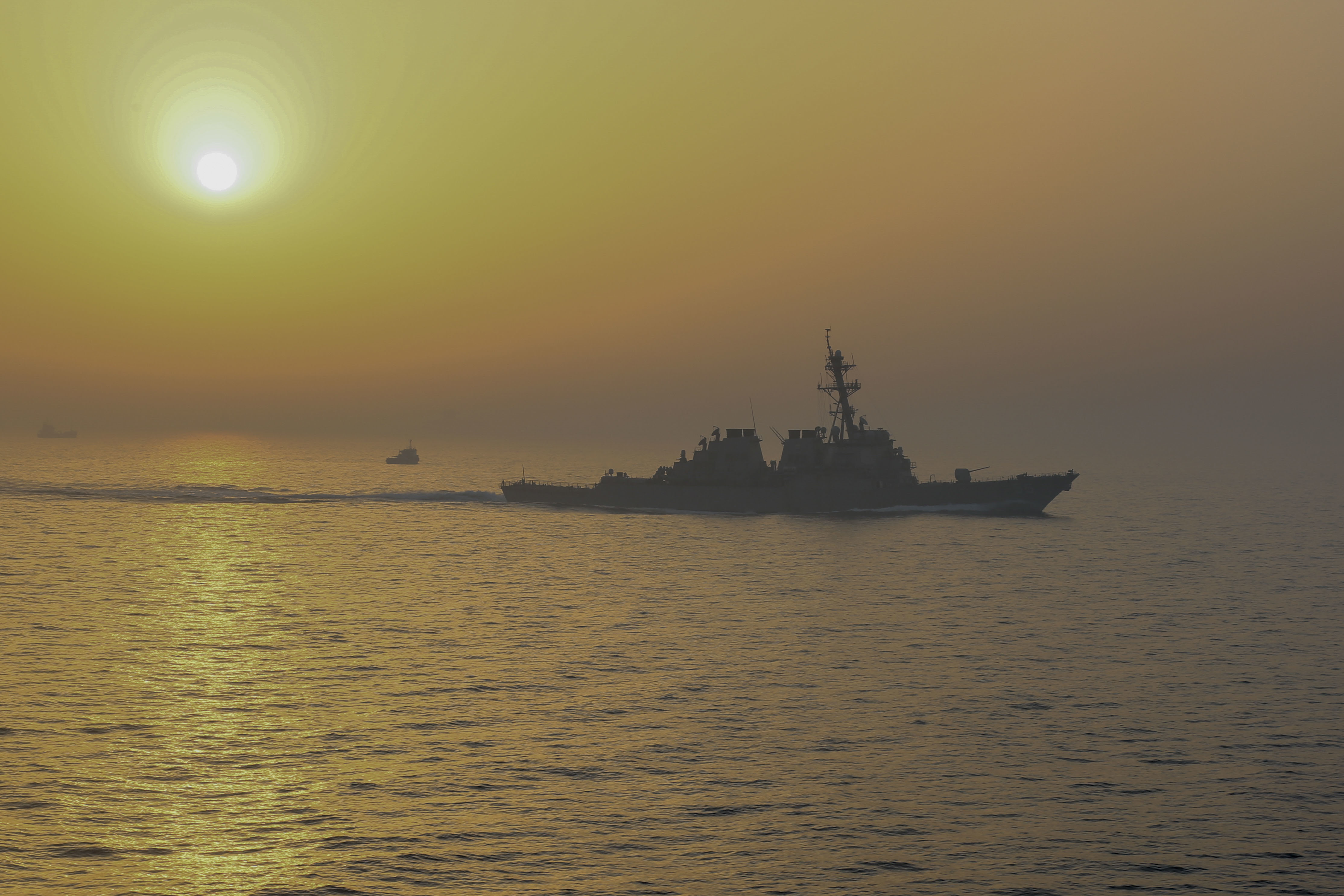
On Monday, an Islamic Revolutionary Guard Corps spokesman added a new target to Iran's list of threats in the Strait of Hormuz: the undersea fiber-optic cables that carry a share of the world's internet traffic beneath that same channel of water. The same day, Qatar's deputy prime minister told a security forum in Doha that a new regional defense partnership would be unveiled "soon." Five U.S. senators led by Elizabeth Warren asked the U.S. Central Command for an updated, honest accounting of what the war with Iran now costs. And a few hours into Tuesday, Iran's military said a supertanker carrying more than two million barrels of oil had struck a mine near the strait. None of this is a single news event. It is a Tuesday in the eighth month of an American war that was never declared, has twice been voted down by the chamber built to end it, and is now failing by the very measure the Pentagon uses to justify it.
A war measured in barrels
The clearest scorecard for this conflict is not battlefield geography but oil flow, and the government's own numbers are damning. Before the fighting began on February 28, roughly 125 large commercial vessels transited the Strait of Hormuz daily, carrying an average of 20.9 to 21.6 million barrels of oil a quarter, according to the U.S. Energy Information Administration's Global Energy Security data. By the second quarter of 2026 that figure had collapsed to 4.9 million barrels a day. Flows partially recovered over the summer, and tanker-tracking firm Kpler found that Gulf exports actually exceeded pre-war levels on several days in September. Then October arrived: Kpler data cited by Al Jazeera shows roughly 20.8 million barrels passing through the strait on October 8, and just 2.9 million three days later — against a pre-war daily average of 17.1 million. The UK Maritime Trade Operations centre logged 15 attacks on shipping between October 6 and 14 alone, eleven of them in the final four days of that span, and the U.S. Navy-led Joint Maritime Information Center rated the threat to merchant shipping "severe," its second-highest classification.
The costs of that volatility are no longer theoretical. War-risk insurers have added as much as $8 to the price of a barrel of oil moving through the Gulf, and claims tied to the conflict have already topped $2 billion, according to shipping-industry analysis published by AGBI. Brent crude settled above $109 a barrel on Monday and West Texas Intermediate closed at its highest level since mid-September, Fox News reported from its rolling coverage of the conflict. In early October, Reuters counted at least a dozen attacks on oil, liquefied natural gas and liquefied petroleum gas tankers in a single week — the highest weekly tally since the war began — and India's foreign ministry said twelve crew members were injured when an unidentified projectile struck the tanker On Peace, reporting relayed through gCaptain's account of that Reuters dispatch.
Central Command disputes the framing, insisting the "vast majority" of Iranian attacks fail and that the strait remains functionally open; it says it helped move more than 19 million barrels through the passage on a single day in mid-October. Both things can be true at once, and that is precisely the problem: a chokepoint that requires an active American naval escort to move oil at a fraction of its pre-war volume, through waters where insurers now treat every transit as a war-risk event, is not a chokepoint that has been secured. It is a chokepoint that has been priced into a permanent emergency.
The vote Congress keeps losing
The War Powers Resolution exists for exactly this situation, and this year lawmakers have tested it more than almost any other point in the statute's half-century history. On July 23, the House passed H.Con.Res. 89 by a vote of 214-208, directing the president, under Section 5(c) of the War Powers Resolution, to remove U.S. armed forces from hostilities with Iran. It was the second time this year the chamber had gone on record against the war; the Senate had separately passed its own nonbinding rebuke in June, 50-48, with four Republicans crossing over. Momentum, briefly, looked real.
Then, on September 24, the Senate took up the House's own resolution and killed it, 49-50, in a vote recorded on the chamber's official roll call. Every Republican voted no except Susan Collins, Lisa Murkowski, Rand Paul and Thom Tillis. Every Democrat voted yes except John Fetterman, whose single defection flipped a 50-49 majority into defeat. Because it was a concurrent resolution, it would not even have reached the president's desk had it passed; it was a demand, not a binding order. It failed anyway, as have, by various counts, somewhere between a dozen and fourteen similar measures brought in both chambers since the war began — each one a few votes, sometimes a single vote, short.
Accountability has fared no better on the balance sheet than it has on the floor. The Pentagon's own public cost estimate for the war stood at $43.6 billion through September 3 — more than six weeks stale by the time Senator Warren and four colleagues asked Central Command on October 19 for a current, honest figure. The Congressional Budget Office, working independently, had put the total closer to $38 billion as of August 1 and flagged "considerable uncertainty" in its own math. Neither number captures the cost of rebuilding damaged installations or the full scope of lost equipment. A war whose price tag updates slower than its own casualty reports is a war the public cannot actually weigh against its stated aims.
Who pays, and what comes next
The administration's rebuttal is coherent on its own terms: ending the campaign now would hand Iran a propaganda victory days before Israel's October 27 election, in which President Trump has publicly tied himself to Prime Minister Netanyahu's survival; Qatar's forthcoming defense arrangement shows regional partners still betting on the American security umbrella rather than abandoning it; and Central Command's tally of disabled and destroyed vessels in Iran's "shadow fleet" is a real operational achievement, whatever happens to the oil price. Those are legitimate considerations in a serious debate about ending a war. They are not, however, answers to the specific question the law requires Congress to keep asking, which is whether hostilities that have run eight months without a declaration, without a sunset, and without an audited cost should continue on the executive's say alone.
"You are smuggling, but the strait is under Iran's control, and we manage it," Iran's security chief Mohsen Rezaei told shipping companies this month, a claim Central Command rejects outright, insisting American and partner forces — not Tehran — control the waterway.
The people actually absorbing the cost of that standoff are not the officials arguing about who controls the strait. They are the merchant crews, like the twelve sailors hurt aboard the On Peace, sailing through waters their own insurers now price as a war zone. They are the service members whose families, per congressional offices citing Pentagon figures, now count the dead at close to twenty. They are drivers and manufacturers worldwide absorbing a Brent price still roughly 50 percent above its pre-war level, and the consumers of global shipping paying insurance surcharges baked permanently into freight. And they are, in a less visible but no less real sense, the members of Congress who voted twice to end this war and were overridden both times by margins thinner than a rounding error.
Iran's threat against undersea cables is worth taking seriously precisely because it points toward where this goes next if nothing changes: an economic war that no longer confines its damage to oil tankers and insurance markets but reaches into the data infrastructure the rest of the world depends on. Pakistan's army chief is reportedly traveling to Tehran this week to mediate; Houthi forces aligned with Iran have reportedly killed Yemeni recruits in a missile strike, a sign the conflict's edges are still fraying outward rather than closing. None of that argues for recklessness in how the war ends. It argues against the current arrangement, in which an undeclared conflict renews itself indefinitely through inertia, a stale cost estimate stands in for public accountability, and the only vote that has mattered all year was the one Washington lost by exactly one senator.
Opinion: Washington just banned DeepSeek for the third time in ten months. That's the real failure.

Opinion: Washington can't say who cut off Ukraine's battlefield communications. That silence is the scandal.

Opinion: Alberta's independence vote matters less than how it got on the ballot
