An enormous, recurring cloud on Mars reveals a new way ice can form
A cloud that stretches nearly 1,800 kilometers across a Martian volcano's flank forms through a process never before documented on any planet, researchers reported this week, resolving a puzzle that has lingered since Europe's Mars Express spacecraft first photographed it in 2018.

A cloud that stretches nearly 1,800 kilometers across the Martian sky, forms anew every morning for months at a stretch, and then dissolves by midday has puzzled planetary scientists since it was first photographed in 2018. A study published this week in Nature Geoscience reports that the cloud forms through a process never before documented in any planetary atmosphere, including Earth's: ice crystallizing directly out of water vapor with no dust, soot or other particle to kick-start the process.
The European Space Agency, whose Mars Express orbiter has tracked the phenomenon for years, described the finding this week as evidence that the Martian atmosphere behaves in ways that standard cloud physics, developed mostly from observations of Earth, does not fully capture. The cloud in question, known to researchers as the Arsia Mons Elongated Cloud, or AMEC, forms on the leeward side of Arsia Mons, a shield volcano roughly 20 kilometers high and one of the largest in the solar system.
The numbers behind the cloud
At its peak, the AMEC extends up to 1,800 kilometers, nearly twice the length of the United Kingdom laid end to end. It forms during the dusty season of the Martian southern spring and summer, reappearing on a daily cycle for several months before fading as the season turns. Mars Express first flagged the feature in 2018 using its Visual Monitoring Camera, and researchers have since added observations from the spacecraft's High Resolution Stereo Camera and its OMEGA spectrometer to build a fuller picture of how it behaves.
The new modeling work, led by planetary scientist Jorge Hernández-Bernal of the Laboratoire de Météorologie Dynamique at the CNRS and Sorbonne Université in Paris, found that winds sweeping past Arsia Mons generate an atmospheric wave that lifts moist air several kilometers in a matter of minutes. As the air rises, its temperature drops by about 30 degrees Celsius in roughly 10 minutes. That sudden chill pushes relative humidity to more than 100,000 times typical conditions on Earth, a threshold the researchers argue is high enough for water vapor to freeze directly into ice particles without any dust grain to nucleate around.
A cloud that outgrew the textbook
For most of the time since its discovery, the AMEC was treated as a well-understood type of feature: an orographic cloud, the kind that forms routinely when air is forced upward and cooled as it passes over mountains or volcanoes, on Mars as on Earth. What set the AMEC apart was its sheer scale and its stubborn refusal to show up correctly in atmospheric models built on the usual assumption for Mars, which is that clouds need airborne dust particles to act as seeds for ice to condense on, a process called heterogeneous nucleation.
Earlier simulations using that assumption could not reproduce a cloud anywhere close to the length or persistence of the real AMEC. Hernández-Bernal's team instead added a mechanism known as homogeneous nucleation, in which ice forms directly from vapor under extreme cold and humidity, without a dust seed at all. According to the ESA summary of the paper, that single change allowed the model to generate a cloud resembling the one Mars Express has watched for years, although the authors note some features of the simulated cloud still do not perfectly match what has actually been observed, a gap they describe as a subject for further work rather than a flaw that undermines the result.
The preprint version of the study, posted to arXiv ahead of peer review, lays out the fluid-dynamics calculations in more detail, including the wave mechanics that lift air so abruptly over the volcano's flank. The concept the team leans on, nucleation, describes the earliest step in any phase change, the moment a new ice crystal, droplet or bubble first takes shape, and it is usually far easier for that to happen around an existing particle than for a vapor to freeze on its own.
Who has a stake in a Martian cloud
The audience most immediately affected is the community of researchers who build and rely on climate and atmospheric models of Mars, which inform everything from forecasts of dust storms to the design of future landers and the search for recoverable water ice. If homogeneous nucleation operates on Mars under conditions once assumed to require dust, that same physics could be relevant to clouds elsewhere in the solar system, including the hazes of Titan or the ice clouds of other planets, where dust is scarce but humidity spikes can still occur locally.
Mars Express and ESA's ExoMars Trace Gas Orbiter remain among the few spacecraft positioned to observe the planet during the early-morning hours when the AMEC is actually present, a practical constraint that has shaped how slowly this particular mystery has been resolved. Colin Wilson, ESA's project scientist for Mars Express, said the mission's long tenure in orbit, now in its third decade, has given scientists what he called an unrivaled view of short-lived phenomena on the planet, the kind of repeated, high-cadence monitoring that first made the AMEC's daily cycle visible and that ultimately supplied the observations the new model was built to match.
What researchers are saying
Hernández-Bernal described the modeling breakthrough as turning on including physics that had not previously been invoked for any planetary atmosphere.
"To create the AMEC in our modelling, we found that we needed to include some exotic physics that has never been proposed before to explain a cloud on any planet: homogeneous nucleation of water-ice," Hernández-Bernal said, according to the European Space Agency.
He added that once that process was built into the simulations, "the result is remarkable," pointing to how closely the model's output tracked the real cloud's length and its daily rhythm of growth and collapse. Wilson, for his part, framed the finding as a product of patience as much as insight, noting that Mars Express "discovered the AMEC, has followed up and monitored it for years, and is now helping reveal the secrets of its formation."
What happens next
The paper's authors are explicit that their model, while a substantial improvement over previous attempts, does not reproduce every detail of the observed cloud, and they call for continued monitoring to refine it further. Mars Express is expected to keep collecting images through the Visual Monitoring Camera each Martian spring and summer, adding to a dataset that now spans multiple Martian years, roughly double the length of years on Earth. Researchers are also likely to test whether the same homogeneous-nucleation mechanism can account for other large, recurring cloud features that have been observed near different Martian volcanoes, which would suggest the phenomenon is not unique to Arsia Mons.
More broadly, the result is likely to feed into revisions of the general circulation models that scientists use to simulate the Martian atmosphere as a whole, since those models have generally not included a pathway for ice to form without dust. Whether that revision changes forecasts of dust storms or water-ice distribution elsewhere on the planet is, for now, an open question the authors leave to follow-up studies.

Europe's New Climate Satellite Sends Back Its First Images
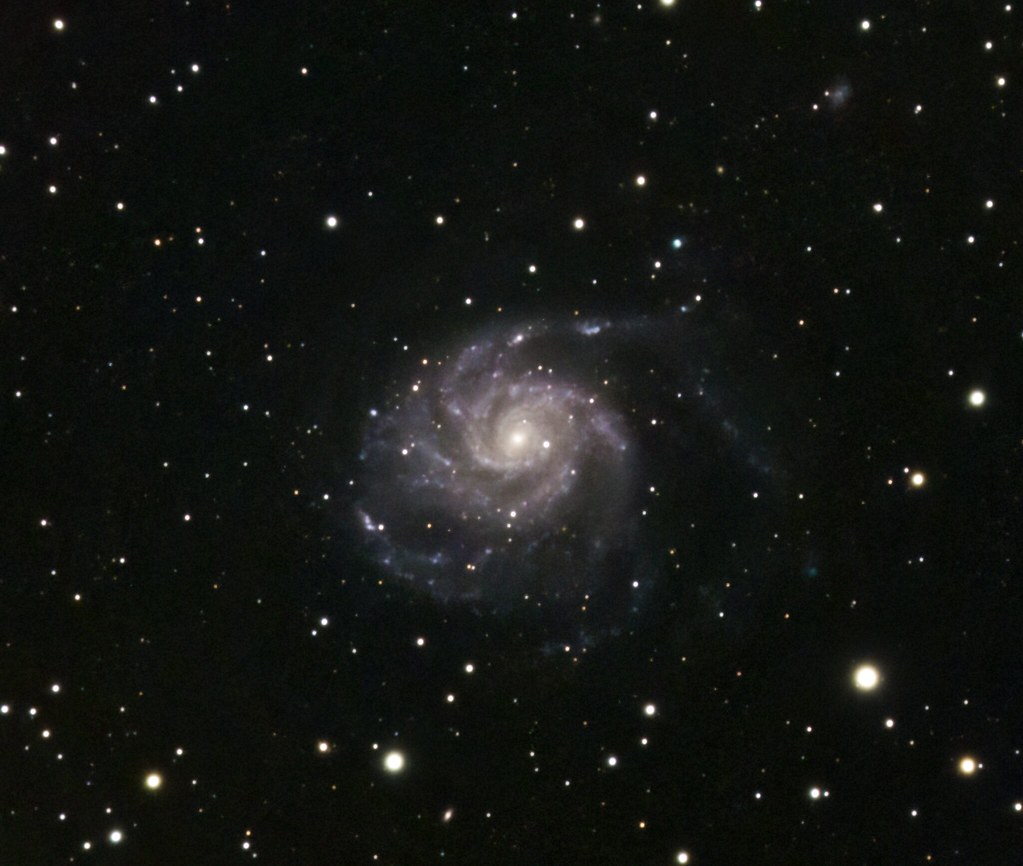
Long-Predicted "Backsplash" Galaxies May Have Finally Been Found Near the Pinwheel

Margaret Hamilton, Software Pioneer Behind the Apollo Moon Landings, Dies at 90
