Archived Chandra data reveal a hidden class of X-ray objects
Astronomers combing through two decades of public NASA telescope data have identified 84 unusually faint, ultraviolet-drenched objects that may include the long-sought progenitors of the exploding stars used to measure the universe's expansion.
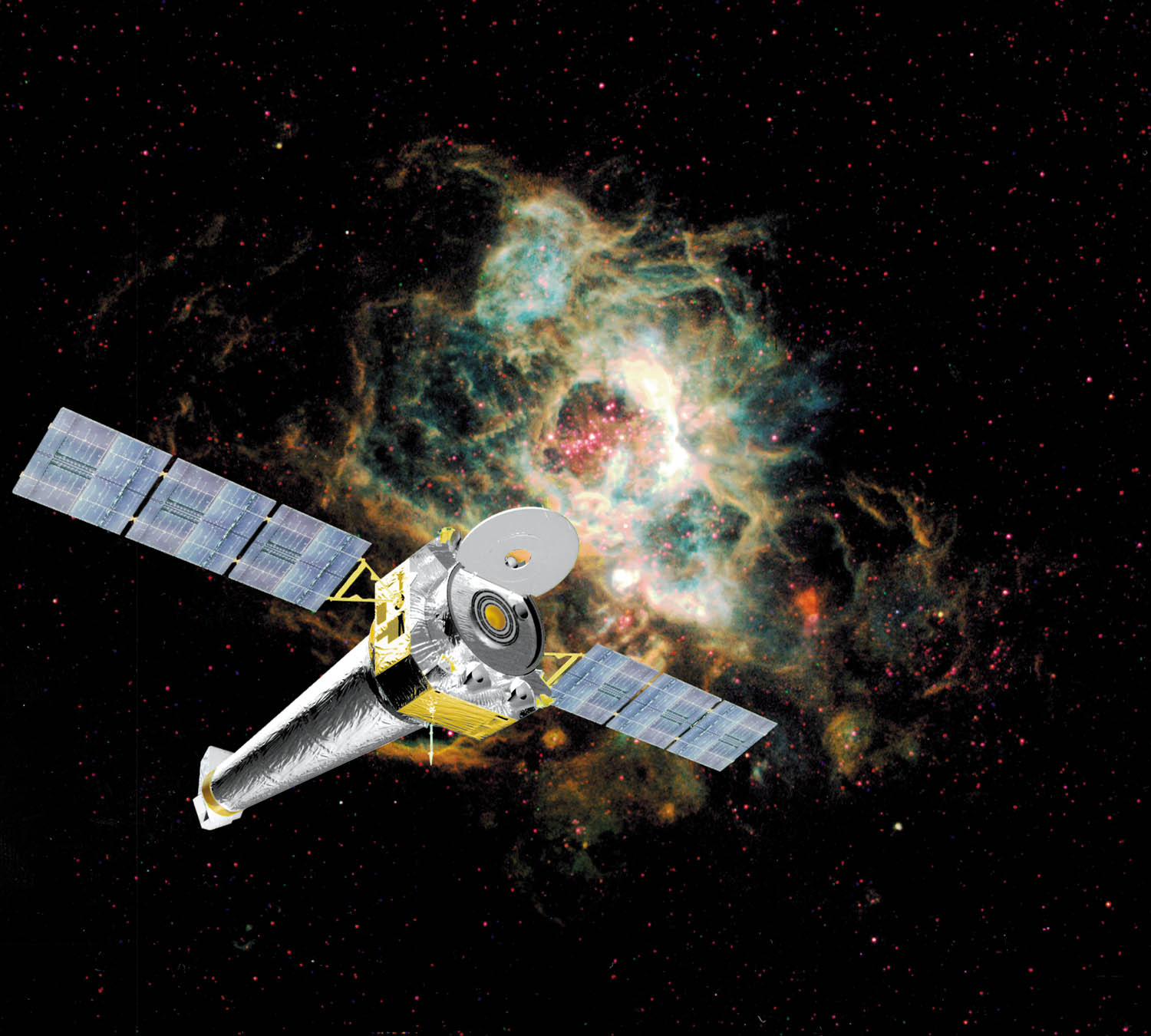
Astronomers using NASA's Chandra X-ray Observatory have identified a previously unrecognized class of cosmic object, hiding in plain sight inside data the telescope has been collecting for more than 25 years. The objects, named "hypersoft X-ray sources," emit almost none of the higher-energy X-rays that Chandra was built to detect, but blaze with far more low-energy X-rays and intense ultraviolet radiation than anything astronomers had previously catalogued in that category.
The discovery, described in a paper published Wednesday in Nature Astronomy, was led by Mustafa Muhibullah, a physics doctoral candidate at the University of Alabama, working with his adviser, astronomer Jimmy Irwin, and Rosanne Di Stefano of the Center for Astrophysics | Harvard & Smithsonian. Rather than pointing Chandra at a new target, the team mined the observatory's public archive, searching for faint sources that showed up in the lowest-energy X-ray images but vanished at higher energies — a signature no one had systematically searched for before.
A blind spot in the X-ray sky
The team found 84 hypersoft X-ray sources scattered across six nearby galaxies: the spiral galaxies M101, known as the Pinwheel Galaxy, and M31, the Andromeda Galaxy, along with four elliptical galaxies. The sources turned up in both active star-forming regions and older stellar populations, suggesting the phenomenon is not confined to any single type of stellar environment.
According to the NASA account of the findings, the objects give off radiation concentrated in an extreme-ultraviolet band so far to the low-energy end of the X-ray spectrum that it is "exceptionally cool" by the standards of X-ray-emitting objects, yet the sources are still among the most luminous non-nuclear objects in their host galaxies, radiating hundreds of thousands to millions of times the energy output of the sun. That combination — faint at high energies, ferociously bright at low energies — is what had kept them concealed. Extreme-ultraviolet light is readily absorbed by the hydrogen and helium gas that fills interstellar space, meaning telescopes looking for it from Earth's vantage point are working through what amounts to cosmic fog. "By combing through the Chandra archive, we were able to eliminate what used to be a blind spot" for telescopes, Di Stefano said, according to NASA.
Muhibullah described the objects as unlike anything the team had previously encountered. "We've never encountered a group of objects that act like this," he said. "These clandestine X-ray sources are actually among the most energetic objects in galaxies."
Two long-standing puzzles
The researchers argue the discovery, detailed further in a preprint of the study, could bear on two separate, decades-old problems in astrophysics. The first concerns Type Ia supernovae, the explosions of white dwarf stars that serve as standardized "distance markers" for measuring the universe's expansion — the same class of explosion whose study led to the 2011 Nobel Prize in physics for the discovery that the expansion is accelerating. Despite the importance of these explosions to cosmology, astronomers have never conclusively identified the systems that go on to produce them. One leading model holds that a white dwarf slowly pulls material from a companion star until it destabilizes and detonates; a hypersoft X-ray source, powered by a white dwarf steadily burning accreted hydrogen on its surface, is a plausible stage in that process, the researchers say.
The second puzzle involves the diffuse gas that drifts between galaxies, known as the intergalactic medium. Observations have long shown that helium atoms in this gas have had an electron stripped away, a process called ionization, at a rate that known populations of hot, massive stars cannot fully explain. The intense ultraviolet output of hypersoft X-ray sources, multiplied across the many such objects likely populating galaxies, is now a candidate source for at least part of that missing ionizing radiation, with implications for how gas cools and collapses to form new stars across cosmic time.
"If we could find a way to spot these Type Ia supernova explosions before they go off, that would be really important," said Jimmy Irwin, the study's co-author at the University of Alabama.
Who stands to benefit, and what comes next
The immediate audience for the finding is narrow — observational astrophysicists and cosmologists who rely on Type Ia supernovae to calibrate distances across the universe, and researchers modeling how galaxies and the gas around them evolve. But the stakes are broader: the rate of cosmic expansion derived from these supernovae underlies much of modern cosmology, including estimates of dark energy, so any improvement in understanding what produces them carries weight well beyond a single subfield.
As phys.org reported in its account of the paper, the sources were hiding not because Chandra lacked the sensitivity to see them, but because standard data-processing pipelines were not built to flag objects with this particular spectral fingerprint — faint or absent at the energies analysts typically scan, conspicuous only in the lowest energy channel. That means the population uncovered so far, spread across just six galaxies, is likely a fraction of what exists in the broader Chandra archive and in future observations.
The research team's next steps involve searching for additional hypersoft X-ray sources in other archived Chandra fields and developing methods, potentially combining X-ray, ultraviolet and optical observations, to catch a white dwarf system in this phase before it detonates rather than reconstructing its history after the fact. Confirming the physical nature of individual sources will likely require follow-up spectroscopy from other telescopes to determine which are white dwarfs steadily burning accreted material, which might be interacting binaries of another kind, and whether any can be linked directly to a subsequent supernova. Given that Chandra has been operating since 1999, the archive the team drew on continues to grow, and the authors note that the same low-energy search strategy could be applied retroactively to galaxies well beyond the six examined in this first study.
Nature Astronomy — A hidden population of hypersoft X-ray sources in nearby galaxies
NASA Science — NASA's Chandra Unveils Mysterious X-Ray Objects
Chandra X-ray Center (Harvard-Smithsonian) — A Hidden Population of Cosmic Beacons
Phys.org — Chandra uncovers 'hypersoft X-ray sources' that may solve two astrophysical puzzles
Cedars-Sinai Identifies Protein That Lets Aging Cells Evade the Immune System
Telescope catches meter-wide asteroid hours before it burns up over the Indian Ocean

Global conservation planning overlooks the tropics, home to most insect species, study finds
