Astronomers find earliest known ancestor of a galaxy supercluster
A newly mapped clump of ten merging galaxy groups, seen as it appeared just 2.1 billion years after the Big Bang, is the most distant proto-supercluster ever identified, giving cosmologists a rare direct look at the universe's largest structures still being built.
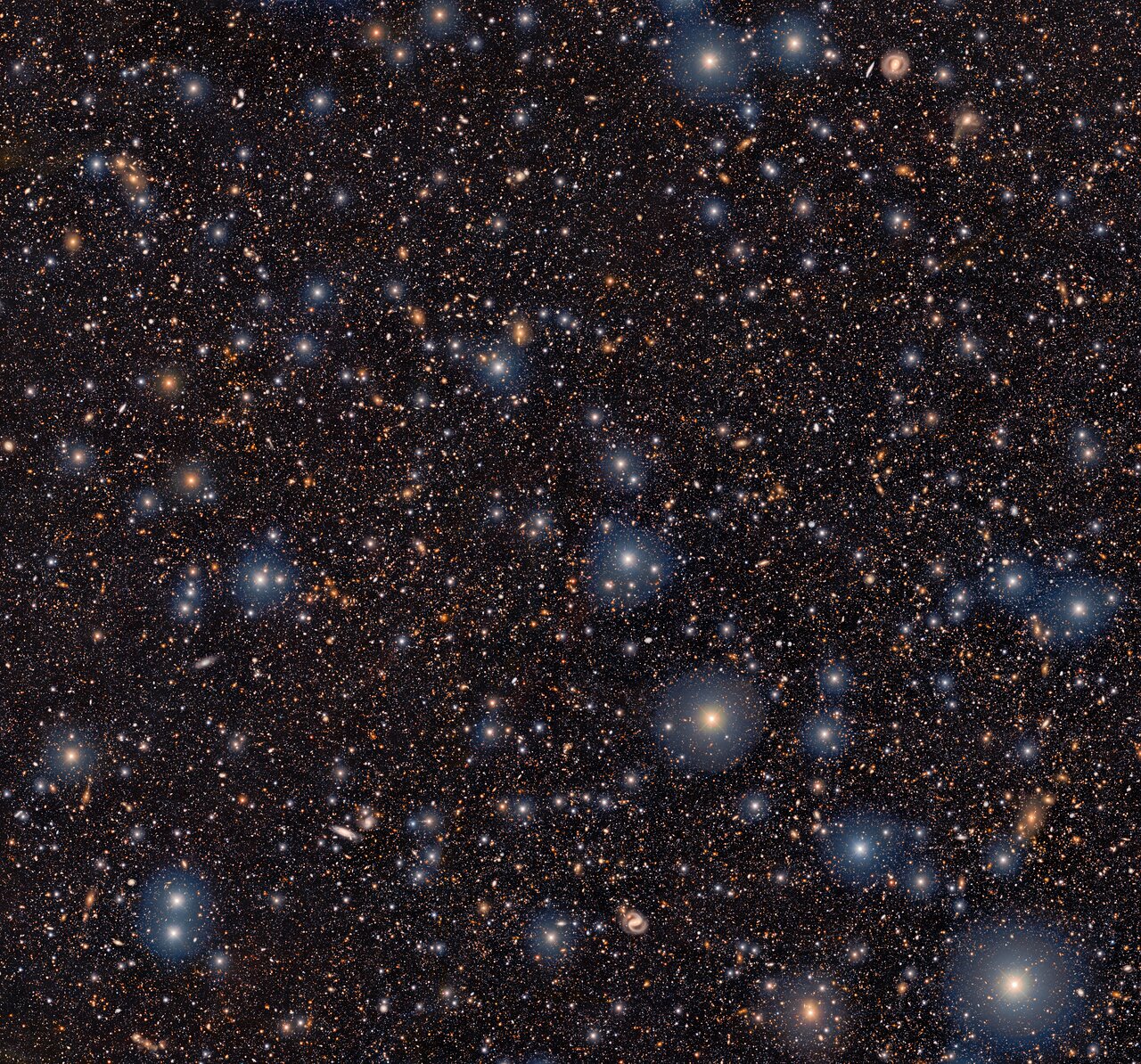
Astronomers have identified the most distant known ancestor of a galaxy supercluster, a sprawling, still-forming structure so far away that its light left home when the universe was barely 2 billion years old. The object, cataloged as COSMOS-z3.1-A, is described in a new paper in The Astrophysical Journal and detailed in a press release from NSF NOIRLab, the U.S. national center for ground-based optical astronomy.
The discovery, led by Vandana Ramakrishnan, who completed the work as a doctoral student at Purdue University, pushes back the observational record for these enormous cosmic assemblies and offers researchers a rare, direct look at the "bottom-up" process by which the universe's largest gravitationally bound structures are thought to form.
What was found
A proto-supercluster is not yet a single object in the way a galaxy or even a galaxy cluster is. It is a loose, sprawling association of smaller groups — in this case ten distinct, dense clumps of galaxies — that are gravitationally drawn toward one another and will, over billions of years, merge into what astronomers call a "cluster of clusters." The nearby, present-day universe is full of these finished superclusters, including the one containing our own Milky Way. What is rare is catching one in the act of assembly, this early and this far away.
COSMOS-z3.1-A sits at redshift 3.1, meaning its light has been traveling toward Earth for roughly 11.7 billion years, arriving from an era when the universe itself was only about 2.1 billion years old — a bit more than a tenth of its current age. Despite that youth, the structure already carries an estimated mass some 5,000 times that of the Milky Way, spread across tens of millions of light-years. The research team calculates that fewer than one such object should exist for every 10,000 galaxy clusters found in a comparable volume of sky, making it, in the words of the discovery paper, one of "the most extreme, most overdense regions of the Universe."
How they found it
The find came out of the ODIN survey — formally the One-hundred-deg2 DECam Imaging in Narrowbands project — which used the 570-megapixel Dark Energy Camera mounted on the National Science Foundation's 4-meter Víctor M. Blanco Telescope at Cerro Tololo Inter-American Observatory in Chile. Over more than 100 nights across three years, the camera's narrowband filters were tuned to pick out the faint glow of hydrogen gas known as Lyman-alpha emission, a signature that lets astronomers flag galaxies at specific, very early cosmic epochs. That approach turned up roughly 150 candidate protoclusters dating to between one and three billion years after the Big Bang.
Ramakrishnan's team then went back with three of the world's premier observatories — the Dark Energy Spectroscopic Instrument on the Mayall Telescope at Kitt Peak National Observatory in Arizona, the Gemini Multi-Object Spectrograph on Gemini South in Chile, and the Deep Imaging Multi-Object Spectrograph on the Keck II telescope in Hawaii — to measure precise distances to individual galaxies within two of the densest candidate regions. Combining those spectroscopic distances with the imaging data let the team build a three-dimensional map of the structures for the first time, rather than relying on a flat, two-dimensional projection on the sky that can make chance alignments look like real clusters.
"Once we include the redshift information and add the third dimension, you can start to see galaxies grouping together," said Ashley Ortiz, a Purdue undergraduate and co-author on the study, describing how the 3D reconstruction separated genuine structure from projection effects.
Why it matters
Cosmologists have long modeled the universe's biggest structures as building up hierarchically: small clumps of matter merge into bigger ones, which merge into bigger ones still, over cosmic time. Superclusters, the largest gravitationally associated structures known, are the end state of that process. But because that assembly plays out over billions of years, no single observation can watch one structure evolve — astronomers instead have to find many different structures at many different distances, each representing a different snapshot in the assembly timeline, and stitch those snapshots into a story.
COSMOS-z3.1-A is now the earliest and most distant such snapshot on record, surpassing the previously identified Hyperion structure at redshift 2.4. The research team's models suggest that, given billions more years of gravitational pull, its ten separate density peaks would merge into a single bound supercluster with a present-day mass rivaling that of the Coma Cluster, one of the largest structures in our cosmic neighborhood.
"When we look at galaxy clusters in the nearby universe, we are seeing the finished product. This distant structure takes us back to a much earlier stage when the individual pieces were still coming together." — Eric Gawiser, Rutgers University, co-leader of the ODIN survey
That distinction matters beyond bragging rights over a distance record. Structures like COSMOS-z3.1-A sit in the densest filaments of the cosmic web, the vast lattice of matter that connects galaxies across the universe, and the galaxies growing inside them are thought to evolve differently — faster, and along different chemical and star-forming pathways — than galaxies in emptier regions. Pinning down exactly how common these overdense pockets were in the young universe, and how quickly they formed stars and enriched themselves with heavier elements, is a direct test of the computer simulations cosmologists use to model the universe's evolution from the Big Bang to today.
Who is affected, and reaction
The immediate audience for the result is the community of astronomers who study large-scale structure and galaxy evolution, along with the teams operating the next generation of wide-field cosmic surveys, including the Vera C. Rubin Observatory and NASA's Nancy Grace Roman Space Telescope, both of which are expected to find far larger samples of these early structures in the coming years. More than 50 researchers from Purdue, Rutgers, the Korea Astronomy and Space Science Institute, Lawrence Berkeley National Laboratory, the University of Pennsylvania, Ohio State University and more than three dozen other institutions worldwide contributed to the ODIN survey and the new analysis.
Nicole Firestone, a doctoral student at Rutgers who worked on the imaging, said the first pass through the data made clear something unusual was there. "The first images told us that these regions of the Universe were exceptionally crowded with galaxies," she said. Ramakrishnan, for her part, framed the discovery in terms of the broader puzzle it helps solve: "I think the distance and sheer scale of the structures we are studying is really extraordinary," she said, adding that the goal of the wider project is "to understand the growth of massive structures in the Universe and how they influence the evolution of galaxies within them," and to clarify how individual protoclusters connect into the larger cosmic web.
- COSMOS-z3.1-A lies at redshift 3.1, with light that has traveled roughly 11.7 billion years to reach Earth.
- It is composed of ten separate, dense galaxy groupings expected to merge into one supercluster over billions of years.
- Its estimated mass is about 5,000 times that of the Milky Way, and researchers estimate fewer than one such structure exists per 10,000 galaxy clusters.
- The ODIN survey that found it has cataloged roughly 150 candidate protoclusters from the universe's first three billion years.
What happens next
The paper describing COSMOS-z3.1-A covers just two of the roughly 150 protocluster candidates the ODIN survey has flagged so far, and the team says three-dimensional reconstruction of the remaining candidates is already underway. Follow-up spectroscopy with Gemini, Keck and the Dark Energy Spectroscopic Instrument is expected to continue over the next several years, and the team says the same 3D-mapping method used here will be applied to distinguish the dense cores of other protoclusters from the cosmic filaments feeding into them.
Ground-based work will soon be supplemented by more powerful instruments. The Vera C. Rubin Observatory's decade-long Legacy Survey of Space and Time is expected to reveal thousands of additional candidate protoclusters across the sky, while targeted infrared observations from the James Webb Space Telescope could resolve individual galaxies within structures like COSMOS-z3.1-A in far greater detail than is currently possible. Researchers say the eventual goal is a large enough catalog of these early structures, at a wide enough range of cosmic epochs, to test — and if necessary revise — the standard model of how the universe's largest structures assembled over the past 13.8 billion years.
Scientists Find Tens of Thousands of Organic Molecules Packed Inside Two Meteorites

Black Holes of Every Size Follow the Same Rule for Launching Jets, Study Finds

Stanford-led study finds the human brain is built from two separate organs, not one
