European X-ray Laser Hits Record Wavelength, Edging Past the Scale of Atoms
Scientists at Germany's European XFEL facility say they can now reliably produce X-ray laser flashes shorter than the typical distance between atoms in a solid, a milestone that could sharpen views of materials under extreme conditions.
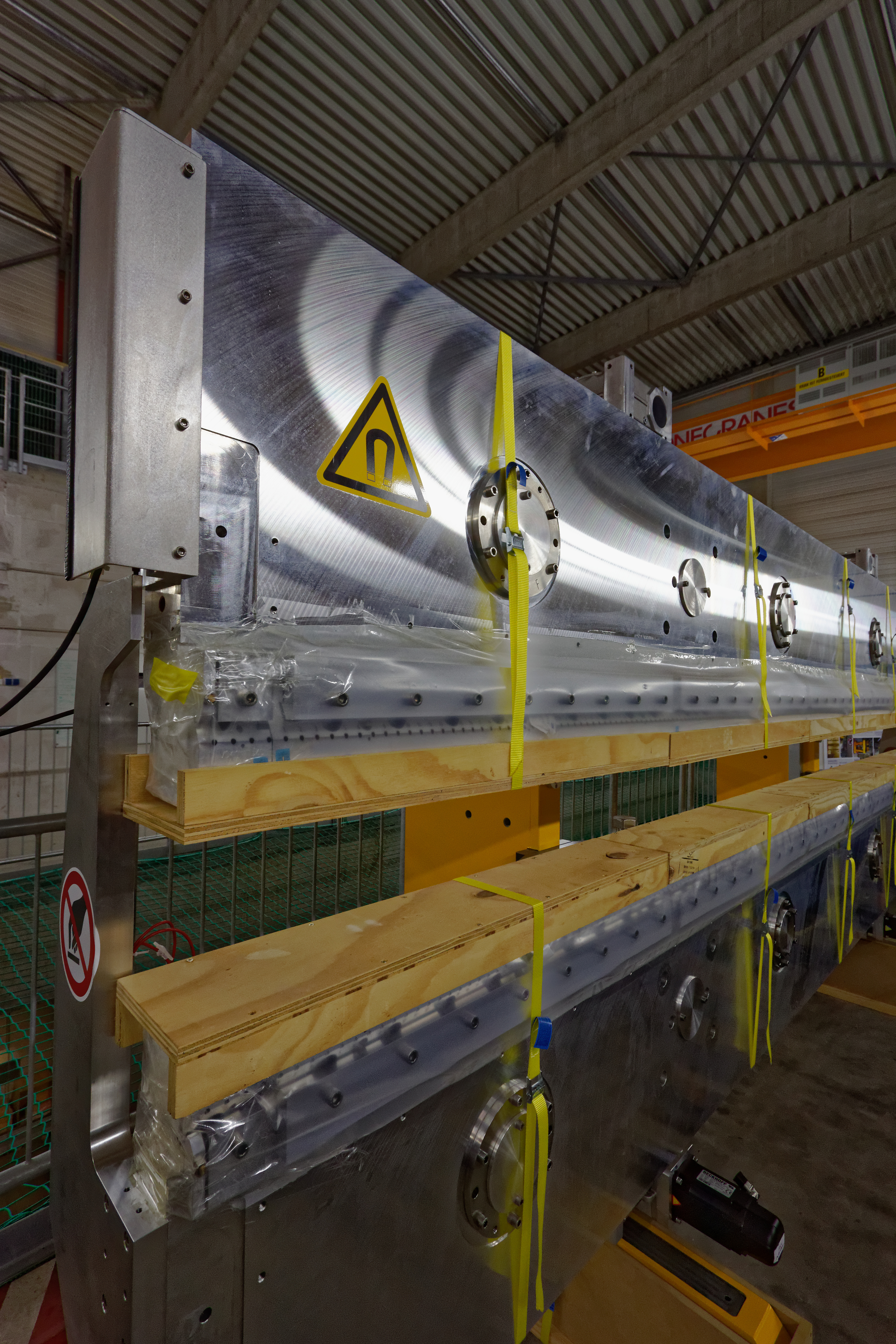
Physicists at the European X-ray Free-Electron Laser (European XFEL) facility near Hamburg, Germany, have demonstrated that they can reliably generate and transport X-ray laser pulses at a wavelength of about 0.04 nanometers, shorter than the spacing between neighboring atoms in many solids. The result, reported in the journal Optica, extends the facility's own previous record and moves the technique from an occasional experimental feat toward something closer to routine operation.
The work was carried out jointly by teams at European XFEL and its neighboring accelerator laboratory, DESY (Deutsches Elektronen-Synchrotron), which together operate the roughly 3.4-kilometer-long facility that runs from DESY's Hamburg campus to the town of Schenefeld. European XFEL describes itself as the world's largest X-ray laser, and its underground tunnel houses an electron accelerator feeding seven separate experimental instruments, each tuned to a different kind of research. The facility employs more than 500 people and produces X-ray flashes with a brilliance it says is roughly a billion times higher than that of the best conventional X-ray sources used in hospitals and industrial labs.
The numbers
According to the paper and accompanying facility statement, the team generated flashes with a photon energy of about 30,000 electron-volts (30 keV), corresponding to a wavelength of roughly 0.04 nanometers. For comparison, atoms in a typical crystalline solid sit on the order of 0.1 to 0.3 nanometers apart, meaning the new flashes probe a scale finer than the gaps between atomic neighbors. The laser produced these pulses at a rate of 800 per second, and the team reported that the beam retained almost 60 percent of its intensity after traveling roughly one kilometer through a chain of steering and focusing optics to reach an experimental station.
Those figures matter because photon energy and achievable spatial resolution are directly linked in X-ray science: a shorter wavelength allows finer detail to be resolved, in the same way a finer pencil tip allows a more precise line. European XFEL's standard operating range has for years been described as spanning roughly 0.05 to 4.7 nanometers; the new result sits at the harder, shorter-wavelength edge of what the machine can do.
From one-off test to working tool
X-ray free-electron lasers work by accelerating bunches of electrons to nearly the speed of light and steering them through long arrays of alternating magnets, called undulators, which force the electrons into a sinusoidal path. As they wiggle, the electrons emit X-ray light, and under the right conditions that light reinforces itself through the electron bunch until it builds into an intense, laser-like pulse. Reaching higher photon energies, such as 30 keV, requires exceptionally tight control over the electron beam's quality, since any disorder in the electron bunch degrades the amplification process at shorter wavelengths.
Engineers had previously shown that European XFEL's accelerator could touch 30 keV photon energies in short test runs dating back several years, but those attempts produced only modest, inconsistent intensity and were not set up to deliver the light onward to an actual experiment. The new paper describes what the team calls the first demonstration of sustained, "fundamental-mode" lasing at 30 keV with enough stability and intensity to transport the beam over the full length of a beamline to a working instrument, rather than stopping at a diagnostic station close to the accelerator.
"A key enabling factor for this world record in X-ray laser science was the high electron beam quality," said Ye Chen, the DESY accelerator physicist who led the work, crediting extensive beam-dynamics studies and accelerator optimization carried out with colleague Frank Brinker.
Who stands to benefit
The beam was delivered to European XFEL's MID instrument, which is built for materials-science experiments that use the coherent properties of X-ray pulses to study everything from magnetism and glass formation to the internal strain of nanostructured materials. Harder, shorter-wavelength X-rays penetrate more deeply into dense samples than the lower-energy flashes typically used at the facility, which should let researchers probe materials held at extreme pressure, or track processes buried deep inside opaque samples, with less distortion from absorption.
Anders Madsen, the scientist in charge of MID, said the advance widens what the facility can offer visiting researchers. "The recent advance increases the span of wavelengths that European XFEL can provide to users," he said, noting that the capability sets the facility apart among the world's handful of hard X-ray free-electron laser centers. Scientists studying catalytic reactions, battery materials, and quantum materials, fields in which understanding how atoms rearrange themselves under stress or heat is central, are among those expected to draw on the capability once it becomes a standard offering rather than a specialized one.
What happens next
The milestone caps several years of simulation work and incremental accelerator tuning, and the facility says the next step is to make 30 keV pulses available as a routine option for visiting experimental teams, rather than a capability reserved for dedicated test runs. European XFEL has also pointed to its ongoing program to develop superconducting undulators, magnet arrays cooled to superconducting temperatures, which engineers expect to further raise achievable photon energies and intensities over the next few years. A parallel effort is coordinating upgrades to detectors, optics, and diagnostic instruments so they can keep pace with the harder X-rays now coming off the accelerator.
The 30 keV result is a separate line of work from another recent European XFEL milestone: in October, a team at the same facility reported a record-intensity attosecond hard X-ray pulse, focused to a spot smaller than a human hair's cross-section, in a separate Optica paper. Together, the two results illustrate a broader push at European XFEL to extend the X-ray laser's reach along two axes at once: toward higher photon energies and toward ever-shorter pulse durations.
New imaging method reveals hidden structures in brain wiring maps

UK-Built X-ray Telescope Opens Its Eyes for the First Time as Mercury Probe Nears Arrival
New Theory Predicts the Power Fusion Reactors Need to Reach Peak Efficiency
