Europe's Hera Probe Finally Sees Two Asteroids Where It Once Saw One
A camera image taken 1,280 kilometers from the Didymos asteroid system has let ESA's Hera spacecraft tell its two targets apart for the first time, four years after NASA deliberately crashed a probe into the smaller of the pair.
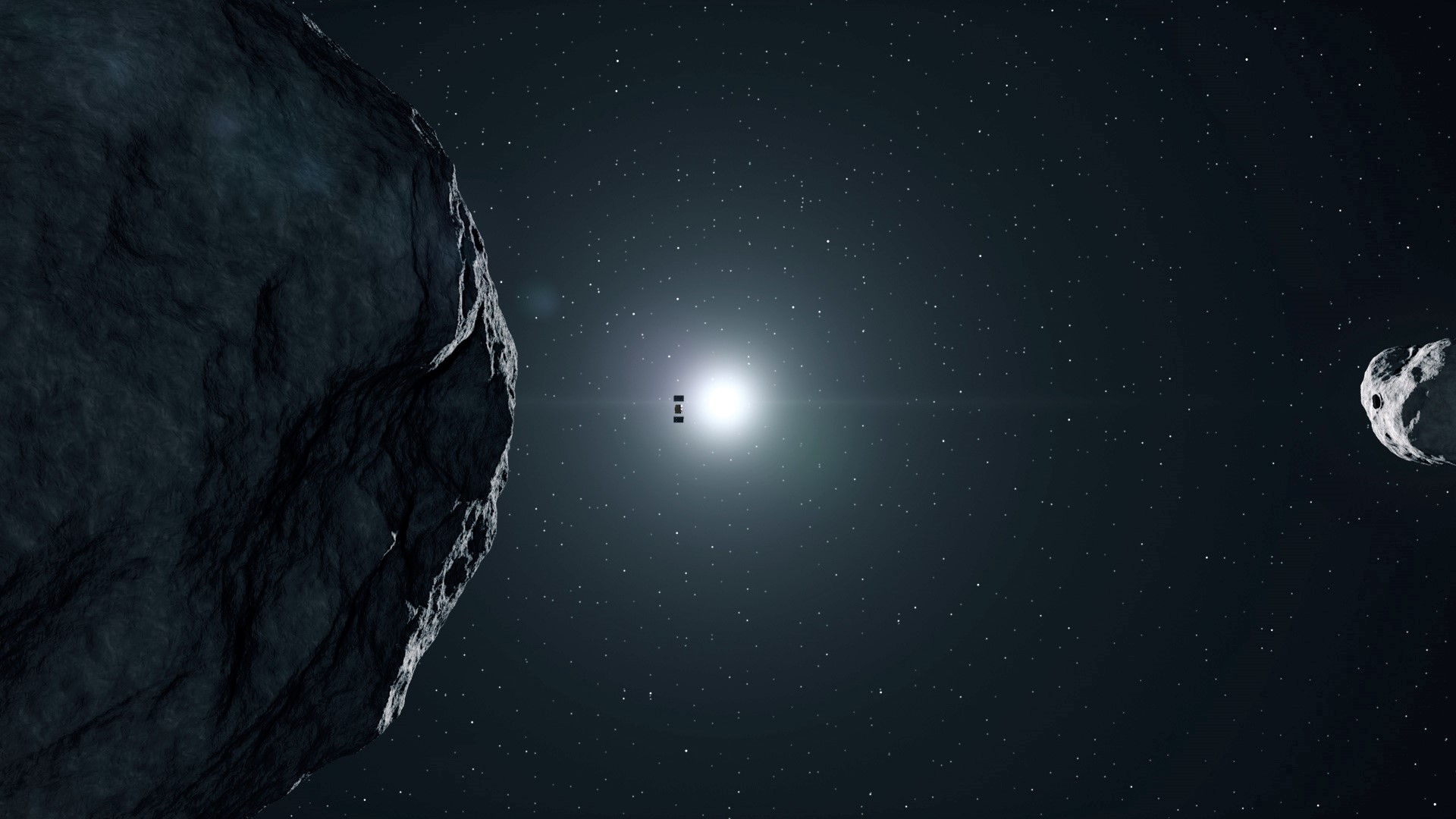
Four years after NASA deliberately rammed a spacecraft into a small asteroid to test whether a dangerous object could be nudged off a collision course with Earth, a European probe has finally gotten close enough to see the aftermath as something more than a single point of light. On the evening of October 18, the European Space Agency's Hera spacecraft used its monochrome Asteroid Framing Camera to take a picture, from about 1,280 kilometers out, in which the smaller asteroid Dimorphos appears as a separate speck beside its larger companion, Didymos, rather than as one indistinguishable blur. The agency announced the image on October 27, describing it as "first light" for the mission's final approach.
The picture is unremarkable to look at. Dimorphos occupies roughly a single pixel. But it is the first time Hera's cameras have separated the two bodies of the binary system it was built to study, after an earlier sighting on October 7 — exactly two years after launch — showed Didymos only as a single unresolved point of light from about 236,500 kilometers away. Didymos measures roughly 780 meters across, a little smaller than Dubai's Burj Khalifa; Dimorphos is about 151 meters wide, close to the footprint of the Great Pyramid of Giza, and the two orbit each other at an average separation of 1.15 kilometers, with Dimorphos creeping around its parent at about 18 centimeters per second. To get the new image, Hera fired its thrusters twice over the preceding two weeks, braking to within about 20 meters per second of the asteroid pair's own velocity.
"With this image the smaller Dimorphos asteroid becomes visible for the first time," said Michael Küppers, Hera's project scientist, while mission manager Ian Carnelli added: "For the very first time we are seeing through Hera's own eyes."
A rehearsal four years in the making
Dimorphos is not an ordinary asteroid. On September 26, 2022, NASA's DART spacecraft intentionally struck it at roughly 6.1 kilometers per second, flinging up a debris plume that stretched some 10,000 kilometers and marking the first time humans had deliberately altered the path of a celestial body. A NASA announcement weeks after the impact confirmed the asteroid's orbit around Didymos had shortened by roughly half an hour, comfortably clearing the mission's minimum bar for success. A more detailed reconstruction published in 2024 in The Planetary Science Journal narrowed that figure to 33 minutes and 15 seconds, with an uncertainty of only a few seconds — a precision that a companion study from NASA's Jet Propulsion Laboratory called unexpectedly tight, given how little was known beforehand about the asteroid's shape or composition.
DART itself was destroyed on impact and sent back no pictures of the crater it left or of Dimorphos's interior. That gap is what Hera, launched in October 2024 as the European half of the joint NASA-ESA Asteroid Impact and Deflection Assessment collaboration, was built to close. Where DART tested whether a kinetic strike works, Hera is meant to measure, in forensic detail, why it worked as well as it did — data that mission planners say is essential before any similar deflection is attempted against an asteroid that is actually headed for Earth.
What the spacecraft is looking for
Hera carries twelve instruments and two shoebox-sized companion probes, Milani and Juventas, which it will release once it reaches the asteroid pair. According to ESA's description of the deep-space CubeSats, Milani will map the mineral composition of the asteroids' surfaces with a hyperspectral imager, while Juventas will use ground-penetrating radar to probe up to 100 meters into Dimorphos's interior — something no previous mission has attempted on an asteroid this small. Both are designed eventually to attempt a landing.
The underlying scientific puzzle is still open. Researchers have never directly measured Dimorphos's mass or internal structure, both of which govern how much momentum a given impact transfers — and therefore how reliable kinetic deflection would be as a planetary-defense tool. A separate 2024 analysis found that the asteroid's own reshaping after the DART strike, as loosened material resettled under weak gravity, likely accounted for roughly two of those 33 minutes on its own, meaning the impact's efficiency was higher, and harder to predict from physics alone, than mission planners had modeled in advance.
What comes next
ESA says Hera is scheduled to deliver its first detailed, close-up images of Dimorphos on November 25, after continuing to close the distance over the coming weeks. From there, the spacecraft begins what mission staff have called a "crash site investigation," combining camera, radar, laser-altimeter and spectrometer data to reconstruct the crater DART left behind and to pin down the asteroid's mass directly, something ground-based telescopes have not been able to do with confidence. The CubeSats are expected to attempt their landings later in the mission.
The findings will feed directly into Europe's next planetary-defense effort. RAMSES, a mission approved by ESA's member states in November 2025 and built on a near-identical copy of Hera's own spacecraft design, is due to launch in 2028 to intercept the asteroid Apophis shortly before that object's close pass by Earth in April 2029 — a flyby that will bring a 340-meter asteroid closer to Earth than many communications satellites. Whatever Hera learns about how cleanly, and how unpredictably, a small asteroid responds to being struck or disturbed will shape how seriously, and how early, scientists plan to intervene the next time one is found heading toward Earth rather than past it.

Radio Images Show Betelgeuse's Hidden Companion Disturbing the Supergiant's Atmosphere

Risk-taking tracks leadership in both humans and chimpanzees, study finds
Physicists Achieve First Clear Demonstration of "Helicon" Current Drive in a Fusion Reactor
