Feather preserved in dinosaur droppings may explain why some birds survived the asteroid impact
A 66-million-year-old coprolite from Montana holds the remains of a diving bird eaten by a tyrannosaur, and its mix of primitive and modern feathers offers a new clue to why some avian lineages survived the extinction that killed off the dinosaurs.
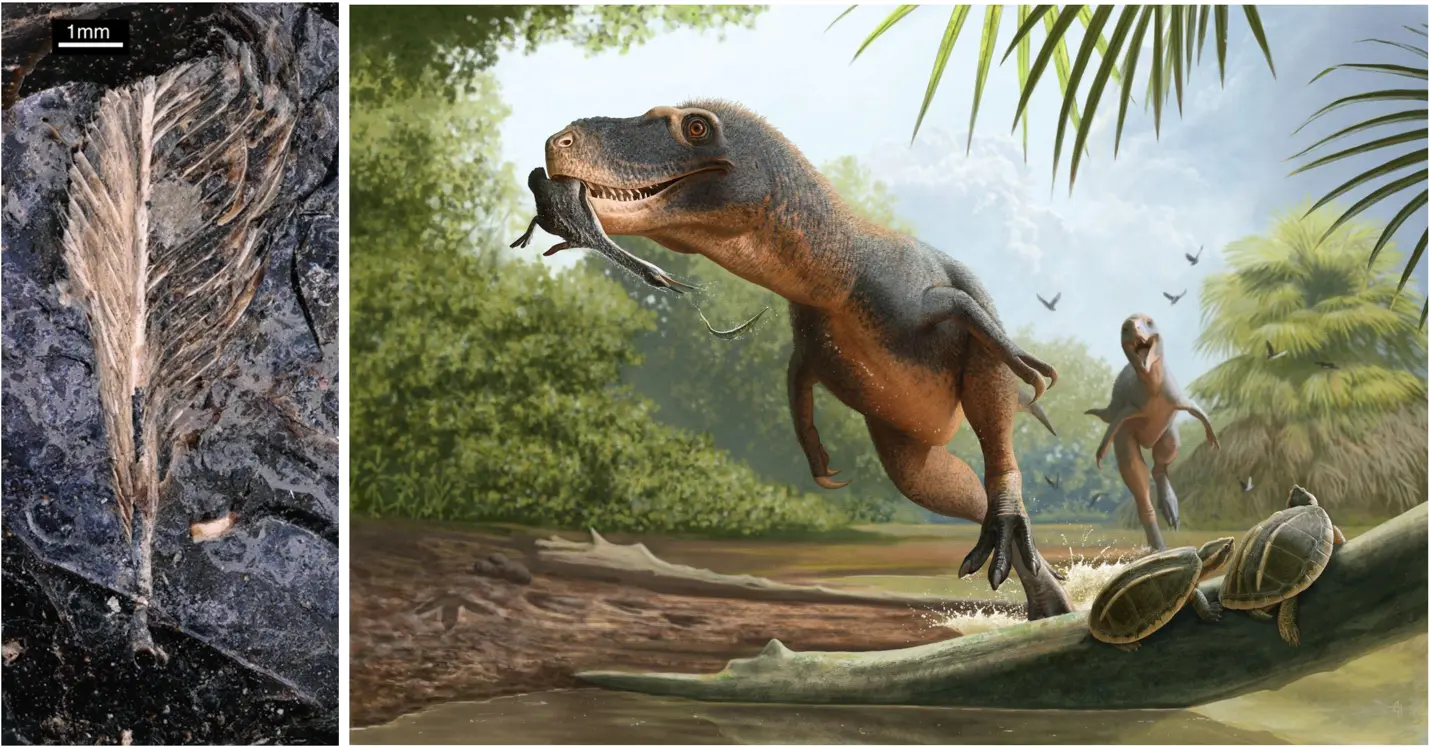
A decade after a paleontologist picked up an unremarkable, cherry-sized nodule in the badlands of northeastern Montana, researchers have determined that it is fossilized dinosaur droppings containing the most detailed bird feathers ever recovered from the Age of Dinosaurs. The find, described in a paper published in Current Biology, is the first fossil feather ever identified inside a coprolite, and its authors say it may help explain why the ancestors of today's birds survived the asteroid impact that wiped out the rest of the dinosaurs 66 million years ago while several other bird lineages did not, a finding also covered by NPR this week.
The specimen was found in 2016 by David DeMar Jr., a research scientist and collections manager of the Hell Creek Project at the University of Washington's Burke Museum, while he was surveying a rock outcrop in the Hell Creek Formation for fish fossils. A dark, reddish-brown nodule caught his eye, and a hand lens revealed a tiny feather pressed into its surface. It took years of subsequent analysis, led by Jingmai O'Connor, an associate curator of fossil reptiles at the Field Museum in Chicago, to establish what the object actually was and what it contained.
A predator's discarded meal
Micro-CT scanning allowed the research team to build three-dimensional digital models of the nodule's interior without cutting into the fossil. The scans showed it was a coprolite — fossilized feces — containing multiple feathers, scales from a gar fish, and leg bones from a hesperornithiform, an extinct, loon-like diving bird that lived alongside the last non-avian dinosaurs. The researchers concluded that a large theropod, probably a Tyrannosaurus rex or the smaller, closely related Nanotyrannus, had eaten the diving bird and later expelled its indigestible remains, preserving them in a form of fossilization no one had previously thought to search for feathers in.
"It's such a beautiful, well-preserved feather, from such an unexpected source, and it's exciting that it could help us answer this huge question in paleontology," said O'Connor, the study's lead author. "As far as I know, no one has ever thought to look for feathers or to study feathers in coprolites."
Nate Carroll, a co-author affiliated with the Carter County Museum in Montana who processed the scan data, described watching the hidden contents of the nodule emerge one layer at a time. Reconstructing the specimen digitally, he said, revealed "another feather, another scale, another bone — in stunning 3D" with each successive hour of analysis, according to the University of Washington's account of the research.
Modern feathers on an ancient bird
Two of the feathers stood out for reasons beyond their rarity. Under the scans, they showed a square-shaped shaft, or rachis, with a light, sponge-like interior — a structural combination that among Mesozoic fossils had previously been documented only in the immediate ancestors of living birds, and roughly 10 million years later in the fossil record than this specimen. That structure gives feathers strength while keeping them light, an efficient design that modern birds still rely on for flight and waterproofing.
Yet other feathers preserved in the same coprolite, evidently from the same individual bird, were smaller, downy and structurally primitive, resembling the fuzzy body coverings of earlier feathered dinosaurs rather than the sleek plumage of living birds. Gregory Wilson Mantilla, a University of Washington biology professor and co-author, said the mix captured in one fossil offers a rare, direct glimpse of a predator-prey encounter from 66 million years ago, preserved down to the level of individual feather structure. David DeMar, who found the specimen, noted that this was the first time such modern feather anatomy had turned up in a fossil from the Mesozoic era at all, let alone in a hesperornithiform, a group that had never previously yielded a preserved feather.
A possible clue to who survived the impact winter
The mix of primitive and modern feather traits matters because hesperornithiforms did not survive the mass extinction that ended the Cretaceous period, even though the lineage that became modern birds, known as Neornithes, did. A separate group of Mesozoic birds, the enantiornithines, also died out. O'Connor and her co-authors argue that differences in feather insulation, and possibly in molting patterns, between these lineages may have been one factor determining which birds could endure the prolonged cold and darkness that followed the Chicxulub asteroid impact, sometimes called an impact winter, and which could not.
The hypothesis is offered cautiously. The paper's authors note that a single, exceptionally preserved specimen cannot settle the question of why the extinction was so selective among bird lineages, and they describe feather quality as one plausible contributing factor rather than a proven cause. Confirming the idea will require comparable feather specimens from other Late Cretaceous birds, which remain exceedingly rare.
An overlooked source of fossils
The discovery also points to a gap in more than 150 years of fossil collecting in the Hell Creek Formation, a fossil-rich expanse of Montana, North Dakota, South Dakota and Wyoming that has produced dinosaur skeletons by the hundreds but, until now, no directly preserved feathers. Coprolites, the authors suggest, may protect delicate organic material such as feathers from the scavenging, weathering and decay that typically destroy it before it can fossilize in open rock, making dinosaur droppings an unexpected but potentially valuable place to keep looking. The specimen is now on public display at the Burke Museum, in an exhibit on the end of the Cretaceous period, as researchers continue combing existing coprolite collections for other overlooked feathers, a search that specialist outlets such as Sci.News are already tracking closely.
Physicists Measure Gravity's Effect on a Falling Atom's Quantum Wave for the First Time

Nighttime light exposure linked to structural changes in the heart, large UK study finds

New supercomputer simulations suggest the Moon could have formed intact within five hours
