Four Volunteers Mark One Year Sealed Inside NASA's Simulated Mars Habitat
With less than two weeks left in a 378-day analog mission at Johnson Space Center, NASA says the Houston crew's isolation data will help shape how real astronauts might one day live on Mars.
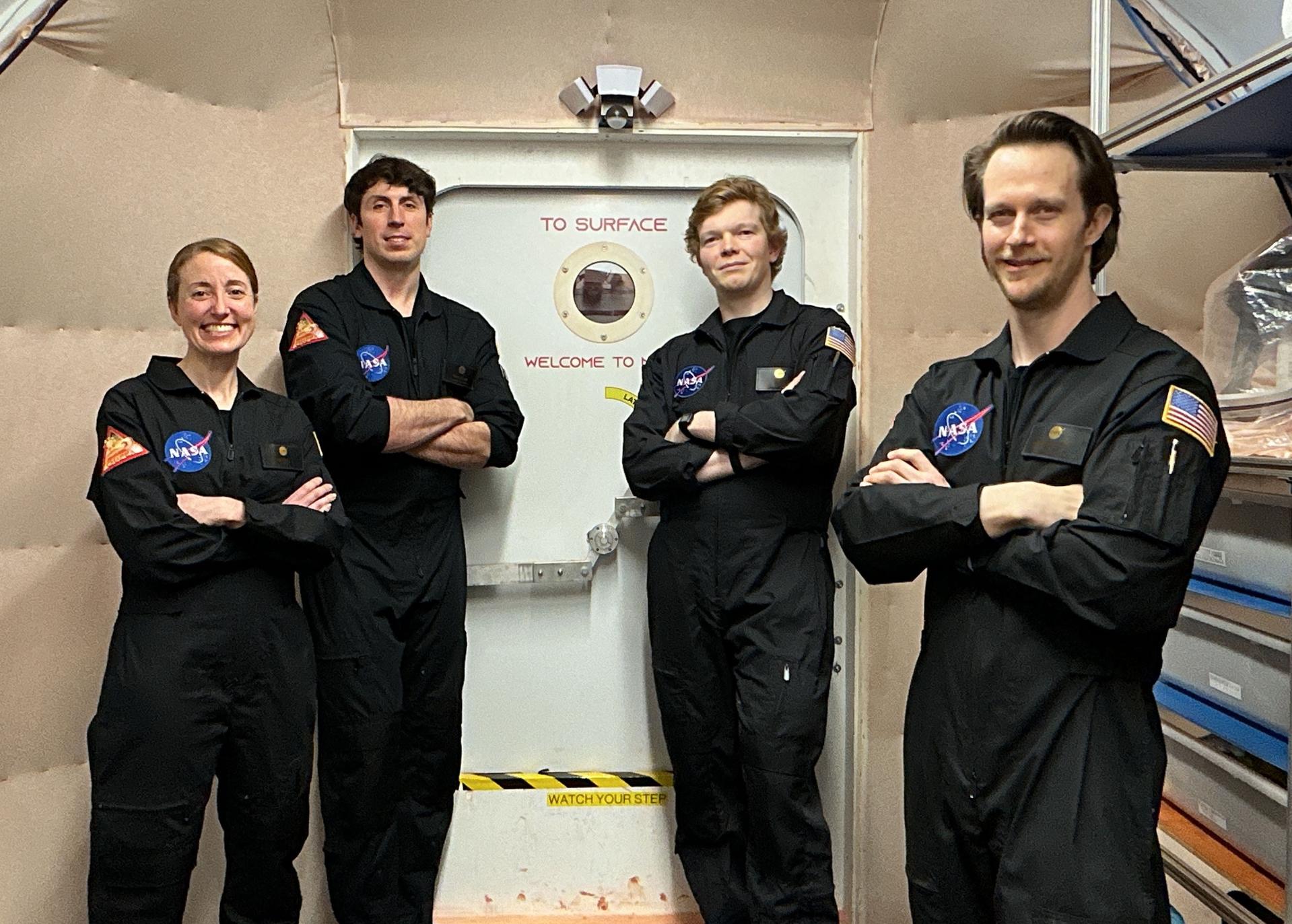
Four volunteers inside a windowless, 3D-printed building at NASA's Johnson Space Center in Houston have not set foot outside or spoken with a family member in real time in a year. For the past 365 days, mission commander Ross Elder, medical officer Ellen Ellis, science officer Matthew Montgomery and flight engineer James Spicer have been living as though they were on Mars, and under NASA's simulation rules, they still are.
The four are nearing the end of CHAPEA Mission 2, the second of three planned yearlong analog missions NASA is running to study how isolation, confinement and the practical limits of a Mars expedition affect human health and performance. NASA marked the one-year point of the crew's confinement on Monday in a release from its Human Research Program, noting that the crew has spent the past 365 days growing crops, rationing supplies, working through communication delays and carrying out suited spacewalks on a simulated Martian surface, all without leaving the building.
The numbers
The crew entered the habitat on Oct. 19, 2025, and is scheduled to remain there until Oct. 31, 2026, for a total mission length of 378 days. The structure they have been living in, known as Mars Dune Alpha, is a 1,700-square-foot, 3D-printed habitat built for NASA by the construction-technology company Icon in partnership with the architecture firm Bjarke Ingels Group. It contains four private crew quarters, a kitchen, a medical station, workstations, a crop-growing area and a shared common space, and its exterior is built to mimic the red sand and rock of the Martian surface.
- 378 days: total planned length of the mission, mirroring the time a Mars surface crew might spend isolated from Earth
- 1,700 square feet: size of the Mars Dune Alpha habitat at Johnson Space Center
- 45 minutes: the one-way communication delay NASA has built into the simulation, up to which the crew has had to manage decisions without quick guidance from Earth
- 4 crew members: Ross Elder, Ellen Ellis, Matthew Montgomery and James Spicer
Those numbers are meant to approximate what a real Mars crew would face. NASA has built the communication lag into the simulation rather than allowing the crew normal phone or video contact, and the agency says the resulting data could help it build decision-support tools for crews coping with long delays on an actual mission. Over the course of the year the crew has had only email contact with their families.
How we got here
CHAPEA, short for Crew Health and Performance Exploration Analog, grew out of NASA's need for data it cannot yet collect on an actual Mars mission, since no human has traveled beyond the Moon. The program's stated goal is to make the analog "as Mars-realistic as feasible," subjecting volunteer crews to resource limits, equipment failures, isolation and a heavy workload, then using the resulting health and performance data to shape food systems, vehicle design and crew-support standards for future missions.
The first CHAPEA crew, commanded by research scientist Kelly Haston and including structural engineer Ross Brockwell, physician Nathan Jones and microbiologist Anca Selariu, entered the same habitat on June 25, 2023, and emerged 378 days later, in July 2024, after a mission that an early account of the program's first crew had described as NASA's first attempt at a fully sealed Mars analog in a purpose-built habitat. Icon, the habitat's builder, has said its 3D-printing approach was chosen in part because a real Mars habitat would need to be built largely from local material rather than components shipped from Earth, a constraint the company's own account of the project says informed the habitat's design even though Mars Dune Alpha itself sits inside a Houston hangar.
Who is affected
The most direct effects fall on the crew members themselves, who have spent a year managing a Mars-like diet, exercise regimen and workload with no outside contact beyond email. But NASA's Human Research Program frames the real audience as future astronauts. The program says it uses ground analogs like CHAPEA, together with research aboard the International Space Station and data from Artemis missions, to study how spaceflight affects human bodies and behavior, with the goal of keeping crews healthy as exploration extends toward the Moon and Mars. Mission planners, nutritionists and engineers designing food and life-support systems for eventual Mars missions are the ones expected to draw most directly on the data the crew is generating.
Reaction
NASA officials have framed the milestone as a step toward understanding what long-duration missions will demand of both crews and mission support teams on Earth.
"We are extremely proud of the crew for their commitment and achievements over the last year on such a fast-paced, highly demanding mission," said Grace Douglas, CHAPEA's principal investigator. "The entire CHAPEA team is excited to congratulate the crew in person."
Michael Stenger, chief scientist for NASA's Human Research Program, said the mission's value lies less in any single data point than in combining realistic conditions with sustained measurement. "This mission has been incredibly valuable in starting to teach us how to understand requirements for year-long missions, including medical and psychological care, via communication delays," Stenger said, adding that pairing the Mars-realistic analog with physiological, psychological and performance measures in a controlled environment should let NASA "translate the knowledge from these experiences to Moon Base and beyond."
What happens next
The crew is scheduled to exit Mars Dune Alpha on Saturday, Oct. 31, ending the 378-day mission and allowing Elder, Ellis, Montgomery and Spicer to see their families in person for the first time in just over a year. NASA plans to livestream an egress ceremony marking their return. The crew will then spend two weeks in post-mission evaluations and debriefs with NASA scientists, who will use that period to assess how the group adapted to the mission's routines and stresses, including how limited food and exercise systems affected their ability to carry out tasks such as simulated spacewalks, and how well decision-support tools helped them cope with the communication lag.
CHAPEA Mission 2 is the second of three analog missions NASA has planned for the program; the first concluded in mid-2024, and NASA has indicated a third mission is expected at some point after this one wraps up, though the agency has not yet announced a start date or crew for it. The data from all three missions is intended to feed into planning for NASA's long-term human exploration goals beyond the Moon, as the agency continues to weigh what a real Mars expedition would require of the people sent to carry it out.
Century of Records Shows Europe's Wild Bees Losing Ground

Japan Launches Spacecraft to Bring Home a Piece of a Martian Moon

AI-Built Chemical Map Finds the Step Catalysis Models Were Missing