Hubble finds a ten-sided wave forming around Saturn's south pole
Astronomers have documented a new decagon-shaped jet stream pattern circling Saturn's south pole, the first large regular-sided structure ever seen in that hemisphere and a rare chance to watch such a feature form in real time.
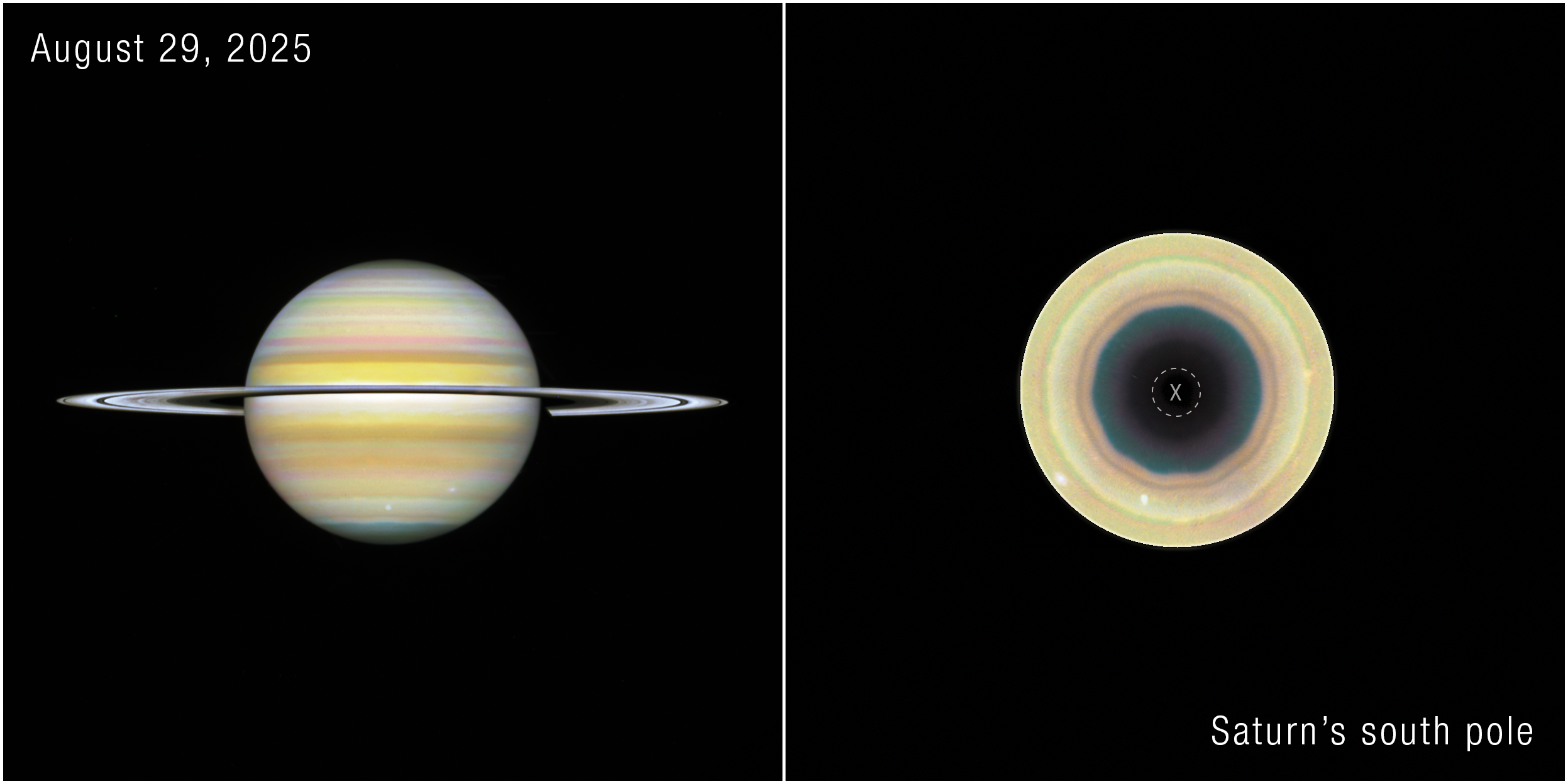
For four decades, Saturn's north pole has worn the same unmistakable signature: a six-sided jet stream, roughly hexagonal, that has churned steadily since it was first glimpsed in Voyager images in 1980 and formally identified in 1988. Its southern counterpart, by contrast, has never shown anything comparable. That changed this month. Astronomers using NASA's Hubble Space Telescope have confirmed a new, ten-sided atmospheric wave encircling Saturn's south pole, the first large, regular-sided jet pattern ever documented in the planet's southern hemisphere, according to a paper published September 3 in the journal Science Advances.
A decagon takes shape
The structure, described in the NASA Hubble mission announcement, sits near 63 degrees south latitude and traces a ten-vertex polygon around the pole, embedded in one of Saturn's fast-moving jet streams. The winds that sustain it move at roughly 400 kilometers per hour (about 250 miles per hour), and the wave is not a superficial cloud-top feature: it extends through multiple layers of Saturn's atmosphere, indicating a genuinely three-dimensional structure rather than a thin haze pattern. Researchers first caught a faint, ten-vertex outline in Hubble and ground-based images from October 2023. The shape sharpened by August 2024, and by August and September 2025 all ten vertices had become clearly and unevenly defined, according to reporting from Sci.News. The study's lead author is Agustín Sánchez-Lavega of the University of the Basque Country in Spain, working with Amy Simon of NASA's Goddard Space Flight Center, who serves as principal investigator of Hubble's Outer Planet Atmospheres Legacy program, and Michael Wong of the University of California, Berkeley.
Filling in a gap Cassini left behind
Saturn's northern hexagon is one of planetary astronomy's most durable curiosities: a six-sided standing wave that has held its shape since Voyager 2's flyby, surviving decades of seasonal change. Scientists had long wondered whether the south pole might host a mirror image, and NASA's Cassini spacecraft, which orbited Saturn from 2004 until it was deliberately steered into the planet's atmosphere in 2017, imaged the entire southern hemisphere without ever finding a comparably long-lived structure. That left a gap in the observational record just as Saturn's axial tilt carried its south pole out of view from Earth for roughly a decade. Hubble's long-running Outer Planet Atmospheres Legacy program, which has tracked Jupiter, Saturn, Uranus and Neptune annually for more than ten years through the Space Sciences Laboratory at UC Berkeley, picked up the pole again as it swung back into view. Amateur astronomers Trevor Barry and Jean-Paul Oger, contributing images through the Planetary Virtual Observatory and Laboratory network, were among the first to flag the subtle undulating band that Sánchez-Lavega and his colleagues then traced through years of higher-resolution Hubble data.
The timing matters because it means researchers caught the feature essentially as it formed, rather than encountering it fully developed. That is unusual in planetary science, where most named atmospheric structures, Jupiter's Great Red Spot among them, predate systematic observation by centuries.
Why atmospheric scientists are watching closely
The discovery matters most immediately to the community of planetary scientists who study jet streams and polar vortices on giant planets, a puzzle with implications well beyond Saturn. Understanding what forces a fluid, rotating atmosphere to organize itself into sharp-edged polygons, rather than smooth circular flow, bears on models of atmospheric dynamics used to interpret Jupiter's belts and storms and, increasingly, the atmospheres of giant exoplanets that cannot be observed directly with anything like Hubble's resolution. Because the decagon appears to still be strengthening rather than settling into a fixed state, it offers scientists something the static northern hexagon cannot: a live view of how such a pattern comes together in the first place, as reported by ScienceDaily's coverage of the findings.
"We've never seen anything quite like this in Saturn's southern hemisphere. The northern hexagon has been there every time we've looked for more than 40 years. This feature is different — it appears to be strengthening, giving us the rare opportunity to watch a giant atmospheric pattern develop," said Amy Simon of NASA's Goddard Space Flight Center.
Simon has also pointed to the puzzle the timing presents. "The most intriguing part to me is that this seems to have just formed recently. The question is, why did it suddenly form now when we haven't seen one before?" she said, according to the same NASA release. Sánchez-Lavega, the study's lead author, noted that the search itself long predates the discovery: researchers had been checking Hubble images for a southern counterpart to the northern hexagon since 1990, without success, given the symmetry one might expect between Saturn's north and south jet stream systems, a point covered in Live Science's report on the study.
Open questions and the next round of observations
Several basic questions remain unresolved. Researchers do not yet know what gives the wave its blue-tinted aerosols, nor how its structure changes as it extends deeper into Saturn's atmosphere below the layers Hubble can resolve. Wong, the Berkeley co-author, has suggested that a smaller anticyclonic vortex sitting just north of the decagon, near 55 degrees south, may have triggered the initial disturbance that a balance of atmospheric forces then locked into a stable ten-sided shape, though he has been careful to frame that as a hypothesis rather than a settled finding, saying the team needs more detailed three-dimensional simulations of the structure to know for sure.
The team plans to keep watching. Hubble's Outer Planet Atmospheres Legacy program will continue its annual monitoring of Saturn, tracking whether the decagon stabilizes into something as durable as its northern counterpart or instead evolves, weakens or dissipates over the coming Saturnian seasons, which each last roughly seven Earth years. Researchers also intend to bring the James Webb Space Telescope's infrared instruments to bear on the feature, which could reveal temperature and composition details invisible to Hubble's visible-light cameras, alongside new computer models aimed at reproducing how a jet stream organizes itself into sharp vertices in the first place. Whatever the answer, scientists now have, for the first time, a real-time record of a planetary-scale atmospheric pattern arriving rather than simply persisting, a rare vantage point that decades of hexagon-watching at the opposite pole never afforded them.
NASA Science — NASA's Hubble Tracks New Decagon Encircling Saturn's South Pole
Science Advances — A decagon wave around Saturn's south pole (Sánchez-Lavega et al., 2026)
UC Berkeley Space Sciences Laboratory — Decagon Wave Emerges Near Saturn's South Pole
ScienceDaily — NASA scientists discover a giant 10-sided pattern on Saturn

Feather preserved in dinosaur droppings may explain why some birds survived the asteroid impact

New supercomputer simulations suggest the Moon could have formed intact within five hours

NOAA Raises Odds of Historic-Strength El Niño to 75% for This Winter