Hubble Spots a New Ten-Sided Wave Circling Saturn's South Pole
Years of Hubble Space Telescope images have revealed a newly formed "decagon" encircling Saturn's south pole — the first large, regular-sided jet-stream pattern seen in the planet's southern hemisphere, and a possible, still-mysterious counterpart to its famous northern hexagon.
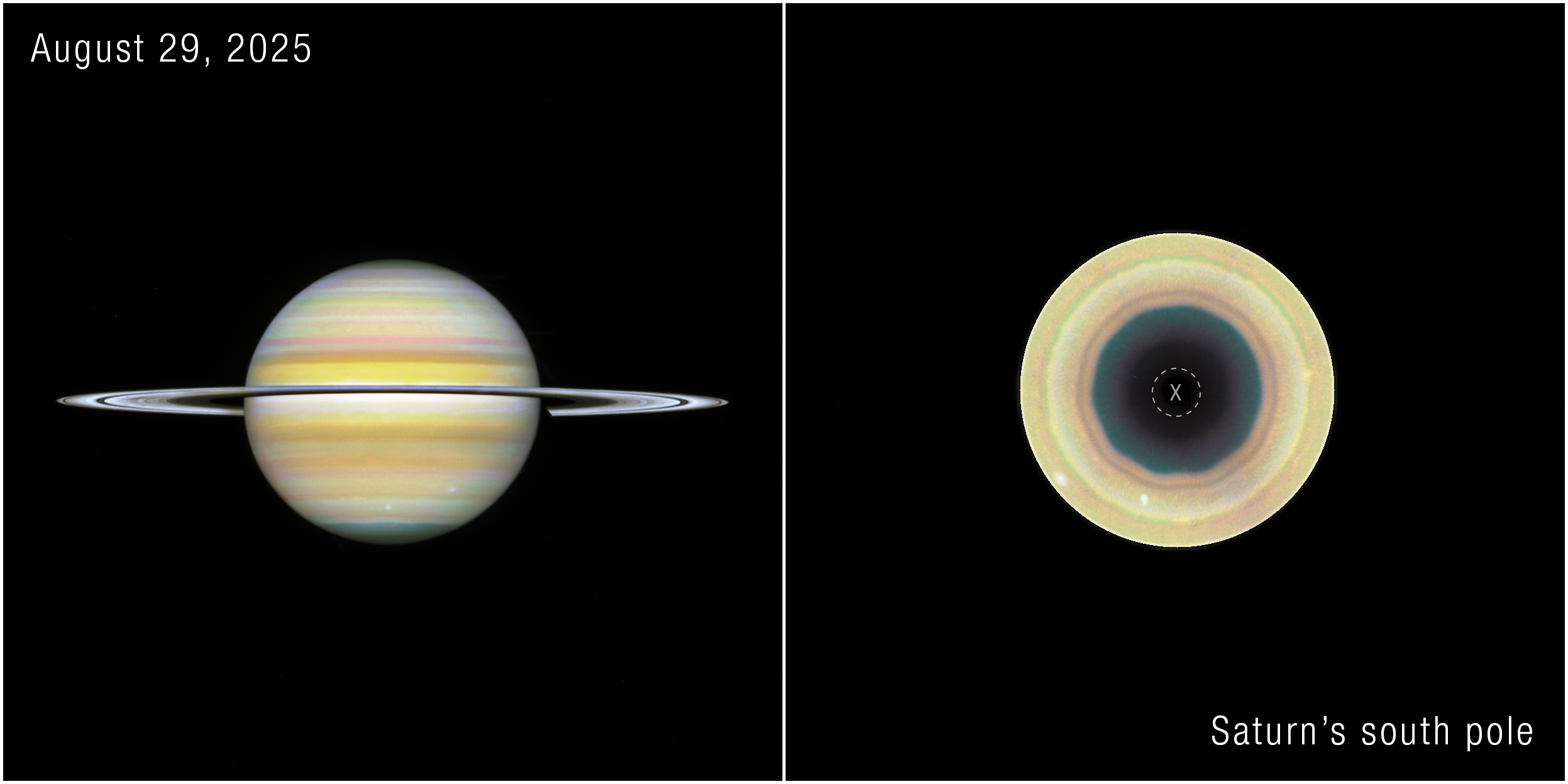
Astronomers using NASA's Hubble Space Telescope have identified a newly formed, ten-sided atmospheric wave encircling Saturn's south pole — the first large, regular-sided jet-stream pattern ever recorded in the planet's southern hemisphere. Informally dubbed a "decagon," the feature echoes the six-sided hexagon that has girdled Saturn's north pole for more than four decades, but researchers say the two structures differ enough that the new one may represent a distinct, still-developing phenomenon rather than a straightforward southern twin. The team published its findings Sept. 2 in the journal Science Advances, and NASA detailed the discovery in a release from Goddard Space Flight Center.
Led by planetary scientist Agustín Sánchez-Lavega of the University of the Basque Country in Spain, the international team pinned the wave to planetographic latitudes of roughly 58 to 63 degrees south, within one of Saturn's fast east-to-west jet streams. The jet itself races along at about 116 meters per second at 60.5 degrees south, but the decagon's ten vertices drift eastward far more slowly, at only about 2.5 meters per second, and oscillate in longitude on a roughly 32-day cycle with amplitudes of 4.6 to 8.4 degrees. The blue-tinted wave is visible in Saturn's upper troposphere, where winds blow near 400 kilometers per hour, and images taken through different Hubble filters show it extends through multiple atmospheric layers rather than sitting only at the cloud tops — evidence, the authors say, that it is a genuinely three-dimensional structure and not a superficial cloud pattern.
A pattern hidden in a decade of images
The discovery grew out of Hubble's Outer Planet Atmospheres Legacy (OPAL) program, which has photographed Jupiter, Saturn, Uranus and Neptune roughly once a year since 2018, filling a gap left when NASA's Cassini spacecraft ended its 13-year tour of the Saturn system with a planned dive into the planet's atmosphere in 2017. Cassini had imaged Saturn's south pole in 2004 and spotted a brief polygonal ripple in the jet at 60.5 degrees south, but that perturbation lasted only a few days and was never seen again before the mission ended, according to a University of California, Berkeley account of the research.
The trail picked back up in 2024, when Sánchez-Lavega spotted a subtle undulating band in ground-based images submitted by amateur astronomers Trevor Barry and Jean-Paul Oger to the Planetary Virtual Observatory Laboratory, a website the University of the Basque Country runs for citizen contributions. Additional ground images in 2025 strengthened the signal enough that Sánchez-Lavega brought the tip to the OPAL team, who dug back through Hubble's archive and found hints of the structure dating to 2023. Dedicated Hubble observations on Aug. 29, 2025, then resolved the decagon clearly across several wavelengths, the European Space Agency's imagery release shows.
Why a ten-sided jet stream matters
Saturn's northern hexagon, discovered in Voyager spacecraft data in the early 1980s, has remained a stable, six-sided fixture for more than 40 years even as its color has gradually shifted from blue toward gold. Laboratory experiments — spinning tanks of liquid at different rotation rates — can reproduce hexagon-like polygons, but scientists still do not fully agree on why Saturn settled on six sides specifically, or why the shape has proven so durable. A newly emerging, different-shaped counterpart at the opposite pole gives researchers a rare chance to watch such a pattern take shape in something close to real time, rather than reconstructing its origin after the fact.
The OPAL program's steady cadence has already turned up other slow-building changes on the outer planets: increasing wind speeds inside Jupiter's Great Red Spot, a brightening polar haze on Uranus, and, this past July, the full life cycle of a dark storm on Neptune. Saturn's decagon fits that pattern of discoveries that only become visible through years of repeated observation rather than a single flyby or snapshot, according to the Space Telescope Science Institute, which conducts Hubble's science operations for NASA.
"We've never seen anything quite like this in Saturn's southern hemisphere," said Amy Simon, OPAL's principal investigator and a study co-author at NASA's Goddard Space Flight Center. "The northern hexagon has been there every time we've looked for more than 40 years. This feature is different — it appears to be strengthening, giving us the rare opportunity to watch a giant atmospheric pattern develop."
Sánchez-Lavega said the team had been watching specifically for a southern counterpart to the hexagon since 1990, without success, until now. "Images from NASA's Cassini spacecraft, which orbited Saturn between 2004 and 2017, showed no inkling of a long-lived formation, either," he said. "The Hubble data confirmed the feature's presence back to 2023." Michael Wong, a study co-author at the University of California, Berkeley's Space Sciences Laboratory, credited the finding to the OPAL program's long-term design: "A lot of the discoveries we see coming from OPAL are not just based on one observation, but on years and years of data. Regular observations over time are enabling a lot of new findings."
What remains unexplained
The paper offers one clue to the decagon's origin without fully resolving it. The wave sits just south of a compact, isolated anticyclone vortex centered near 55 degrees south that Hubble first spotted in 2023. That vortex darkened abruptly in 2025, shortly before the decagon became clearly visible — a timing coincidence the authors flag as suggestive but not conclusive. "Perhaps the vortex caused the initial perturbation, and then the balance of forces caused the persistent decagon," Wong said. "We really need more detailed simulations of its 3-D structure to know for sure."
Sánchez-Lavega has already built a simplified shallow-water fluid model showing that decagon-like waves can emerge from turbulent, rotating flow, lending the vortex hypothesis some theoretical support. But several basics remain open: what aerosol chemistry gives the wave its blue color, how far down into Saturn's atmosphere the structure extends, and — the question Simon called the most intriguing of all — why a wave of this kind would suddenly appear now rather than at any point in the roughly three decades astronomers have been looking for one. The team says continued monitoring with Hubble and NASA's James Webb Space Telescope, paired with more detailed computer modeling, will be needed to determine whether the decagon settles into a hexagon-like fixture that persists for decades or proves to be a shorter-lived feature of a southern hemisphere now swinging back into view as Saturn's seasons shift.
Science Advances — A decagon wave around Saturn's south pole
NASA Science — NASA's Hubble Tracks New Decagon Encircling Saturn's South Pole
UC Berkeley Space Sciences Laboratory — Decagon wave emerges near Saturn's south pole
Space Telescope Science Institute — NASA's Hubble Tracks New Decagon Encircling Saturn's South Pole

ADHD Linked to Sharply Higher Rates of Gut Problems, Largest Review Finds
Physicists Measure Gravity's Effect on a Falling Atom's Quantum Wave for the First Time

Nighttime light exposure linked to structural changes in the heart, large UK study finds