James Webb telescope maps a lopsided exoplanet atmosphere for the first time
A new mapping technique applied to James Webb Space Telescope data shows the hot Jupiter WASP-17b's atmosphere bulges outward on its evening side, giving astronomers the first direct, point-by-point confirmation that heat and wind reshape a planet's air into a genuinely three-dimensional structure.
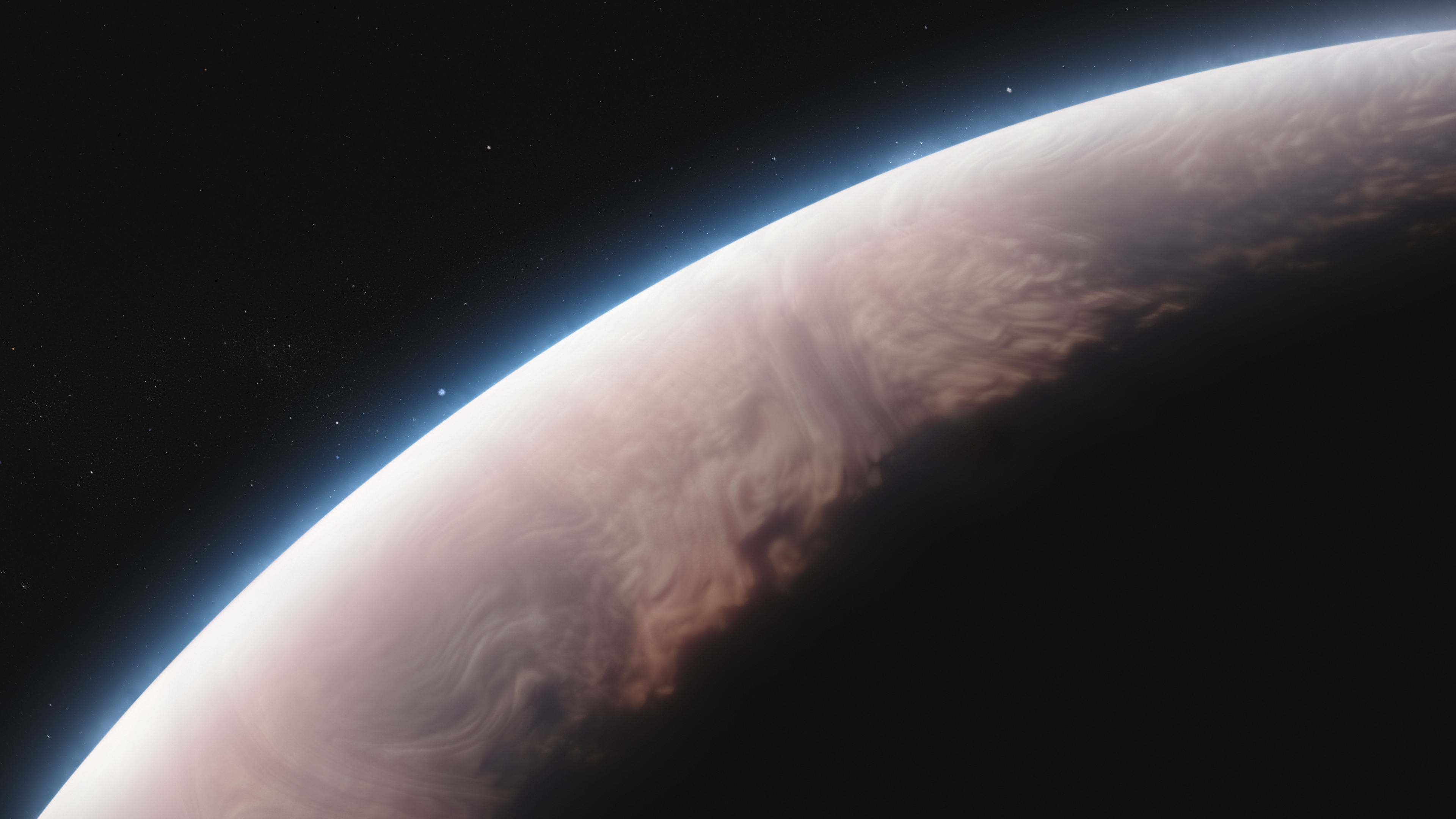
For more than two decades, astronomers studying the atmospheres of planets beyond our solar system have leaned on a convenient simplification: when starlight filters through a transiting planet's air on its way to Earth's telescopes, that air is treated as a uniform ring — the same thickness and temperature all the way around. A study published this week in Nature Astronomy shows that assumption breaks down for at least one well-studied world, and the technique the researchers used to prove it could change how scientists read the atmospheres of thousands of other planets.
A team co-led by astronomers at Cornell University and the University of Bristol used data from NASA's James Webb Space Telescope to map, point by point, the atmosphere of WASP-17b, a scorching gas giant roughly 1,300 light-years from Earth. Rather than the smooth, featureless circle most models assume, the planet's atmosphere turned out to be subtly egg-shaped, bulging outward on the side facing its oncoming evening and pinched in on the side facing its morning — the clearest direct evidence yet that heat and wind physically reshape a planet's air into something genuinely three-dimensional.
A ring resolved into its parts
WASP-17b is tidally locked to its star, meaning one hemisphere bakes in permanent daylight while the other sits in permanent night, with a "morning" terminator and an "evening" terminator in between, much as Earth has twilight zones that circle the globe. As the planet passes in front of its star, starlight grazes through these different limb regions in sequence, but conventional analysis has long averaged all of that light into a single transmission spectrum, erasing any differences between one side of the planet and the other.
The new study applies a technique called "transmission strings," developed at Bristol by David Grant and Hannah Wakeford, that instead tracks how the starlight's spectrum changes continuously as the transit unfolds, effectively slicing the ring into separate arcs rather than collapsing it into one average. "Rather than assuming your atmosphere is a circle with the same radius all the way around, we've gone from a ring to understanding where on the ring the gemstones are, so to speak," said Lili Alderson, a Klarman Postdoctoral Fellow at Cornell and the study's lead author, who did her doctoral work at Bristol.
The approach let the team recover separate readings for the morning and evening limbs of WASP-17b for the first time, rather than a single blended signal. WASP-17b was already a familiar target for atmosphere hunters: when it was discovered in 2009 by the ground-based SuperWASP (Super Wide Angle Search for Planets) survey, its inflated size made it one of the largest exoplanets known, and it has since become a flagship test case for Webb's ability to pick apart exoplanet chemistry in fine detail.
- Distance from Earth: roughly 1,300 light-years, in the constellation Scorpius
- Planet type: a "hot Jupiter," among the largest and puffiest exoplanets known, roughly twice Jupiter's radius
- Data source: NASA's James Webb Space Telescope, via the Telescope Scientist Team's DREAMS observing program
- Exoplanets confirmed to date, for context: more than 6,000
Winds that drag heat around a scorched world
WASP-17b has drawn scientific attention before. In 2023, a Webb-led team reported quartz nanocrystals high in its clouds — the first detection of silica particles in any exoplanet's atmosphere. The new mapping builds on that same Webb dataset to ask a more basic question: does the planet's air behave like the idealized sphere in a textbook diagram, or something messier?
The answer, the authors say, matches decades of theoretical circulation models but had never been confirmed directly. Because WASP-17b's dayside is perpetually blasted by starlight, powerful equatorial jet winds sweep that heat eastward, toward the evening terminator, before it has a chance to radiate away. That piles up extra heat — and, the team finds, extra atmospheric puffiness — on the planet's evening side, while the morning limb, which has had a full nightside's worth of time to cool, stays comparatively compact and chilly.
"Planets are temperamental, their atmospheres complex and chaotic," said Hannah Wakeford, an associate professor of astrophysics at the University of Bristol and a co-author of the study. "Having this very robust mathematical model that we can apply to this state-of-the-art data is incredibly exciting."
Alderson said the result is less a surprise than a long-awaited confirmation. "Theory predicts that the morning and the evening sides should have a strong temperature difference," she said, and the Webb data bear that prediction out in a planet-by-planet, limb-by-limb way that earlier instruments could not deliver.
Why a lopsided atmosphere matters
The finding matters less for WASP-17b itself — an uninhabitable gas giant unlikely to ever be visited — than for what it says about the limits of current atmospheric modeling across the broader exoplanet catalog. With more than 6,000 confirmed planets now cataloged by NASA's exoplanet-tracking programs, and a large fraction of the best-studied ones being tidally locked hot Jupiters like this one, researchers who fit single, averaged spectra to their data may be smoothing over real physical structure, potentially skewing estimates of temperature, chemistry and cloud coverage.
That has consequences for how astronomers interpret Webb's growing library of exoplanet spectra generally. Many of the molecular and cloud detections reported over the past few years — including the quartz clouds found on this same planet — were derived from the kind of averaged, ring-as-a-circle spectra the new study says can mask real asymmetries. Refining those models with limb-resolved data could sharpen future estimates of a planet's composition and climate, including eventually for smaller, cooler worlds where the day-night contrast bears more directly on questions of habitability.
The team notes the approach is a genuine methodological advance rather than an incremental tweak: earlier efforts to probe day-night differences relied mainly on "eclipse mapping," which reads a planet's heat signature as it disappears behind its star, a technique that works for emitted light but cannot resolve the transmitted starlight spectra that reveal atmospheric chemistry. Transmission strings extends that resolving power to the transit itself, and the authors report that the measured temperature split between the two limbs lines up with what atmospheric circulation models have predicted for tidally locked gas giants for more than a decade, giving modelers their first direct observational check on those simulations.
What happens next
The WASP-17b analysis was carried out under Webb's DREAMS Guaranteed Time Observations program, which is continuing to gather multi-instrument spectra of hot Jupiters specifically to stress-test atmospheric models like this one. The Bristol and Cornell groups say they intend to apply the transmission-strings technique to additional transiting planets in the Webb archive to see how common lopsided, wind-sculpted atmospheres turn out to be, and whether the degree of asymmetry tracks predictably with a planet's temperature, rotation or host star.
Longer term, the authors see the method as a template rather than a one-off result: a tool for turning Webb's transit data, planet by planet, from flat averages into the kind of three-dimensional pictures atmospheric scientists have long produced for Earth and other solar-system planets. The work was supported by NASA, the UK's Science and Technology Facilities Council and Cornell's Klarman Fellowship program.

A common salt mineral could preserve signs of life inside Enceladus's ocean, study finds

NASA's Roman telescope sharpens its focus, outperforming its own design requirements

New York City's natural gas losses traced to furnaces and boilers, not pipeline leaks, study finds
