Long-Predicted "Backsplash" Galaxies May Have Finally Been Found Near the Pinwheel
A paper in The Astrophysical Journal, written by a University of California, Berkeley freshman who began the project in high school, reports three faint, starless dwarf galaxies near the Pinwheel Galaxy — two of them candidates for a population long predicted by simulations but never confirmed nearby.
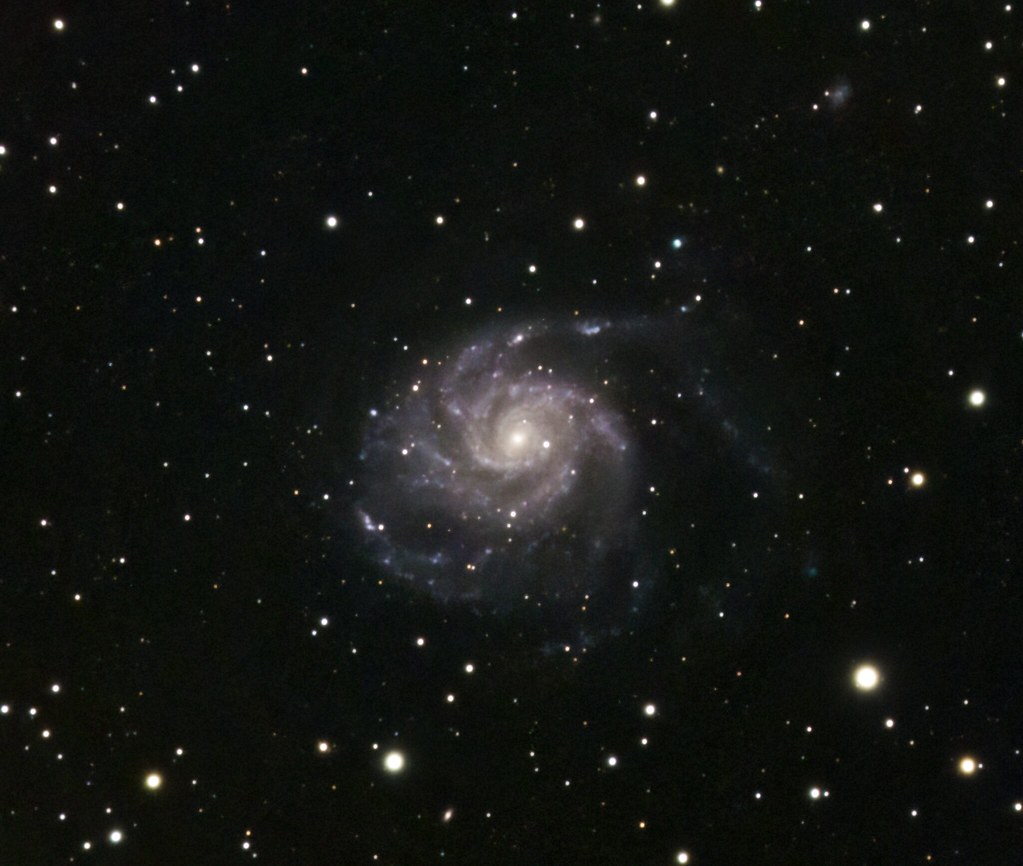
A paper published this week in The Astrophysical Journal describes three faint dwarf galaxies near the Pinwheel Galaxy that appear to have stopped forming stars long ago despite sitting far from any obvious neighbor capable of stripping their gas. Two of the three are strong candidates for "backsplash" galaxies, a population long predicted by cosmological simulations but never clearly confirmed in the nearby universe. The paper has a single author: Julian Shapiro, who began the analysis as a high school student in New York and has since enrolled at the University of California, Berkeley, where he is now a first-semester undergraduate studying astrophysics.
The galaxies, cataloged as Shapiro DG-I, DG-II and DG-III, sit roughly 6.7 megaparsecs from Earth, in the vicinity of the spiral galaxy M101, also known as the Pinwheel Galaxy. Shapiro estimated their absolute brightness at magnitudes of roughly -7.3 to -8.1, among the faintest dwarf galaxies ever cataloged outside the Local Group, with half-light radii of 110 to 140 parsecs. None of the three turned up in ultraviolet imaging from NASA's Galaxy Evolution Explorer mission, and DG-I showed no detectable hydrogen-alpha emission either, both signs that star formation shut off long ago rather than recently.
A galaxy that was stripped bare and flung away
Cosmological simulations built on the standard model of cold dark matter, often called Lambda-CDM, predict that a sizable fraction of small galaxies near a large spiral should be "backsplash" objects: dwarfs that fell toward a massive host billions of years ago, had their gas torn away by ram pressure and tidal forces during a close pass, and were then flung back out to large distances. The result, billions of years later, is a galaxy that looks isolated and long dead even though its quiescence actually traces back to a violent encounter with a more massive neighbor.
Confirming such objects has proven difficult. Measuring precise distances to extremely faint dwarf galaxies is hard, and even when a candidate is identified, ruling out competing explanations, such as star formation suppressed by the ultraviolet background of the early universe or by diffuse heating in the cosmic web, requires careful work on stellar populations and orbital history. Shapiro's approach was to mine archival deep-imaging data from the Canada-France-Hawaii Telescope Legacy Survey and the Subaru Hyper Suprime-Cam survey, subtracting smooth models of brighter foreground and background galaxies to expose faint, resolved stellar populations, then applying surface-brightness-fluctuation techniques to estimate distances to the candidates. The preprint version of the study is explicit that the backsplash classification remains provisional: DG-II could instead be an undiscovered satellite of the nearby galaxy NGC 5585, and the author writes that confirming any of the three as true backsplash galaxies will require follow-up imaging with the Hubble Space Telescope or the James Webb Space Telescope.
Why cosmologists are paying attention
The finding bears on what astronomers call the missing satellites problem: dark-matter-only simulations predict many more small satellite galaxies around large spirals than observers have actually found. Backsplash galaxies complicate that accounting further, because a dwarf that has been slung far from its parent halo can be mistaken for a truly isolated, independently formed galaxy. A confirmed local population would give cosmologists a rare nearby laboratory for testing Lambda-CDM's predictions about how small galaxies are stripped, ejected and quenched, work that so far has rested almost entirely on simulations rather than direct observation.
"My paper argues that they may be among the first resolved 'backsplash' galaxy candidates," Shapiro said of the discovery, adding that he hopes the project will serve "as inspiration for young people aspiring to pursue research in astrophysics."
Alex Filippenko, the University of California, Berkeley astronomer whose research group Shapiro has since joined, said the scope of the work was unusual for its author's age at the time. "Julian conducted some remarkably sophisticated research while still in high school, which is highly unusual," Filippenko said, a reference to a project that also earned Shapiro a 2026 Davidson Fellowship, one of the most selective awards for pre-college research in the United States.
A student researcher with a track record
Shapiro's work on M101's surroundings was not his first contribution to observational astronomy. While conducting a survey of emission-line objects along the galactic plane, he is credited with discovering several new planetary nebulae and supernova remnant candidates, including one now cataloged as Shapiro-1, which made him, by several accounts, the youngest person to have discovered a planetary nebula. That record, built largely from archival and amateur-accessible data rather than dedicated telescope time, won him the Astronomical League's National Young Astronomer Award in 2025 before he had finished high school at the Dalton School in Manhattan, according to a university account of his research.
The M101 satellite search followed the same pattern: rather than proposing for new observations, Shapiro worked through public imaging archives, using simulations to predict where backsplash dwarfs were most likely to be found and where existing survey data might be deep enough to detect them. Much of the analysis, he has said, went into pinning down distances precise enough to establish that the three dwarfs are genuinely isolated rather than close companions of some brighter, uncataloged galaxy.
What comes next
The paper's own conclusions are cautious. Provisional distances and the absence of recent star formation are consistent with a backsplash history, but the author writes that the candidates cannot yet be distinguished from dwarfs quenched by other means, and that space-based imaging will be needed to measure their stellar populations and orbital histories with enough precision to settle the question. Ground-based spectroscopy and deeper imaging are the near-term priorities.
Looking further out, Shapiro and other dwarf-galaxy researchers are counting on the Vera C. Rubin Observatory in Chile, whose decade-long Legacy Survey of Space and Time is expected to image faint, low-surface-brightness objects across a far larger volume of the nearby universe than any single archival survey used so far. If backsplash galaxies are as common as simulations suggest, that survey should turn up many more candidates around other nearby spirals, turning what is now a handful of provisional detections into a statistical sample that can be checked directly against Lambda-CDM's predictions. Shapiro, for his part, is continuing the follow-up observations of the three dwarfs while also working with Filippenko's Berkeley group on research related to the Hubble tension, a separate and long-running dispute over the universe's present expansion rate.

Europe's New Climate Satellite Sends Back Its First Images

Margaret Hamilton, Software Pioneer Behind the Apollo Moon Landings, Dies at 90

An enormous, recurring cloud on Mars reveals a new way ice can form
