Newly found star orbits so close to the Milky Way's black hole that it could reveal its spin
Astronomers using ESO's Very Large Telescope Interferometer have identified the fastest, closest-orbiting star yet seen around the Milky Way's central black hole, giving researchers a rare chance to directly measure how fast Sagittarius A* rotates.
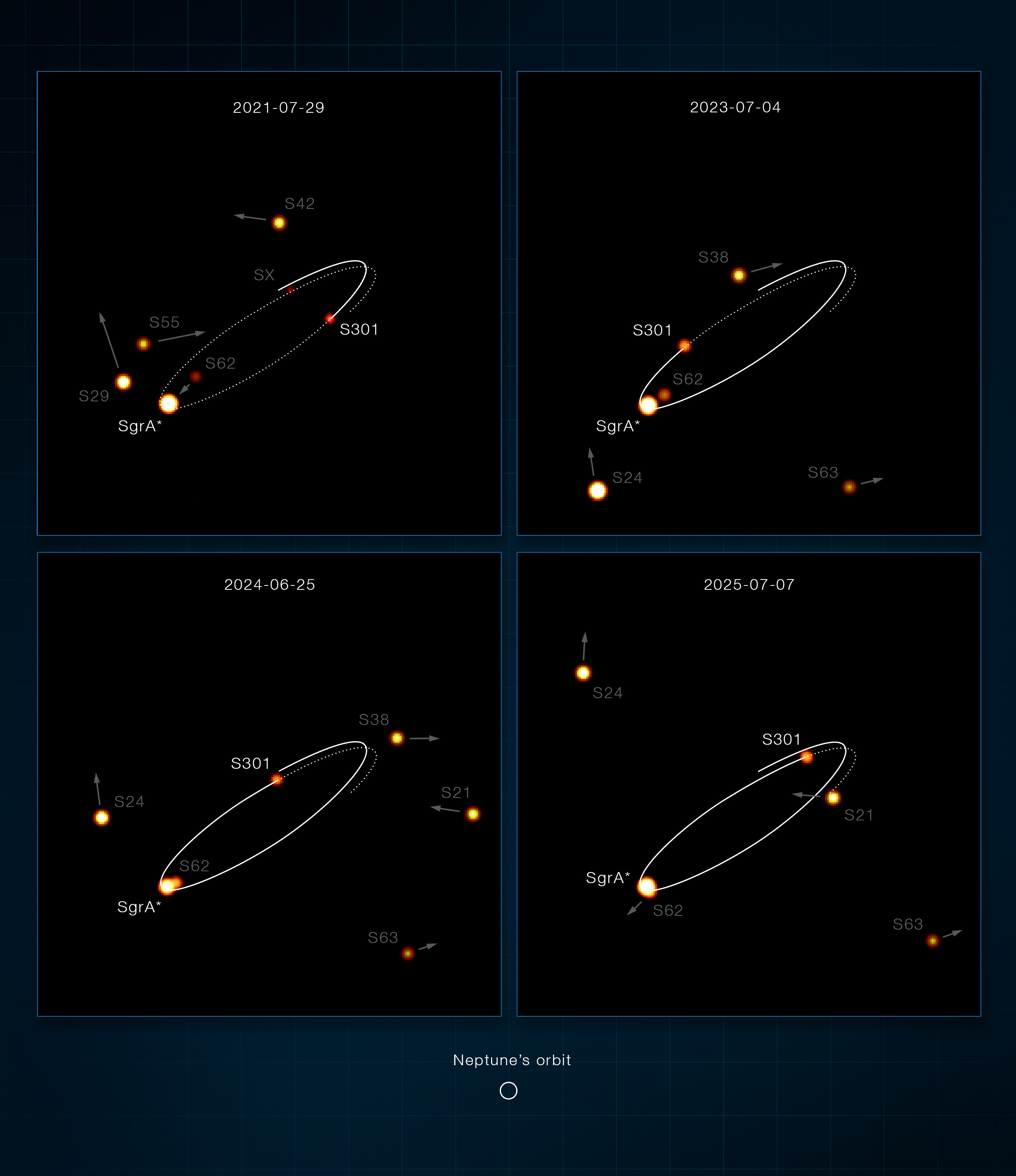
A team of European astronomers has discovered the fastest-moving star ever recorded in the Milky Way, one that swings so close to the supermassive black hole at the galaxy's center that its orbit is being warped by the black hole's own rotation. The discovery, announced by the European Southern Observatory, gives astrophysicists their first realistic shot at directly measuring the spin of any supermassive black hole.
The star, designated S301, was found orbiting Sagittarius A*, the roughly 4-million-solar-mass black hole that anchors the center of our galaxy. At its closest approach, S301 reaches speeds of about 25,000 kilometers per second — close to 8 percent of the speed of light — making it the fastest star ever tracked in the Milky Way. It completes one lap around the black hole in just 8.7 years, passing within roughly 12 astronomical units, about the distance of Saturn from the sun.
A star sensitive to the black hole's spin
No star has ever been observed orbiting this close to Sagittarius A*. That proximity matters because, according to general relativity, a spinning black hole drags the fabric of spacetime around with it — an effect known as frame dragging. A star orbiting far enough away is essentially blind to that dragging. One orbiting close enough, however, has its path perceptibly nudged by it, and S301 is the first star found close enough for the effect to be measurable.
The findings, published in the journal Nature, come from the GRAVITY+ Collaboration, an international group centered at the Max Planck Institute for Extraterrestrial Physics in Germany. The star was detected using the GRAVITY+ instrument on ESO's Very Large Telescope Interferometer (VLTI) at the Paranal Observatory in Chile's Atacama Desert, which combines light from four separate 8-meter telescopes to achieve a resolution roughly 15 times sharper than any single one of them could manage alone.
- Peak orbital speed: about 25,000 km/s, roughly 8 percent of the speed of light
- Orbital period: 8.7 years, the shortest known for any star around Sagittarius A*
- Closest approach: about 12 astronomical units from the black hole
- Black hole mass: approximately 4 million times that of the sun
Decades of watching the galaxy's core
The discovery builds on nearly three decades of work tracking the population of so-called S-stars that loop around Sagittarius A*. That effort, led in large part by Reinhard Genzel and Andrea Ghez, established that an invisible, extraordinarily massive object sits at the galaxy's center and earned the two astronomers a share of the 2020 Nobel Prize in Physics. Genzel, now at the Max Planck Institute, said the new find extends that legacy directly. "Decades carefully tracking stars orbiting our galaxy's central black hole have led to this breakthrough discovery," he said in comments accompanying the announcement.
Those earlier studies were enough to weigh Sagittarius A* and confirm it as a black hole, but they could not say anything about how fast it spins — a second fundamental property, alongside mass, that general relativity says should fully describe it. Measuring spin has so far only been attempted indirectly, through modeling of the hot gas and radiation swirling in accretion disks around distant black holes, or inferred for merging black holes detected through gravitational waves. A star like S301, tracked directly over repeated orbits, would offer a comparatively clean geometric measurement.
"For the first time, we would actually be able to measure very directly the spin of a massive black hole, which would be a key test of Einstein's theory," said Stefan Gillessen, a researcher at the Max Planck Institute for Extraterrestrial Physics involved in the discovery.
Testing Einstein at the edge of a black hole
General relativity makes specific predictions about how a spinning mass should bend the paths of nearby orbiting bodies. If S301's orbit deviates from what a non-spinning black hole would produce, and does so in the pattern relativity predicts, it would count as one of the most direct tests yet of Einstein's theory in the extreme gravitational environment immediately around a supermassive black hole. Any mismatch, however small, could point toward gaps in the theory itself — a result that would ripple well beyond astrophysics.
Sagittarius A* has been directly imaged once before: in 2022, the Event Horizon Telescope collaboration released a picture of the black hole's shadow, the dark region cast against the glowing gas swirling around it, confirming its basic size and mass but revealing little about how fast it rotates. Spin measurements attempted for black holes far outside the Milky Way have generally relied on modeling X-ray emission from accretion disks or, for pairs of merging black holes picked up by the LIGO and Virgo gravitational-wave detectors, on the imprint spin leaves on the shape of the merger signal itself. Both approaches carry substantial modeling uncertainty. A star on a well-tracked orbit, by contrast, offers a comparatively direct geometric measurement, closer in spirit to how astronomers already use stellar orbits to weigh Sagittarius A* in the first place.
The stakes extend beyond simply confirming Einstein was right. A raft of alternative theories of gravity, proposed over the decades to account for phenomena such as dark matter and dark energy without invoking unseen particles, make their own predictions for how spacetime should behave near a spinning black hole. A spin measurement that matches general relativity's prediction would tighten the observational vise on those alternatives; one that does not would hand theorists a genuine anomaly to chase, the kind of unexpected result that has driven major shifts in physics before.
Frank Eisenhauer, another member of the observing team, said the observation was only possible because of the specific capabilities at Paranal. "Paranal is the only place where you can do this type of observation because no other observatory in the world has four 8-meter telescopes that can act together as an interferometer," he said. The observations that led to the discovery began in spring 2023, with the team refining the star's orbit over several years of follow-up monitoring before the result was ready for publication.
Coverage of the discovery quickly spread beyond the astronomy community: NPR reported on the find the day it was announced, and further analysis from Universe Today laid out what the coming years of observation might show.
A decade-long wait for the payoff
The measurement will not happen overnight. S301's orbit needs to be tracked through at least one more close approach to the black hole, expected around 2031, before researchers can extract a reliable spin value. Felix Mang, a doctoral student involved in the study, said the team is treating that timeline as the realistic target. "With this star we hope to measure, within the next 10 years, the spin of the black hole," he said.
Astronomers plan to keep watching S301 with the upgraded GRAVITY+ instrument and expect an even sharper view once ESO's Extremely Large Telescope, currently under construction in Chile and fitted with a planned instrument called MICADO, comes online later this decade. Researchers are also continuing to search the crowded stellar field around Sagittarius A* for other S-stars that might orbit even closer, in case S301 is not the last word on the subject. For now, it stands as the closest and fastest stellar probe of a black hole's spin that astronomers have ever had — and a reminder that the Milky Way's own black hole is not the only one giving up long-held secrets this year, after a separate James Webb Space Telescope survey identified a rare trio of actively feeding black holes in a single galaxy from the early universe.

Europe's New Climate Satellite Sends Back Its First Images
Long-Predicted "Backsplash" Galaxies May Have Finally Been Found Near the Pinwheel

Margaret Hamilton, Software Pioneer Behind the Apollo Moon Landings, Dies at 90
