Physicists Measure Gravity's Effect on a Falling Atom's Quantum Wave for the First Time
An international team split a single atom's quantum state in two, let half fall freely, and found that Einstein's century-old equivalence principle still holds — a small but closely watched step toward reconciling gravity with quantum mechanics.
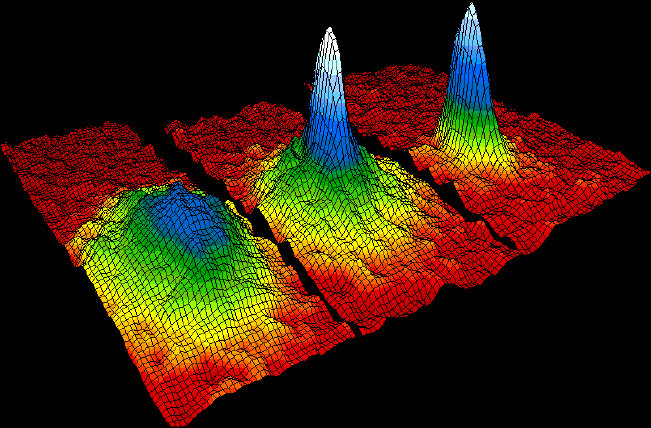
An international team of physicists says it has directly measured, for the first time, a subtle quantum signature of gravity acting on a single falling atom — a result that leaves one of Albert Einstein's foundational assumptions intact even when pushed into the strange territory of quantum superposition.
The experiment, described in a paper published this month in the journal Science Advances, was carried out by researchers at Ben-Gurion University of the Negev in Israel working with colleagues at the University of Ulm and the University of Oxford, along with contributors from the University of Southampton, the German Aerospace Center, the Institute of Quantum Technologies in Ulm and Texas A&M University. The paper's co-authors include the Nobel laureate Sir Roger Penrose, whose own ideas about where quantum mechanics might break down helped motivate the work. A full copy of the paper is also archived in the National Institutes of Health's PubMed Central database, confirming the same title, author list and findings.
The result does not prove that gravity itself is a quantum phenomenon, something physicists have chased for nearly a century. What it shows, more narrowly, is that Einstein's equivalence principle — the idea that all objects fall at the same rate under gravity regardless of what they are made of — continues to hold even for an atom whose quantum wave has been split into two paths and made to interfere with itself.
How the measurement was made
The apparatus, which the team calls the Quantum Galileo Interferometer, works on a scale far removed from Galileo's legendary drop tests. Researchers, led by PhD student Or Dobkowski in Professor Ron Folman's laboratory, cooled a cloud of roughly 20,000 rubidium atoms to about three billionths of a degree above absolute zero on a chip fitted with gold wires and microwave circuitry, according to detail reported by a science-news account of the experiment's inner workings. A microwave pulse split each atom's quantum wave function into two paths at once. A magnetic pulse then tossed one half of that wave upward before switching off its sensitivity to the magnetic field, so it rose and fell under gravity alone, like a ball thrown into the air. The other half remained magnetically suspended, its field tuned to cancel gravity's pull exactly. When the two halves were finally recombined, the interference pattern between them revealed a quantum phase difference — a signature written into the wave itself by its brief encounter with free fall.
The team let the falling half of the wave drop for as long as 2.4 thousandths of a second, gathering 13 complete interference cycles across 633 separate 30-second runs, more than five hours of data in total. The measured phase matched, to within a few percent, a calculation the physicist Charles Galton Darwin worked out on paper in 1927 — decades before anyone could test it — which predicts that this gravitational phase should grow with the cube of the time an object spends falling. A summary of the findings circulated by research-news aggregators noted that the interference contrast, a measure of how cleanly the two quantum paths still matched up, had faded to about a quarter of its original strength by the longest fall times, a reminder of how fragile such superpositions are outside a laboratory built specifically to protect them.
A century of testing free fall
The equivalence principle has been tested with steadily increasing precision since Galileo, through torsion-balance experiments in the early twentieth century, satellite missions such as France's MICROSCOPE, and atom-interferometry experiments that dropped clouds of atoms down tall vacuum towers. What none of those experiments had isolated, researchers say, was the specific higher-order quantum phase that Darwin's 1927 calculation predicted — a term that only becomes measurable when a single quantum object's wave function is split, held partly still and partly in free fall, for long enough to accumulate a detectable signal. Oxford physicists Vlatko Vedral and Chiara Marletto proposed a scheme to chase that signal in 2020, and the Ben-Gurion, Ulm and Oxford collaboration spent the years since building an apparatus precise enough to do it, according to a statement from Oxford's physics department.
"This experiment pushes quantum mechanics into one of its most intriguing frontiers, gravity, and shows that, once again, its predictions hold," said Vedral, a co-author on the paper. "We have no consistent theory telling us why quantum physics should fail."
What the result does and does not settle
Nobody involved in the work is claiming to have unified gravity and quantum mechanics, a project that has resisted physicists since the era of Einstein and Bohr. Folman, the Ben-Gurion physicist who led the experiment, was careful to frame the result as a step rather than an answer. "This is a unique paper, in the sense that it combines a hard experiment with a far-reaching theoretical interpretation, about one of the most fundamental questions in physics: how can gravity, described by Einstein's theory of relativity, and quantum theory, be unified into one understanding of the universe?" he said, according to a research-institution news release describing the study. "These two pillars of modern physics have so far eluded all attempts at a unified theoretical framework, but this complex experiment gives more hints as to how such a unification may be achieved."
"We have no consistent theory telling us why quantum physics should fail. This experiment pushes quantum mechanics into one of its most intriguing frontiers, gravity, and shows that, once again, its predictions hold." — Vlatko Vedral, University of Oxford
The practical stakes are, for now, confined to fundamental physics rather than any near-term technology. Confirming that gravity behaves the way Einstein's principle predicts, even for a quantum object, matters chiefly to theorists trying to reconcile general relativity with quantum field theory — two frameworks that each describe the universe with extraordinary accuracy but have never been folded into a single, consistent theory. A result that had instead shown a deviation from the predicted phase would have been the far bigger story, potentially pointing toward new physics; instead, as an account of the experiment for a general science audience put it, Einstein's century-old principle survived its latest and strangest test intact.
Chasing the next test
The collaboration is not finished. Folman's group is already working to repeat the measurement with heavier and more complex quantum objects, including nanodiamonds, in place of single atoms. That direction has a particular resonance for Penrose, whose own theoretical work has suggested that quantum superpositions might become unstable and collapse on their own once an object is massive enough for its gravitational field to matter — a proposal, distinct from the experiment reported here, that some physicists hope future versions of this kind of interferometer could eventually test. Separately, Vedral and his collaborators say they want to push the underlying technique further still. "Ultimately, of course, the idea is to test the quantum nature of the gravitational field," Vedral said, according to reporting on the collaboration's longer-term goals.
That would require an experiment of a different order of difficulty: one sensitive not just to how a quantum object responds to a classical gravitational field, as this one was, but to whether gravity itself carries the fingerprints of quantum behavior. No one in the field expects that test soon. For now, physicists say, the value of the Ben-Gurion experiment lies in demonstrating that the tools exist to ask the question at all — to take a single atom's quantum wave, drop half of it, and read off, in the pattern of light and dark that comes back together, whether Einstein's oldest idea about gravity still holds. It does.

Nighttime light exposure linked to structural changes in the heart, large UK study finds
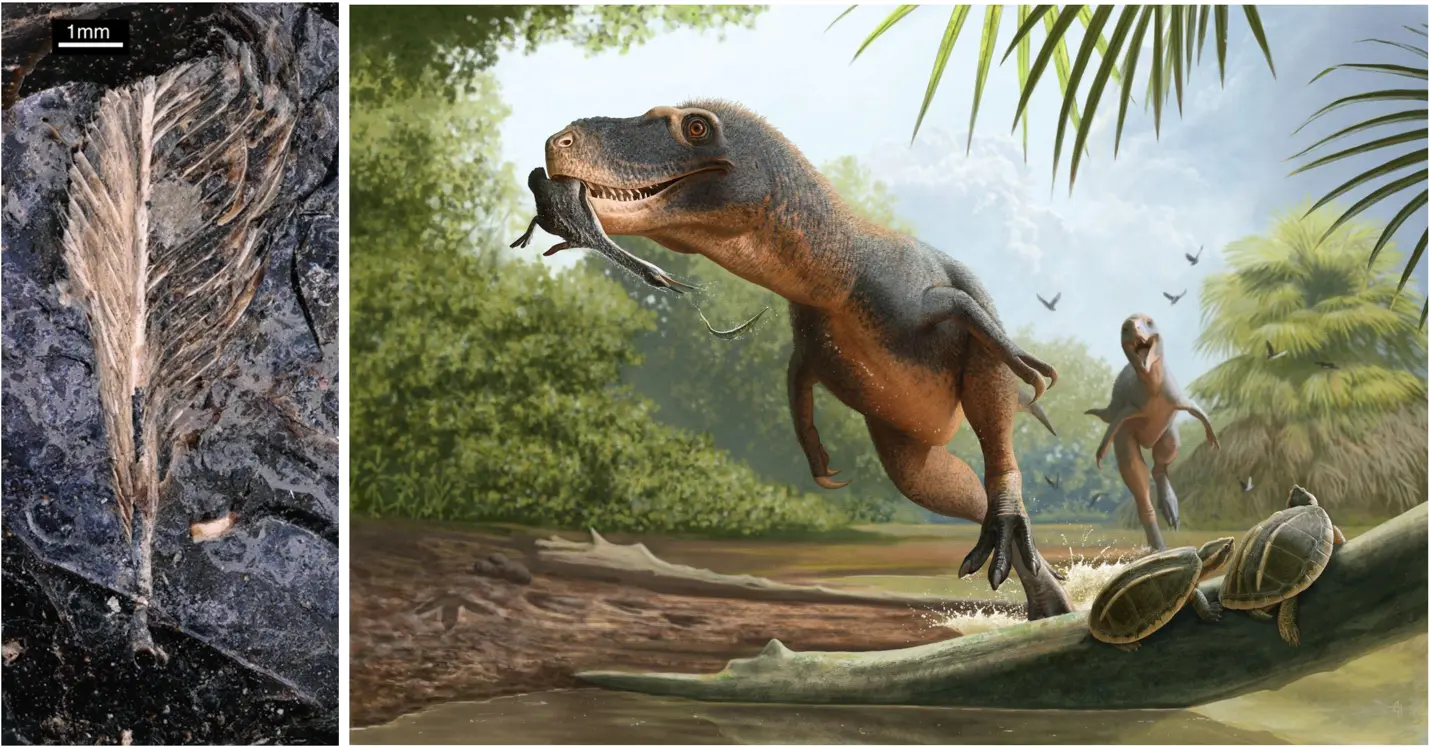
Feather preserved in dinosaur droppings may explain why some birds survived the asteroid impact

New supercomputer simulations suggest the Moon could have formed intact within five hours
