Physicists rule out giant primordial black holes as dark matter's hidden source
Using archival data from Europe's Planck satellite, researchers in Germany have closed off a long-standing theory that colossal black holes formed moments after the Big Bang could account for most of the universe's missing mass.
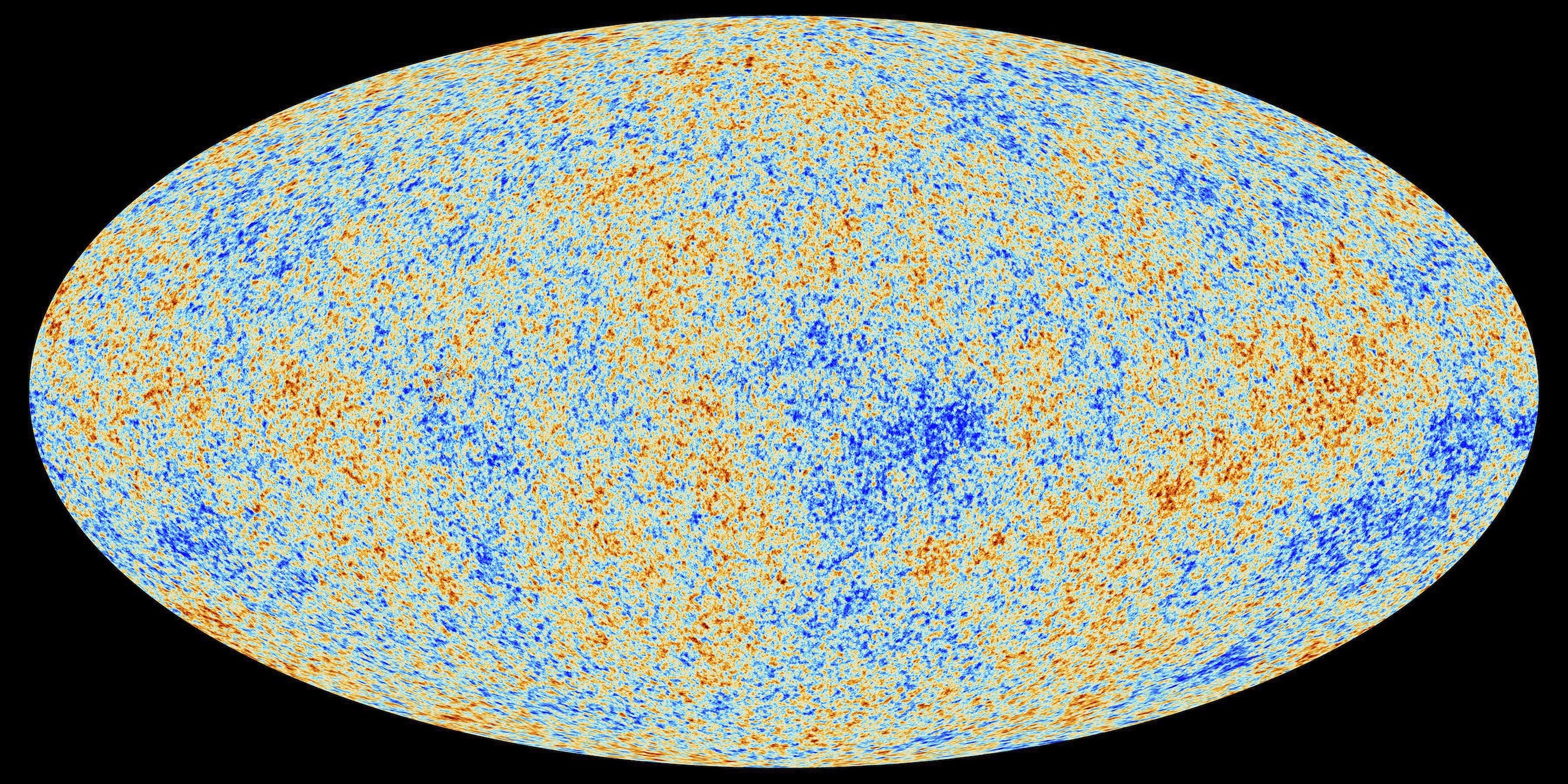
Physicists at Johannes Gutenberg University Mainz have ruled out one of the more exotic explanations for dark matter, the invisible substance thought to make up most of the matter in the universe. Using more than a decade-old dataset from the European Space Agency's retired Planck satellite, the team concluded that black holes of almost unimaginable size, formed in the first instant after the Big Bang, cannot account for a significant share of the universe's dark matter.
The findings, published in Physical Review Letters, close off a hypothesis that has circulated in cosmology for several years: that dark matter might not be made of exotic subatomic particles at all, but of a relatively small number of extraordinarily massive black holes that condensed directly out of the hot, dense early universe, long before the first stars existed. The result builds on a preprint of the paper the team posted earlier this year.
Searching the oldest light in the sky
The researchers, led by theoretical physicist Christopher Gerlach at Mainz's PRISMA+ Cluster of Excellence, worked with the term physicists have coined for these objects: "stupendously large black holes," or SLABs. According to the university's account of the hypothesis, such black holes would range from roughly 100 million to ten billion billion times the mass of the sun — dwarfing even the supermassive black holes known to anchor the centers of galaxies.
To test whether SLABs could exist in large enough numbers to explain dark matter, Gerlach and his colleague Nicholas Leister, along with co-authors Yann Gouttenoire and Antonio Iovino, turned to the Planck satellite, an ESA mission that spent four and a half years mapping the cosmic microwave background (CMB) before its operations ended in October 2013. The CMB is relic light released when the universe was about 380,000 years old, and it preserves an extraordinarily precise record of the density of matter at that early moment.
If a meaningful fraction of dark matter were locked up in a comparatively small number of gigantic black holes, the researchers reasoned, those objects would have distorted the distribution of matter around them, leaving a distinctive, grainy imprint on the CMB — a pattern cosmologists call isocurvature perturbations. The team modeled what that imprint should look like for various assumed SLAB masses and abundances, then compared the prediction against the real Planck measurements, which remain, in Gerlach's words, the most precise record of the infant universe available.
No sign of graininess
The comparison turned up nothing. The CMB data showed far less of the predicted graininess than a dark-matter-sized population of SLABs would require, which let the team set a firm new upper limit on how many such black holes could exist. Leister described the physical logic in direct terms: if dark matter were concentrated into a relative handful of enormous objects, "the universe becomes grainy on very large scales" — and the data show it is not.
"So these black holes can't be a significant part of the dark matter," Nicholas Leister, a theoretical physicist at the Mainz Institute for Theoretical Physics, told Space.com.
Crucially, the researchers are careful to note what the result does not show. The analysis does not rule out that stupendously large black holes exist somewhere in the universe — only that they cannot make up a major share of the roughly 27 percent of the cosmos that dark matter is thought to constitute. Earlier studies had already cast doubt on primordial black holes as a complete solution to dark matter across other mass ranges; the new paper closes the specific, very high-mass window that had remained open.
A line also drawn under other puzzles
The result carries implications beyond dark matter bookkeeping. SLABs had also been floated as a possible explanation for two other open puzzles: the faint, nanohertz-frequency "hum" of gravitational waves detected by pulsar timing arrays, and the surprisingly bright, massive galaxies the James Webb Space Telescope has observed from very early in cosmic history, which some theorists suggested might have been seeded by huge black holes already in place soon after the Big Bang. Leister said both of those puzzles are now "unlikely to be answered by SLABs," since the population needed to explain either phenomenon would have been too large to escape detection in the Planck data.
Dark matter itself remains one of the largest unresolved problems in physics. It does not emit, absorb or reflect light, and despite decades of searches with particle detectors, dark-matter-hunting telescopes and now precision cosmological surveys, no experiment has directly detected whatever it is made of. Its existence is inferred almost entirely from its gravitational effects — on the rotation of galaxies, the motion of galaxy clusters and the structure of the CMB itself. Ruling out candidate explanations, piece by piece, is how physicists have narrowed the field over the past half-century, from exotic particles to primordial black holes of various sizes.
Where the search goes next
The Mainz team is not abandoning primordial black holes as a line of inquiry. Having closed off the high-mass end of the spectrum, Gerlach and Leister say they are now examining the opposite extreme: whether black holes no larger than asteroids, formed under the same early-universe conditions, could make up a meaningful fraction of dark matter. That mass range is harder to probe with CMB data alone and would require different observational signatures, such as gravitational microlensing of distant stars.
Gerlach noted that even though Planck's instruments have been silent for thirteen years, the mission's archived measurements continue to answer new questions about the universe's structure and evolution — a reminder, he said, that a satellite's scientific life can extend well beyond its operational one. Leister, for his part, put the broader state of the field plainly: "The early universe still has many puzzles waiting to be solved."

Chinese Physicists Set New Cold-Temperature Record Aboard Tiangong Space Station

Human Noise Alters Biology or Behavior in Four of Five Animal Species, Global Study Finds

Scientists report chemical traces of red blood cells in a 115-million-year-old dinosaur bone
