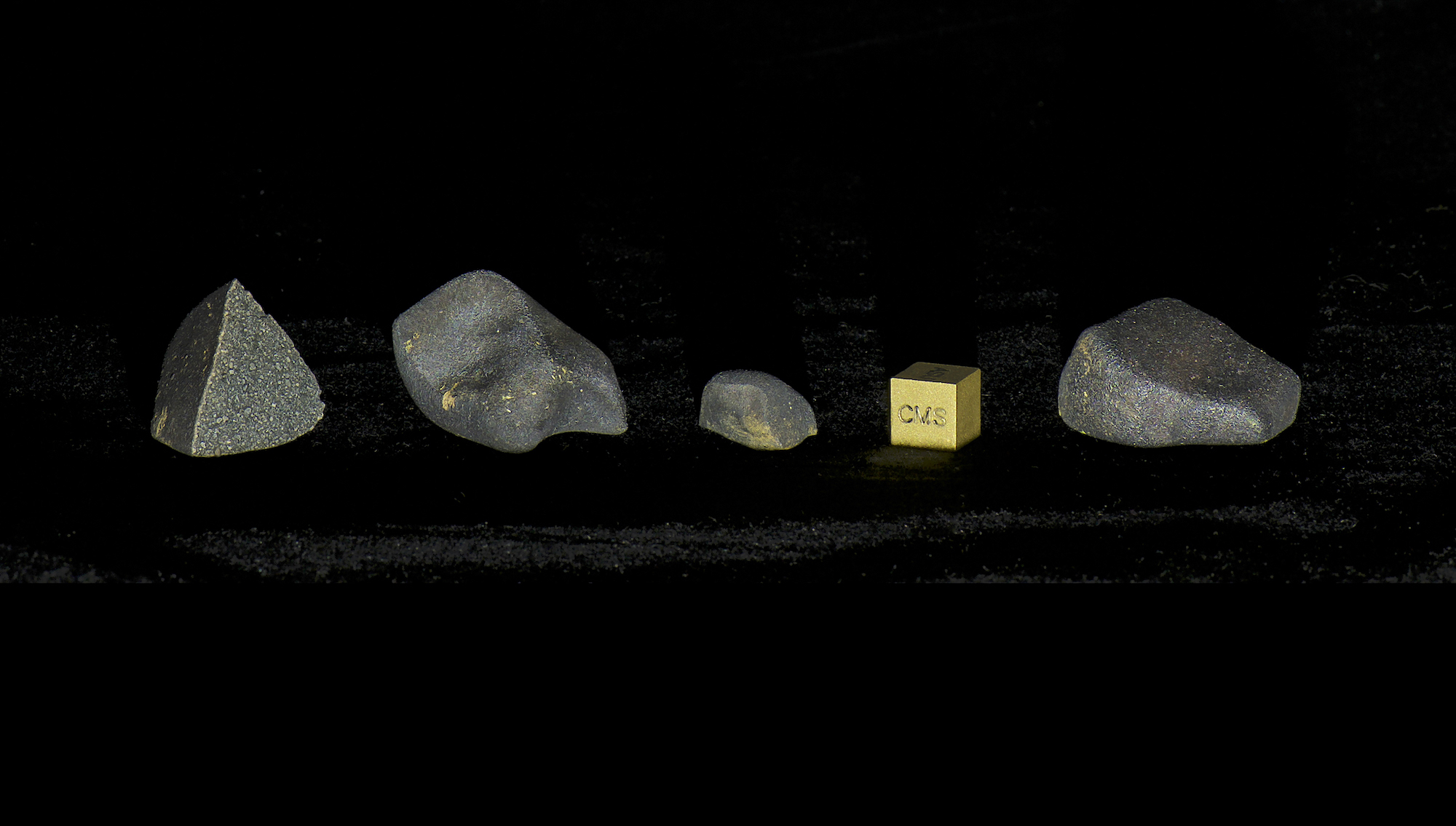
Swiss physicists build cold muonium beam to put Einstein's gravity to a new test
A new technique for producing controlled beams of muonium, a hybrid matter-antimatter atom, could let physicists test within a few years whether gravity affects a "second generation" particle exactly as it affects ordinary matter.

Physicists in Switzerland have built a new kind of particle beam that could, within a few years, put Albert Einstein's theory of gravity to a test no experiment has managed before: whether gravity pulls on a "second generation" particle of matter exactly the way it pulls on the everyday matter that makes up planets, people and starlight.
The advance, described in a paper published in Nature Physics on September 14 and publicized this week by ETH Zurich, is not itself a measurement of gravity. It is the technical breakthrough that makes such a measurement possible: a cold, tightly collimated beam of muonium, an exotic short-lived atom made from an antimuon and an electron, produced at the Paul Scherrer Institute (PSI) in Villigen. Researchers led by Jesse Zhang, a doctoral student, and physicist Anna Soter say the beam is bright and controlled enough that they can now plan a direct free-fall experiment on muonium for the first time.
The numbers behind the beam
The core problem the team had to solve is that muons, the heavier cousins of electrons that anchor one side of the muonium atom, survive for only about 2.2 microseconds before decaying. That leaves almost no time to slow a fast-moving muon down, pair it with an electron and shape the result into a usable beam. The team's solution was to fire antimuons from PSI's low-energy muon source, described by the institute as the world's most intense continuous source of its kind, into a thin layer of superfluid helium chilled to roughly minus 273 degrees Celsius, a hair above absolute zero.
Inside the superfluid, the antimuons pick up electrons and emerge as neutral muonium atoms that are ejected from the helium surface with unusually uniform speed and direction, a "superthermal" beam rather than a scattered thermal cloud. Soter has described the effect as using the chemical potential of the superfluid as an "atomic cannon." Because the resulting atoms travel on near-parallel paths at similar velocities, the beam is dramatically brighter, in the sense of usable particles per second per unit area, than earlier muonium sources, which is the property a future gravity experiment needs to get a statistically meaningful answer before the atoms decay.
The team, whose paper lists co-authors including A. Antognini, M. Bartkowiak, D. Goeldi, K. Kirch, A. Knecht, D. Taqqu, R. Waddy, F. Wauters and P. Wegmann alongside Zhang and Soter, says it intends to test the beam method on its own merits later this year, with the full gravitational free-fall measurement targeted for roughly two to three years out. That measurement would aim for about one percent precision on how fast muonium accelerates in Earth's gravitational field, a threshold fine enough to expose any meaningful deviation from ordinary matter's rate of fall.
A century-old assumption, still largely untested for exotic matter
The experiment targets the weak equivalence principle, the idea at the foundation of general relativity that all objects fall at the same rate in a gravitational field regardless of their mass or composition. Galileo is said to have tested a version of this with falling weights; modern versions have confirmed it to extraordinary precision using ordinary atoms and satellites. But essentially all of that precision testing has involved first-generation matter: electrons, up and down quarks, and their antiparticles.
Muonium breaks that pattern twice over. The antimuon belongs to the second generation of the Standard Model's particle families, a heavier, unstable relative of the electron that ordinary matter never produces on its own. And because the antimuon is antimatter while the electron it pairs with is ordinary matter, muonium is a genuinely hybrid object, electrically neutral overall but built from both sides of the matter-antimatter ledger. No one has been able to watch that combination fall.
The closest precedent is the ALPHA-g experiment at CERN, which in 2023 showed that antihydrogen, made from an antiproton and a positron, falls downward at a rate consistent with ordinary matter. That result closed off one open question but left another: antihydrogen is still built entirely from first-generation particles and their antiparticles. Muonium would be the first test of free fall for a particle from the second generation, and the first involving a genuine mix of matter and antimatter within a single neutral atom.
"We have managed to produce the muonium atoms in a 'cold' state, which is what makes the gravity experiment possible," said Anna Soter, the physicist at ETH Zurich and PSI who leads the project.
Who is watching, and what they are saying
The work sits inside a broader Swiss investment in muon science. It was carried out with support from Muoniverse, a newly funded National Centre of Competence in Research led jointly by PSI and the University of Zurich that brings together more than thirty research groups working on muon-beam applications, from fundamental particle physics to materials science and archaeology. The gravity project itself draws on infrastructure at PSI's Center for Neutron and Muon Sciences, which operates the accelerator complex that supplies the low-energy muons the experiment depends on.
Particle physicists outside the immediate collaboration have flagged the stakes of what a positive result, meaning any measurable deviation from ordinary free fall, would imply. A muonium beam falling at a different rate than predicted would not simply be a curiosity; it would point to physics beyond both the Standard Model and general relativity, potentially including a previously undetected fifth fundamental force that couples differently to different generations of matter. Soter has been cautious about the odds, noting that most precision equivalence-principle tests to date have come back consistent with Einstein, but has also said a deviation "would indeed be surprising" and would be the kind of result that reshapes how physicists think about gravity's reach across the particle families.
For now, the immediate audience for the Nature Physics paper is other precision-physics groups working on muon and antimatter beams, including teams at Fermilab, J-PARC in Japan and CERN's own antimatter factory, all of whom are competing on adjacent questions such as the muon's magnetic properties and antihydrogen spectroscopy. A workable, bright muonium source is also of interest beyond gravity: the same beam technology feeds into precision laser spectroscopy of muonium's atomic structure, which offers an independent check on fundamental constants and possible new physics in the electromagnetic sector.
What happens next
The team's own timeline is deliberately staged. This year, the group plans to validate the beam production method itself, essentially confirming that the superfluid-helium technique produces muonium atoms with the intensity, coldness and directional uniformity the design predicts. Only after that validation would the group move to building and running the actual drop apparatus, a vertical setup that would track the beam's atoms as they fall under gravity over a measurable distance before they decay, in a design conceptually related to the vertical trap CERN's ALPHA-g team used for antihydrogen.
Because muonium atoms live for only microseconds, the drop distance and timing precision required are demanding, which is part of why the group is giving itself two to three years before attempting the full measurement. If the eventual result matches Einstein's prediction, it will close another gap in the experimental record supporting general relativity, extending confidence in the equivalence principle to a particle class it has never directly covered. If it does not, the finding would rank among the more consequential results in fundamental physics this decade, and would likely trigger a wave of follow-up proposals at other muon and antimatter facilities aiming to confirm or refute it independently.
Nature Physics — Synthesis of a superthermal muonium beam (Zhang et al., 2026)
ETH Zurich — Novel particle beam could challenge Einstein's theory of gravity
ScienceDaily — Scientists are about to test Einstein's gravity with exotic matter
Phys.org — Novel particle beam could challenge Einstein's theory of gravity
Experimental Blood Test Catches Early Pancreatic Cancer 87% of the Time

Amateur Astronomer's Campsite Search Uncovers 390-Million-Year-Old Crater
Astronomers find earliest known ancestor of a galaxy supercluster