Telescope catches meter-wide asteroid hours before it burns up over the Indian Ocean
Automated tracking software correctly predicted the atmospheric entry point of a small asteroid discovered less than eight hours earlier, marking only the 13th time a space rock has been detected before hitting Earth, and the first from a previously uncaught orbital class.
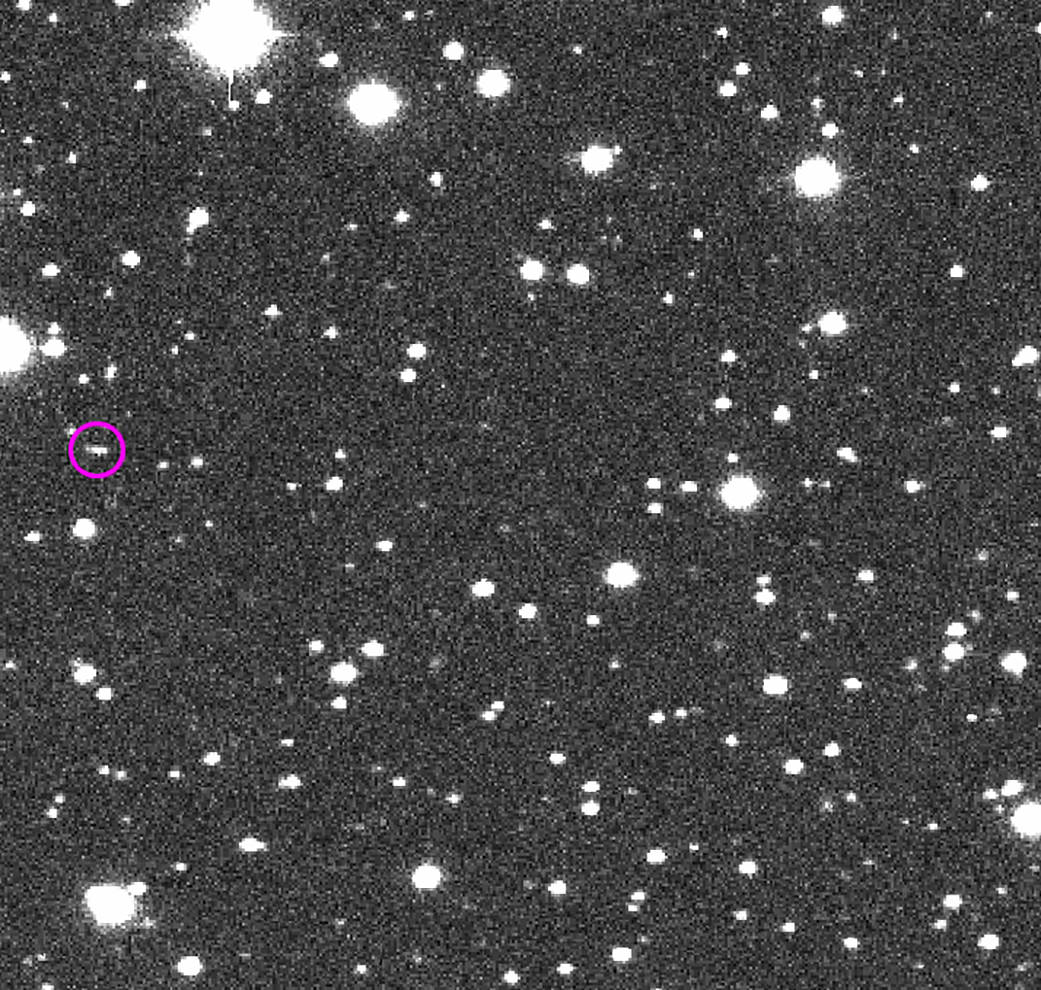
A house-sized telescope in the mountains above Tucson, Arizona, caught a faint speck of light drifting across a field of stars just after 08:45 UTC on September 6. Seven hours and twenty-two minutes later, the object it had spotted, a rubble fragment roughly the size of a washing machine, burned up in the atmosphere over the Indian Ocean northwest of Australia, exactly where automated software had predicted it would. No one saw it happen. No debris reached the surface. But the detection, confirmed independently by the Minor Planet Center and the European Space Agency, made the object, designated 2026 RW1 in a circular issued by the Minor Planet Center, only the thirteenth asteroid ever spotted in space before it hit Earth.
The asteroid was too small to threaten anyone. At roughly 0.8 meters across, it belonged to a class of objects that strike the planet harmlessly several times a year, usually unnoticed. What made the September 6 event notable to astronomers was not the rock itself but the fact that the global tracking network caught it at all, and did so with enough precision to name an impact window and an ocean location hours in advance.
How the detection unfolded
The object was first picked up by the Catalina Sky Survey's Mount Lemmon station, a 1.5-meter reflector operated by the University of Arizona that has been one of the most prolific asteroid-hunting instruments in operation since the mid-2000s. Within minutes, two automated pipelines built to flag exactly this kind of short-notice threat, Scout, run by NASA's Center for Near-Earth Object Studies, and Meerkat, its European counterpart, began computing possible trajectories. As additional observations came in from Pan-STARRS2 on Haleakala in Hawaii, the Kitt Peak-Bok telescope, and the Zadko and Faulkes Telescope South facilities in Western Australia, the uncertainty collapsed fast enough that the impact corridor was narrowed to sub-kilometer precision before the object ever reached the atmosphere.
Orbital calculations placed 2026 RW1 on a tight, one-year-period path around the sun, with an absolute magnitude of 33.26, consistent with a diameter under a meter. Final entry was pinned to roughly 16:07 UTC, at coordinates near 13.8 degrees south, 116.4 degrees east, over open water between Western Australia and the Lesser Sunda Islands. The remote location meant no ground or aerial observers were positioned to record the resulting fireball, according to the record ESA's Near-Earth Object Coordination Centre has logged for the object.
A short list, and a new kind of entry on it
Since the first such detection, of the asteroid 2008 TC3 over Sudan in October 2008, tracking networks have found only a dozen more incoming objects before they struck the atmosphere, a tally that undercounts by orders of magnitude the number of similarly sized objects that arrive undetected. Most small asteroids are found only after the fact, if at all, because surveys can realistically catch objects just hours or days out, and only if weather, lunar glare, and the object's position in the sky cooperate.
What distinguishes 2026 RW1 within that short list is its orbit. All twelve previous pre-impact detections belonged to the Apollo family of near-Earth asteroids, whose orbits are centered mostly outside Earth's own. 2026 RW1 is believed to be the first confirmed Aten-class object caught before impact, a population whose average distance from the sun is less than one astronomical unit, meaning these asteroids spend much of their time in the daytime sky, hidden in solar glare from ground-based telescopes that must observe at night. Finding one before it arrives, rather than after, is a harder technical problem than finding an Apollo asteroid on an outbound approach.
"Our systems have calculated an atmospheric entry in the timeframe between 16:00-16:30 UTC of a harmless object discovered by Mt Lemmon survey with a diameter of ~0.8 m northwest of Australia over the ocean. The impact will likely cause a bright meteor," Richard Moissl, head of ESA's Planetary Defence Office, wrote in a public update as the prediction firmed up.
Why a routine burn-up gets tracked so closely
The value of episodes like this one lies less in the object than in the rehearsal. Every step between a telescope flagging a moving point of light and an agency naming an ocean coordinate hours later exercises the same chain of software, data-sharing agreements, and human judgment that would be needed for a larger, genuinely hazardous object. Objects the size of 2026 RW1 arrive too often and cause too little damage to justify dedicated missions, but the detection pipeline that caught it is the same one tasked with finding the rarer, more consequential impactors that current surveys estimate remain undiscovered. The same Catalina Sky Survey technique used to catch the very first pre-impact object in 2014, comparing sequential images of the same patch of sky to isolate anything that moves against the background stars, is essentially what caught this one twelve years later, now paired with faster automated orbit-fitting software than existed at the start of the decade.
Planetary defense researchers have long noted the asymmetry between objects that arrive from directions well-covered by nighttime surveys and those, like many Atens, that approach from nearer the sun. Ground-based telescopes cannot easily observe close to the solar disk, leaving a persistent blind spot that only space-based infrared surveys are well suited to close. That gap is part of the rationale behind NASA's Near-Earth Object Surveyor mission and behind the wide-field surveys the agency's Near-Earth Object Coordination Centre already draws on for cataloguing threats from the ground.
What follows
No fragments of 2026 RW1 are expected to be recoverable; unlike 2008 TC3, whose remnants were later gathered from the Nubian Desert, this object disintegrated over deep ocean with no vessels nearby, so its physical composition will likely remain unconfirmed beyond what its brightness and orbit imply. Analysts at the tracking centers involved are expected to fold the event into ongoing reviews of how quickly automated systems can convert a handful of telescope observations into an actionable trajectory, a metric planetary defense officials use to judge how much warning time the network could realistically deliver for a more dangerous object approaching on a similar type of orbit. Astronomy outlets that covered the event noted that the underlying lesson is less about the rock itself and more about how routinely the warning chain now works when conditions allow, and how much rarer that success remains for objects that approach from the sun's direction rather than the night sky.

ADHD Linked to Sharply Higher Rates of Gut Problems, Largest Review Finds
Physicists Measure Gravity's Effect on a Falling Atom's Quantum Wave for the First Time

Nighttime light exposure linked to structural changes in the heart, large UK study finds