Wild monkeys with 'wrong' feet climb trees as well as chimps, complicating a key theory of human origins
A new study of sooty mangabeys in Ivory Coast found the monkeys bend their midfeet nearly as much as chimpanzees flex their ankles while scaling vertical trunks, undercutting a long-standing assumption that only ape-like feet could support that climbing style.
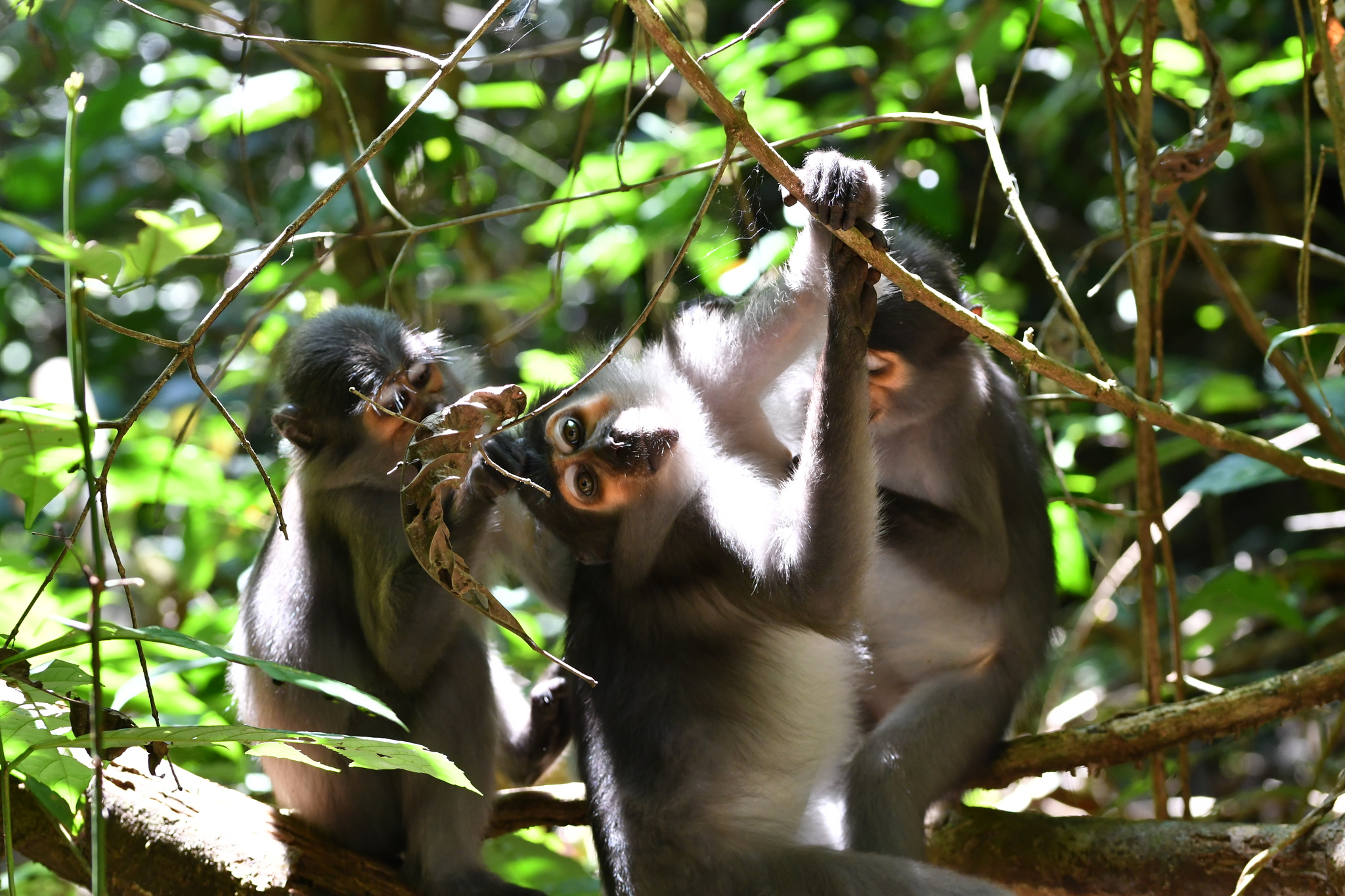
Wild monkeys in an Ivory Coast forest can bend their feet nearly as far as chimpanzees bend their ankles when climbing straight up a tree trunk, according to a study published this month that complicates a long-standing assumption about how the last common ancestor of humans and chimpanzees got around. The finding matters because paleoanthropologists have used foot anatomy as a proxy for climbing ability when trying to reconstruct the locomotion of ancient hominins from fossil bones.
The study, led by researchers at Dartmouth College and Ohio State University, was published in the Proceedings of the National Academy of Sciences under the title "A kinematic convergence in ape and monkey vertical climbing informs debates on early hominin arborealism." It centers on sooty mangabeys, ground-dwelling African monkeys that periodically climb narrow vertical trunks to forage, sleep or hide from predators, despite lacking the highly mobile ankle joints that let chimpanzees and other apes do the same.
What the researchers measured
Working at the Taï Forest Monkey Project field station in Ivory Coast's Taï National Park, lead author Luke Fannin filmed wild sooty mangabeys at 30 frames per second as they climbed vertical trunks, then digitized the footage frame by frame to measure how far the animals bent their ankle and midfoot joints during each climb. The team compared those measurements to published data on chimpanzee ankle flexion and on humans, whose ankles typically bend only about 20 degrees.
The mangabeys' ankles turned out to be fairly stiff, flexing only around 23 degrees on average, not much more than a human's. But their midfeet — the joints roughly in the center of the foot, well forward of the ankle — bent much further, reaching about 46 degrees of flexion on average. That figure was statistically indistinguishable from the roughly 45-degree ankle flexion chimpanzees use to climb the same kind of trunks, and it was also comparable to measurements previously recorded in Twa honey-hunters, a Ugandan community whose members climb trees to harvest wild bee nests and who bend their ankles more than 45 degrees while doing so, a degree of mobility documented in an earlier PNAS study, "Tree climbing and human evolution," that first drew attention to how much specialized human climbers rely on ankle flexibility.
In effect, the mangabeys appear to compensate for a stiffer ankle by recruiting a different joint. "You can't rule out vertical climbing just because something doesn't have a chimpanzee-like foot," Fannin said, describing the core implication of the result.
Why foot shape has carried so much weight
Humans and chimpanzees are thought to have diverged from a shared ancestor roughly six to seven million years ago, and reconstructing what that ancestor looked like, and how it moved, has been a central and unsettled question in paleoanthropology. Much of that debate has hinged on foot bones, because feet fossilize relatively well and their joint surfaces preserve clues about how flexible they once were. Apes such as chimpanzees have long, mobile ankles suited to gripping and climbing vertical trunks, while cercopithecoid monkeys, the group that includes mangabeys, baboons and macaques, generally have stiffer ankles built for walking along branches and on the ground on all fours.
That anatomical contrast has often been used as a dividing line: a fossil hominin foot with monkey-like joints has tended to be read as evidence its owner was a poor vertical climber, and by extension that the last common ancestor itself might have had ape-like feet if vertical climbing was important to its behavior. The new study does not resolve which anatomy the ancestor actually had. Instead, it removes ankle flexibility as a reliable litmus test, since a monkey-like foot turns out to be capable of the same climbing performance through a different mechanical route.
"Arboreality is fundamental to understanding primates because it has shaped our body to a large degree," said senior author W. Scott McGraw, professor and chair of anthropology at Ohio State, who has co-directed the Taï Forest Monkey Project since the 1990s.
Who this affects
The findings are aimed squarely at specialists in human origins, primate anatomy and comparative biomechanics, rather than at any immediate clinical or public application, but the underlying question, how humans came to walk upright, touches enough basic biology that it typically draws wider attention. McGraw noted that the mangabeys used in the study are a living, observable population, not an extinct lineage known only from bone fragments, which let the team capture continuous, high-resolution footage of the animals climbing rather than infer behavior from static anatomy alone. "The great thing about having the video is that it allows us to capture exactly what the monkey is doing in a high-resolution manner," he said.
The researchers were careful to frame the result as complicating rather than resolving the broader debate. Fannin said the study shows there is "a functional equivalence" between the two climbing strategies, meaning outside observers should be cautious about inferring an animal's climbing repertoire, extinct or living, from joint shape in isolation. He added that settling whether the human-chimpanzee ancestor had a monkey-like or ape-like foot will still require more fossil evidence, since the mangabey result shows only that either anatomy is compatible with vertical climbing, not which one the ancestor actually possessed.
- Sooty mangabey midfoot flexion during climbing: ~46 degrees
- Chimpanzee ankle flexion during climbing: ~45 degrees
- Human ankle flexion, typical range: ~20 degrees
- Field site: Taï National Park, Ivory Coast
What happens next
The work was supported by Dartmouth College, the Explorers Club, the U.S. National Science Foundation, the Emory National Primate Research Center, the Primate Society of Great Britain and a Schmidt Sciences postdoctoral fellowship, according to the paper. The authors say the next step is to extend the same kinematic video-based approach to other cercopithecoid species and, where possible, to compare it against fossil hominin foot bones with preserved joint surfaces, to test whether the midfoot-compensation strategy documented in mangabeys shows up elsewhere in the primate family tree. Coverage of the study since its release, including summaries from ScienceDaily and Sci.News, has largely echoed the authors' own framing: the result narrows what scientists can confidently claim from fossil foot anatomy alone, without yet delivering a verdict on what the last common ancestor's feet actually looked like.

A Rail System Built From Single Atoms Could Make Superconductors Leak Less Energy

Astronomers Confirm Third "Wandering" Black Hole Caught Shredding a Star Far From Its Galaxy's Core

Lab-Grown Brain Cells Learn to "Read" Braille, Pointing Toward Biohybrid Computers
