Opinion: Washington's Venezuela Deal Is Long on Oil, Short on Democracy
Nine months after U.S. forces captured Nicolás Maduro, Washington has locked in billions in Venezuelan oil concessions from an unelected interim government while the Nobel Peace Prize-winning opposition leader remains barred from the country and no election date has been set.
Nine months after American commandos seized Nicolás Maduro from his Caracas compound, the strategic logic of that operation looks increasingly transactional rather than democratic. The United States has locked in multibillion-dollar oil concessions from Venezuela's unelected interim government. It has not locked in an election date, and it has not secured safe passage home for the woman who most plausibly speaks for a democratic majority in that country.
A Deal Nine Months in the Making
The raid that removed Maduro on January 3 followed years of a narco-terrorism indictment accusing him of running a cartel out of the presidential palace. Venezuela's compliant supreme court then installed Delcy Rodríguez, his former vice president, as interim head of state. On September 23, addressing the United Nations for the first time as Venezuela's leader, Rodríguez thanked President Trump for his "readiness" to resume ties and declared that elections "will be held in Venezuela," while offering no date and describing only a nascent "political dialogue with opposition sectors," according to the United Nations' own account of her remarks. That vagueness, eight months into an interim presidency with no electoral mandate of its own, is the crux of the problem, and it is worth asking what, exactly, the removal of Maduro was supposed to buy if not a firmer answer than that.
The Numbers Behind the Bargain
What is not vague is the commercial side of the arrangement. In early September, Chevron signed agreements in Caracas to invest more than $7 billion and more than double its Venezuelan output toward 600,000 barrels a day, part of a wider wave of deals with Eni and other firms unveiled at a ceremony with the American energy secretary presiding alongside Chevron's chief executive. Separately, Washington and Caracas struck a government-to-government pact granting the United States preferential access to roughly a fifth of the country's oil reserves. Even the pact's duration is disputed in public: Trump has said the arrangement would run a century, while Rodríguez has put its term at 25 years, a discrepancy that has never been reconciled on the record. The Treasury Department's sanctions carve-out enabling this activity, a general license issued this year for the oil and gas sector, requires that most payments to blocked Venezuelan entities flow into a Treasury-administered account rather than directly to the government in Caracas, an implicit acknowledgment that Washington does not yet fully trust the counterparty it is doing business with. The currency has not stabilized either: the central bank's official rate has moved from roughly 301 bolivars to the dollar at the start of the year to 857 as of the rate published on September 25, a devaluation of nearly two-thirds that shows the oil reopening has not yet reached household budgets.
Democracy Deferred
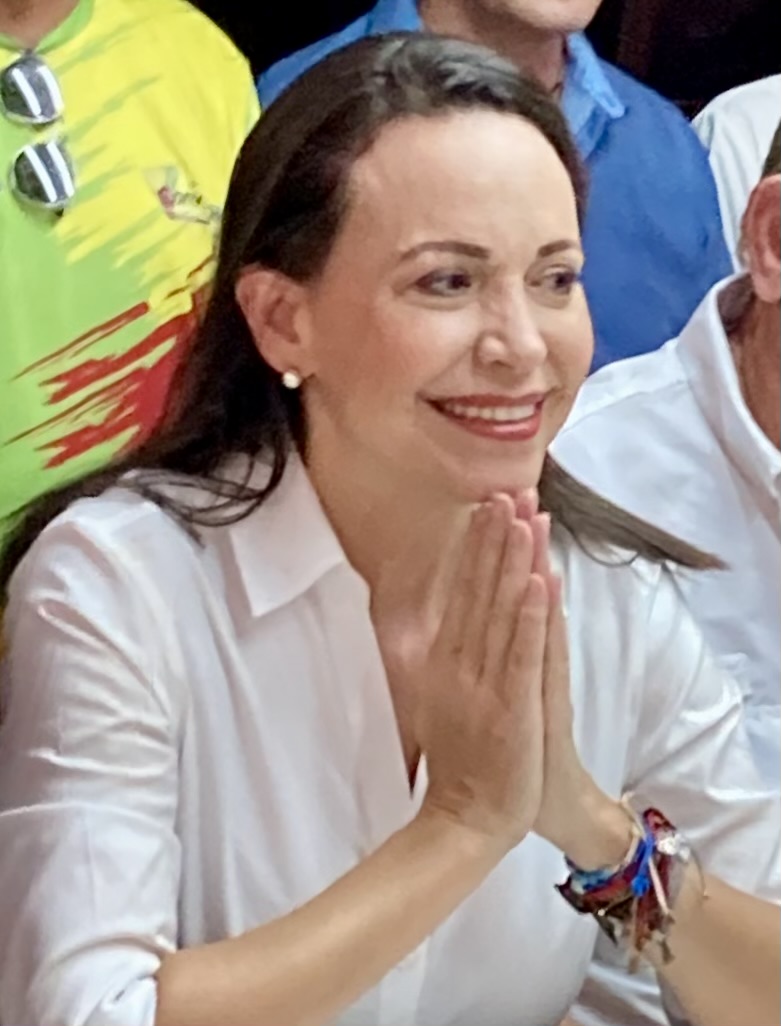
The clearest measure of what has been deferred is María Corina Machado. The winner of the 2025 Nobel Peace Prize, awarded for her efforts toward "a just and peaceful transition from dictatorship to democracy," has been unable to set foot in her own country since leaving it, failing in at least seven attempts, three of them within a single 24-hour span around the time Rodríguez was in New York meeting Trump, including a sea crossing halted over a reported mechanical fault after her passport had already been stamped, and two flights that never left the runway, according to accounts of her team's attempted crossings. Machado has not denounced the oil deal outright; she has instead questioned whether an unelected government has the standing to sign it at all.
"No development is possible without solid institutions and a government elected by popular vote."
A Partial, Reversible Opening
There has been genuine movement on human rights, and it deserves acknowledgment rather than dismissal. In a second round of Washington-backed talks between the interim government and the opposition, 39 political prisoners were released over two days in late September, among them women held since 2021 on narco-terrorism allegations and men accused of aiding a 2020 plot against Maduro. Yet the rights group Foro Penal had counted 344 political detainees as of mid-September, down only gradually from 391 a month earlier, more than half of them never convicted of anything. Even after the latest releases, roughly 300 people remain jailed on political grounds. Progress won prisoner by prisoner through negotiation is not the same thing as a legal or institutional guarantee, and it can stall as easily as it started.
The Administration's Case, and Its Limits
Officials can fairly argue that a hastily scheduled vote in a country with gutted courts, a captured electoral council and a security apparatus still loyal to the old order could produce chaos rather than democracy, and that steady, transactional engagement has already produced results that years of maximum-pressure sanctions under Maduro never did. There is something to that argument. But nothing about institutional caution requires Washington to leave the timetable entirely to Rodríguez's discretion, nor to finalize a decades-long resource concession before a single election commitment is written down anywhere more binding than a General Assembly speech. Sequencing sanctions relief and oil access behind commercial closing dates, while leaving the democratic side of the bargain to good-faith promises, signals to Caracas exactly which commitments Washington will actually enforce and which it will not.
What Washington Should Demand Next
The administration does not need to unwind the oil deals, which most Venezuelans and much of the opposition, including Machado, support in principle as a route out of economic collapse. It needs to attach the same seriousness to the political side of the bargain that it has already shown on the commercial side. Concretely, that should mean:
- A published election date, not a rhetorical promise, as a condition of any further easing of sanctions or licenses
- Guaranteed, monitored passage home for Machado and other exiled opposition figures
- Public disclosure of the oil agreement's actual term and a complete, verified accounting of remaining political prisoners, subject to congressional review
Congress has already shown it is capable of scrutinizing this intervention, having debated, and narrowly rejected, a war-powers resolution over the military strikes that preceded Maduro's capture. It should apply the same scrutiny to what has followed. An intervention justified as a blow against a narco-state and a step toward Venezuelan self-government will be judged, fairly, by whether Venezuelans end up with a government they actually chose. Nine months in, that remains an open question, and every additional month it stays open makes the operation look less like a transition and more like a transaction.

Opinion: Missouri's map chaos shows why mid-decade redistricting has to stop

Opinion: 'The Agency Wants Everyone Arrested': What a Federal Judge Found Inside ICE's Warrantless-Arrest Paperwork
Opinion: The Justice Department Says These School Districts Don't Need Watching Anymore. Its Own Docket Says Otherwise.
