4.1-billion-year-old meteorite is the oldest igneous rock ever found from Mars
A fist-sized stone pulled from the Sahara has been dated to Mars' first few hundred million years, giving researchers a direct sample of the planet's earliest, possibly wetter crust.

Scientists have identified the oldest igneous rock ever recovered from Mars, a meteorite dated to at least 4.1 billion years old, according to a study published Thursday in the journal Science. The stone, cataloged as Teghaza 001 after the region of the Sahara Desert where it was recovered, formed during the so-called Pre-Noachian period, the first few hundred million years of Martian history, a stretch of time from which almost no physical samples exist.
The work was led by planetary scientist Yang Liu of NASA's Jet Propulsion Laboratory, in collaboration with researchers at the University of New Mexico's Institute of Meteoritics, Caltech, UCLA and the University of Maine. The team dated the rock using uranium-lead analysis of microscopic zircon crystals embedded in it. Zircons are prized by geochronologists because their crystal structure locks in a reliable radiometric clock the moment the mineral forms and resists later disturbance better than most other minerals.
A rock far older than its peers
The age places Teghaza 001 in a category almost by itself. Most of the roughly 400 Martian meteorites identified on Earth crystallized around 200 million years ago, during relatively recent volcanic activity on the planet. Teghaza 001 is more than 20 times older than that, placing its formation within the planet's first several hundred million years, alongside the earliest days of the solar system itself.
The sample, which totals just under 800 grams, was recovered from the Sahara and is a single, uniform rock type, which sets it apart from Black Beauty (formally NWA 7034 and related stones), another ancient Martian meteorite that is a jumbled breccia of many rock fragments cemented together. Researchers say that uniformity makes Teghaza 001 easier to interpret as a sample of one specific piece of Mars' early crust and mantle, rather than a mixture of materials from different times and places.
At UNM, Carl Agee, director and curator of the Institute of Meteoritics, first flagged the rock's unusual texture and composition and compared its oxygen isotope signature to that of Black Beauty. Working with Karen Ziegler, a scientist at the institute and a research professor in UNM's Department of Earth and Planetary Sciences, Agee identified domains rich in manganese oxide within the stone. On Earth, manganese oxide deposits often form in the presence of liquid water and sometimes biological activity, and NASA's Curiosity and Perseverance rovers have both searched Martian outcrops for the same mineral as one possible marker of past habitable conditions. The researchers stop short of claiming any link to life on Mars, saying only that the deposits point to a wetter early environment.
Meteorites like Teghaza 001 reach Earth after an asteroid or comet impact on Mars blasts surface rock into space with enough force to escape the planet's gravity; the debris drifts through the solar system, sometimes for millions of years, before a fragment eventually falls to Earth, most often landing undetected in a desert or on polar ice where dark rock stands out against the surface and survives weathering long enough to be found. Scientists still cannot pin down exactly when Teghaza 001 left Mars or when it landed in the Sahara, though its terrestrial age is a separate question from the 4.1-billion-year crystallization age that makes it scientifically significant.
Reading water in ancient stone
The oxygen isotopes and altered minerals in Teghaza 001 indicate that the rock interacted with fluids on the Martian surface not long after it formed. That evidence feeds into a broader picture, laid out in part in a companion paper in Science Advances involving several of the same researchers, suggesting early Mars was warmer and wetter than the cold, dry planet seen today, during a period when the Red Planet may have had at least localized conditions hospitable to life, if life ever arose there.
"It's the oldest Martian igneous rock ever found by a huge margin," said Carl Agee of the University of New Mexico. "We've never found one like this before."
The finding matters most directly to planetary scientists trying to reconstruct Mars' early geologic history, a period largely erased on the planet's own surface by billions of years of erosion, volcanism and impact bombardment. It also carries weight for astrobiologists, since the Pre-Noachian and early Noachian eras are the window during which Mars is thought to have had its best chance at sustaining liquid water on its surface, and by extension, any microbial life.
What comes next
Using orbital remote-sensing data, the research team traced Teghaza 001's likely origin to Mars' ancient southern highlands, a vast, heavily cratered region that no rover or lander has yet directly explored. Agee said that finding bodes well for future missions aimed at the area, though another sample like this one may be a long time coming. "Chances are very slim, or next to impossible, that we'll get another one like this anytime soon," he said, according to the University of New Mexico.
Researchers say the rock's chemistry could help guide where future robotic missions, including any eventual sample-return effort to the southern highlands, ought to focus their search for evidence of the planet's wet early history. For now, fragments of Teghaza 001 remain split between research collections, including UNM's Institute of Meteoritics, for continued study. The findings, first reported by Phys.org and summarized by NASA's own Mars exploration program, add one more data point to a decades-long effort to understand whether the planet now visited by rovers and orbiters was ever truly Earth-like.
A Forgotten Particle May Explain Why Matter Outlasted Antimatter
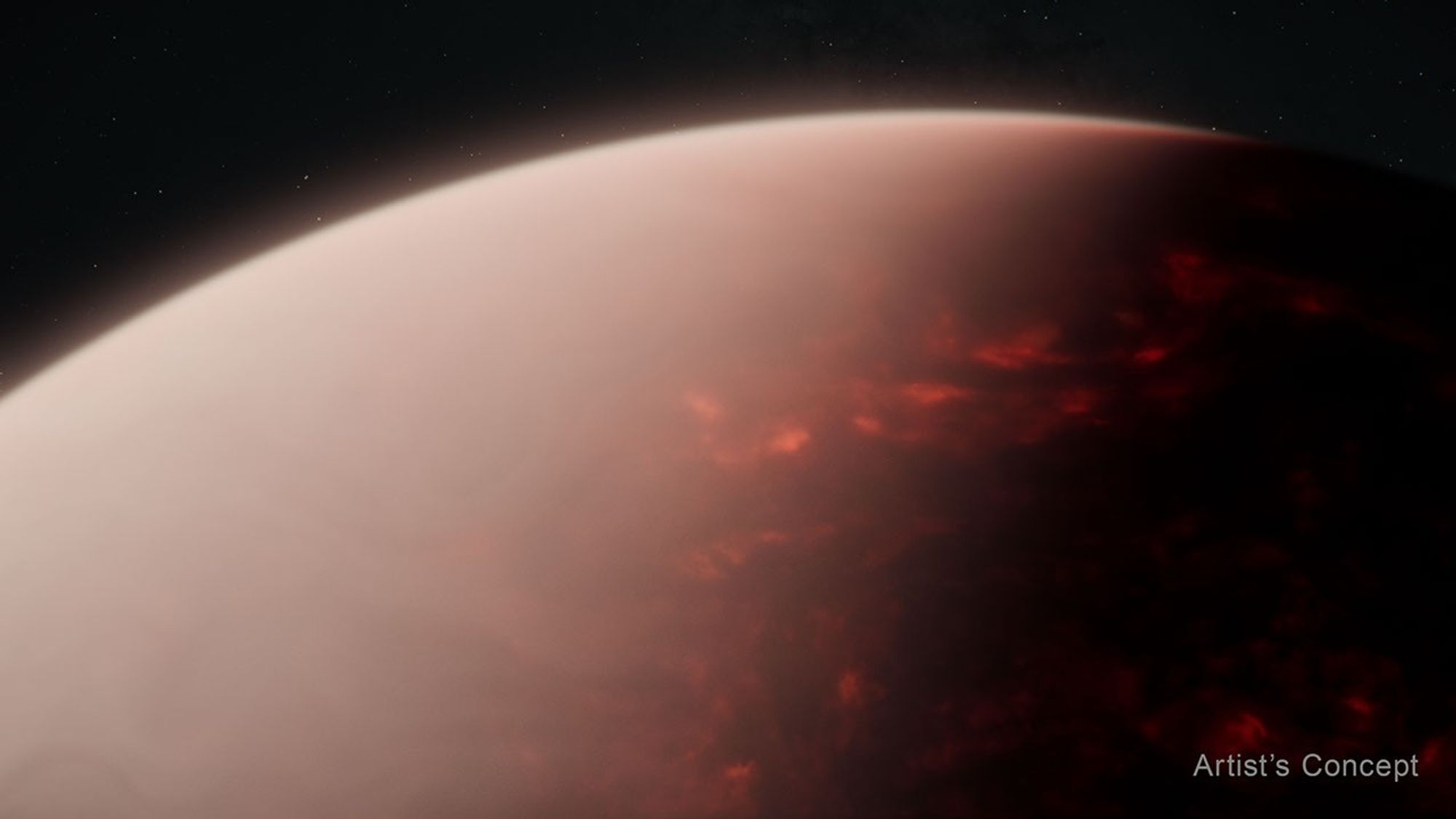
Webb telescope finds a scorched exoplanet that reflects away most of its star's light

Rubin Observatory spots a candidate for the solar system's sixth dwarf planet
