Webb telescope finds a scorched exoplanet that reflects away most of its star's light
New James Webb Space Telescope observations of the ultra-hot rocky planet TOI-561 b show it reflecting roughly three-quarters of its star's light, evidence of a reflective, cloud-wrapped atmosphere that current theory says a planet in its scorching orbit should have lost long ago.
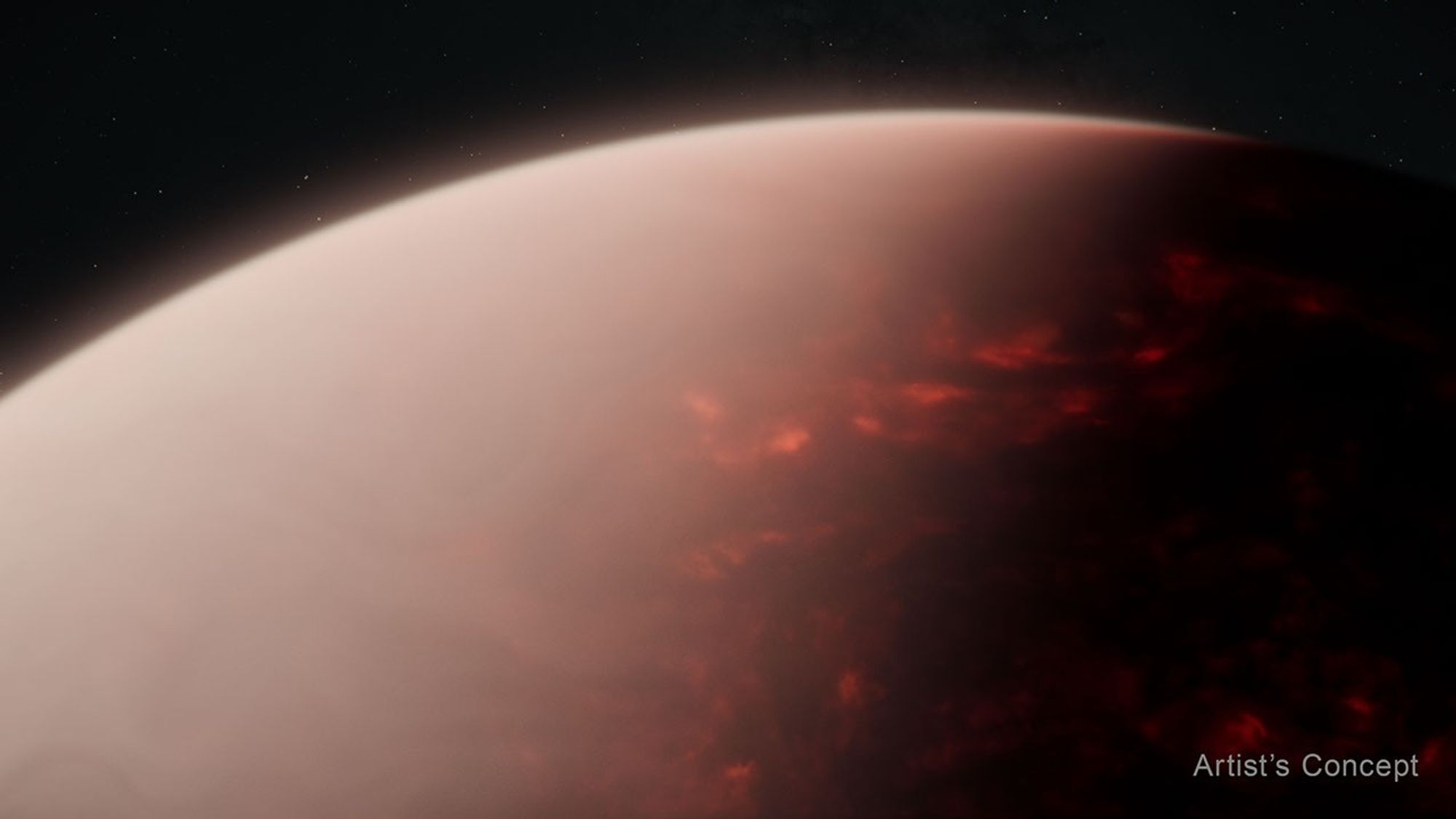
A rocky planet that circles its star so closely that a full year there lasts less than 11 hours should not, by most theories of planetary evolution, still have an atmosphere. New observations from the James Webb Space Telescope suggest one does anyway — and that it may be shielding itself with clouds made of vaporized rock.
The planet, TOI-561 b, is a "lava world" roughly 280 light-years from Earth in the constellation Sextans. An international team led by Samuel Boucher, who began the project as an undergraduate researcher at the Université de Montréal's Trottier Institute for Research on Exoplanets, used Webb's NIRSpec instrument to track the planet's heat and brightness continuously for 37 hours, covering nearly four full orbits. The results, detailed in a preprint of the paper accepted in The Astronomical Journal, show the planet reflects about three-quarters of the starlight that hits it — a reflectivity, or Bond albedo, of roughly 0.74 — a figure comparable to cloud-draped Venus. The work was announced jointly by the University of Waterloo, where co-author Lisa Dang is a physics and astronomy professor and the project's lead, and the University of Birmingham, home to co-author Anjali Piette.
A planet that shouldn't have kept its air
TOI-561 b was first spotted in 2020 by NASA's Transiting Exoplanet Survey Satellite. It is about twice Earth's mass and 1.4 times Earth's radius, and it orbits its star in roughly 10.7 hours. Its host star, TOI-561, is itself unusual: estimated at about 10 billion years old and notably metal-poor, it is one of the oldest stars yet found to host rocky planets, suggesting such worlds were already forming when the universe was less than a third its current age.
Because TOI-561 b sits so close to its star, its dayside is estimated to reach around 2,048 kelvin (roughly 3,200 degrees Fahrenheit), hot enough to maintain an ocean of molten rock, while its nightside runs far cooler, around 1,089 kelvin. Planets this close to Sun-like stars are expected to have had any primordial atmosphere stripped away by intense radiation and stellar wind within a few hundred million years. Most of the handful of similarly scorched, ultra-short-period rocky planets Webb has examined so far orbit smaller, cooler red dwarf stars and have turned out to be bare rock. TOI-561 b's star is far more Sun-like and energetic, making the planet's apparent atmosphere harder to explain — and an earlier Webb study of the planet, published in December 2025, had already hinted that its dayside glow was too dim for bare rock, pointing to some kind of insulating layer.
Reflective clouds, not missing heat
The new phase-curve data let the team test whether the planet's unusually cool dayside could simply be explained by heat flowing efficiently around to the nightside. It could not: the nightside was not warm enough to account for the energy missing from the dayside. That mismatch, the researchers conclude, means much of the stellar energy is being reflected back into space rather than absorbed or redistributed — the signature of clouds rather than exposed magma.
Climate models built by the team suggest the reflective layer is made of vaporized silicate minerals — compounds such as silicon dioxide and magnesium silicate, chemically related to quartz and sand — condensing out of the planet's atmosphere near the day-night boundary. Those clouds would both reflect incoming starlight and reduce the amount of energy available to drive gas escape, potentially helping the atmosphere survive longer than it otherwise could.
"We measured how the planet's brightness and heat changed throughout its orbit. This technique, known as a phase curve, revealed that the planet reflects a significant amount of light from its star," said Lisa Dang, the project's lead and a physics and astronomy professor at the University of Waterloo.
What it means, and what's still unknown
The finding matters beyond one unusual planet. Researchers use ultra-short-period rocky worlds as test cases for how atmospheres survive — or don't — under extreme stellar radiation, which feeds directly into models of rocky planet evolution and, eventually, into assessments of which kinds of worlds can hold onto atmospheres long enough to matter for habitability elsewhere. A Sun-like star retaining a planet with any real atmosphere in such a punishing orbit complicates assumptions built mostly from bare, M-dwarf-orbiting planets examined previously, as a summary of the findings published this week noted.
"Our discovery challenges current theories," said Anjali Piette, an assistant professor of astronomy at the University of Birmingham and a co-author of the study. "Instead, the evidence suggests it still has a significant atmosphere today. This raises major questions such as whether the planet started with an unusually large supply of gases" that has only partly depleted, or whether its atmosphere is continually resupplied by volatiles escaping from its molten interior.
The team has not pinned down what the atmosphere is actually made of. No molecular absorption features have yet been detected in the data, so the composition remains a matter of competing hypotheses: a dense, carbon-dioxide-rich envelope resembling an extreme, overheated version of Venus, or a sulfur-dioxide-heavy atmosphere more like that of Jupiter's volcanically active moon Io.
Next steps
Dang said the group's next priority is distinguishing between those possibilities. "The next big question we will seek to answer is whether TOI-561 b's atmosphere resembles Venus or an extreme Io," she said, adding that "observing the planet at longer wavelengths with JWST could give us insights and help explain how a planet this hot" has managed to hold onto an atmosphere for billions of years. Follow-up Webb observations at those longer wavelengths are expected to look for the specific chemical fingerprints — carbon dioxide versus sulfur compounds — that would settle the question and clarify whether the planet's magma ocean is actively feeding its skies.
A Forgotten Particle May Explain Why Matter Outlasted Antimatter

Rubin Observatory spots a candidate for the solar system's sixth dwarf planet

Ultracold atoms recreate an effect too faint to observe directly