Astronomers capture first direct image of Betelgeuse's companion star
A century-old mystery about the red supergiant's flickering brightness is resolved after VLT images reveal a companion two to three times the mass of the sun.
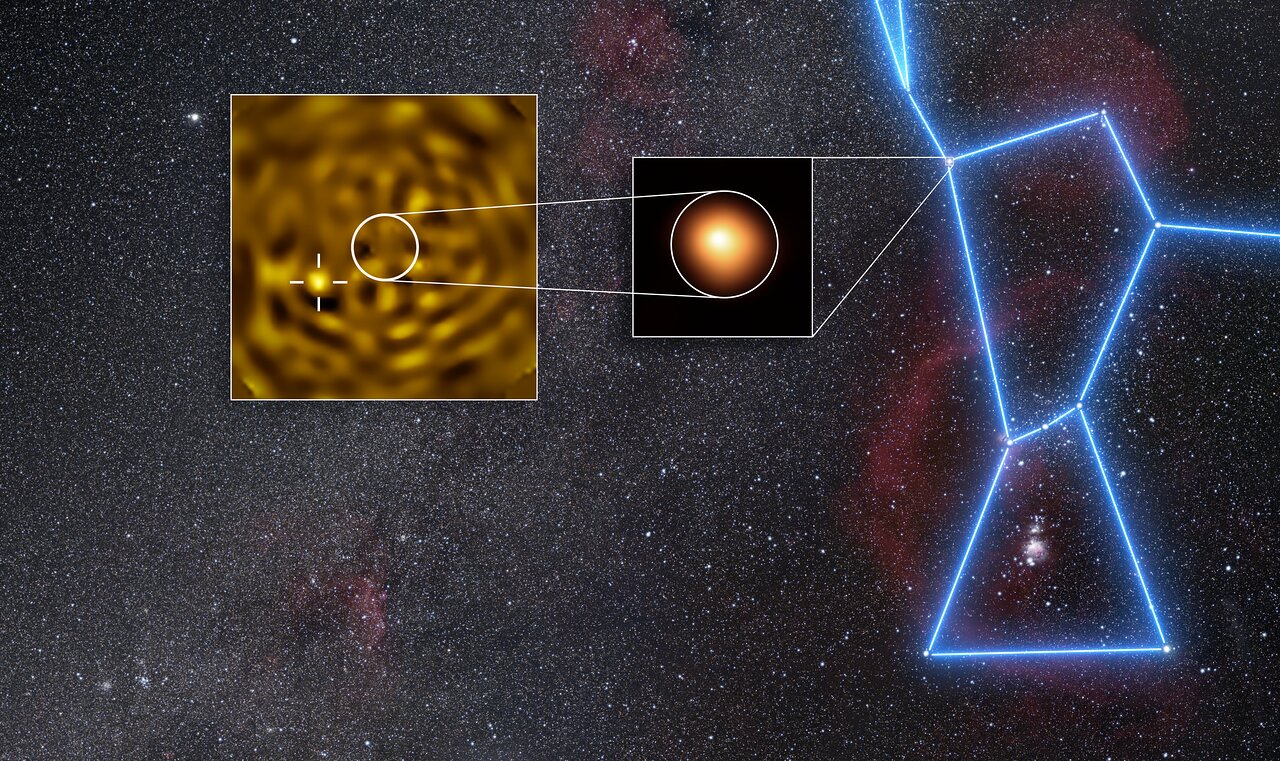
Astronomers say they have finally captured a direct image of the long-suspected companion star orbiting Betelgeuse, closing out a search that stretched back nearly a century. The observation, made with the European Southern Observatory's Very Large Telescope in Chile, is described by the research team as the clearest evidence yet that the famous red supergiant is not alone.
The findings, led by astronomer Miguel Montargès of the Observatoire de Paris – PSL, were published in the journal Astronomy & Astrophysics in late July. Using the VLT's SPHERE instrument, the team photographed the object, nicknamed Betelgeuse B, in December 2024 — timed to a predicted window when the companion would be at its greatest apparent distance from its overwhelmingly bright neighbor. "I jumped from my chair when I saw the processed images," Montargès said. "This is the conclusion of a century-long quest."
Betelgeuse, roughly 500 to 600 light-years from Earth in the constellation Orion, is so large that if it replaced the sun, its surface would extend past the orbit of Mars. Astronomers have puzzled since the early 20th century over unexplained variations in the star's brightness, with a companion star long floated as one possible explanation. Earlier indirect evidence, including a tentative 2024 detection with the Gemini North telescope in Hawaii, had suggested a faint, low-mass companion of under one solar mass. The new direct images instead point to a much heavier object, estimated at two to three times the mass of the sun.
Outside researchers who were not involved in the study said the confirmation was significant. "I mean, it's really there!" astronomer Andrea Dupree of the Center for Astrophysics | Harvard & Smithsonian told Scientific American, adding that she now plans to search other massive, well-studied stars for hidden companions of their own. Meridith Joyce of the University of Wyoming said she trusted the new mass estimate despite some tension with earlier models, noting that stellar databases for such extreme objects remain incomplete.
The discovery matters beyond settling a long-running mystery. Betelgeuse is expected to end its life in a supernova explosion, and binary companions can measurably shape how massive stars evolve and eventually die, through processes such as mass transfer between the pair. Some models suggest Betelgeuse B's orbit will decay over roughly the next 10,000 years until it is ultimately swallowed by its much larger companion — a slow-motion prelude that researchers say could offer clues about the messy final chapters of supergiant stars generally.
Detecting the companion at all required threading a narrow needle: Betelgeuse itself is roughly a million times brighter, meaning any nearby object risks being lost entirely in its glare. The SPHERE instrument, designed originally to hunt exoplanets by blocking out starlight from their host suns, proved sensitive enough to pick out the faint signal once astronomers knew precisely when and where to look. Two independent statistical analyses of the same December 2024 dataset both flagged the same faint point of light, a cross-check the team says bolsters confidence that the detection is real rather than an imaging artifact.
For now, astronomers plan follow-up observations to refine Betelgeuse B's mass, temperature and orbital period, reported at around six years, as they work out exactly what kind of star is hiding in the glare of one of the night sky's brightest points of light. The result is also being framed, as Sci.News put it, as a reminder that even the most scrutinized stars in the sky can still hold surprises.
European Southern Observatory — direct image of Betelgeuse's companion
Observatoire de Paris – PSL — visual proof Betelgeuse has a companion
Center for Astrophysics | Harvard & Smithsonian — strongest evidence yet Betelgeuse has a companion
Scientific American — scientists get best yet glimpse of Betelgeuse's companion star

Deadly hospital fungus survives antifungal drugs by duplicating its whole genome, study finds

China's Chang'e-6 moon rocks suggest a new explanation for the lunar far side's thick crust

NASA Telescopes Trace a Ghostly Radio 'Treble Clef' to a Galaxy-Cluster Collision Hidden Behind the Milky Way
