Astronomers trace first stellar stream found beyond the Milky Way, revealing hidden dark matter
A faint ribbon of stars torn from a globular cluster around a distant ultra-diffuse galaxy gives researchers a new way to measure dark matter in galaxies other than our own.
Astronomers have identified the first stream of stars ever traced around a galaxy beyond the Milky Way, a faint trail left by a globular star cluster that a distant galaxy's gravity slowly tore apart. The discovery, published in the journal Nature, gives astronomers a working tool to weigh the invisible dark matter around galaxies other than our own for the first time.
The stream wraps around UGC 9050-Dw1, an ultra-diffuse galaxy roughly 115 million light-years from Earth, according to a press release from Northwestern University, whose astrophysicist Tjitske Starkenburg is among the study's authors. The finding was reported this week by ScienceDaily and other outlets summarizing the peer-reviewed paper.
A faint arc around a puffed-up galaxy
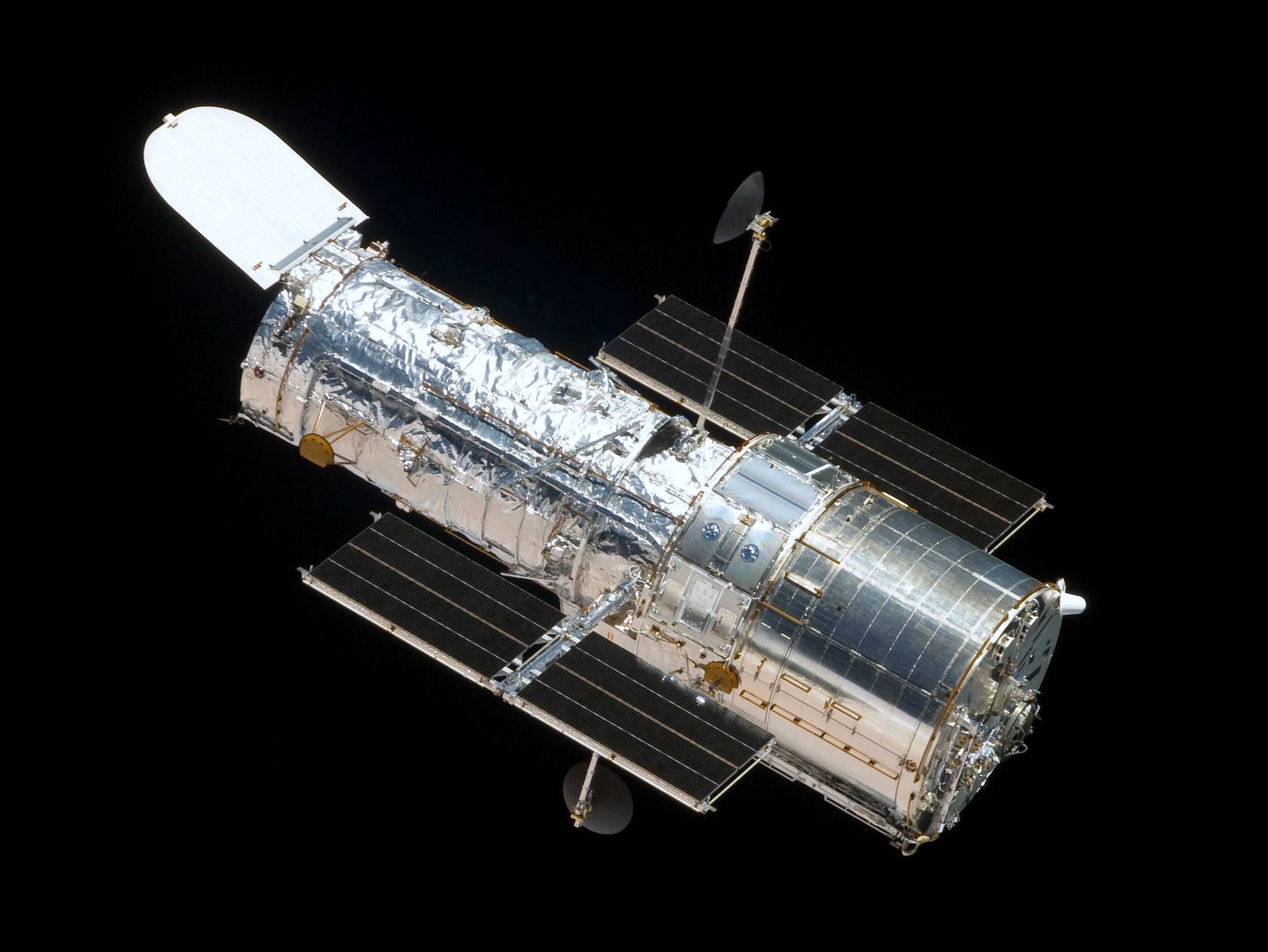
The team, led by Julie Kiel Holm of the University of Copenhagen and Sarah Pearson of the Technical University of Denmark, found the structure by combing through archival images from the Hubble Space Telescope. Study co-author David Hendel spotted a faint, thin arc of light while examining deep exposures of UGC 9050-Dw1, a type of galaxy known as an ultra-diffuse galaxy, meaning it has the physical footprint of a large galaxy like the Milky Way but only a small fraction of its stars. The researchers have named the structure the Oyashio stream, and estimate it stretches roughly 6,000 light-years, a fine ribbon set against the galaxy's otherwise sparse, dark backdrop.
The team confirmed the detection with follow-up ground-based observations, then ran thousands of computer simulations, a technique called generative stream modeling, to test which combinations of orbital shape and dark matter distribution could reproduce the stream's exact form. According to the paper posted to the preprint server arXiv, the analysis produced what the authors describe as the first stream-based constraint on a dark matter halo for an ultra-diffuse galaxy, and it points to a massive, dark-matter-dominated halo surrounding UGC 9050-Dw1.
Why streams reveal what cannot be seen
Stellar streams form when a galaxy's gravity gradually pulls apart a globular cluster or dwarf satellite in orbit around it, stretching its stars into a long thin trail that traces the orbit for billions of years. Astronomers have mapped dozens of such streams inside the Milky Way, including the well-known Sagittarius and GD-1 streams, and have used their shapes to infer the mass and structure of the dark matter halo enveloping our own galaxy. Because the stars in a stream all follow nearly the same orbital path, and that path is bent by everything with mass nearby, including matter that emits no light, a stream's precise geometry works like a scale for weighing a galaxy's unseen material.
Extending that method to another galaxy had not been done before this study. Dark matter is thought to make up roughly 85 percent of all matter in the universe, yet it has never been directly observed; its presence is inferred entirely from its gravitational effects on visible matter, including the rotation speeds of galaxies, the bending of light through gravitational lensing, and now, stream shapes beyond the Milky Way. Each of those techniques has its own blind spots and assumptions, so a method that works on a completely different kind of evidence gives researchers an independent check on the numbers those other approaches produce.
Ultra-diffuse galaxies like UGC 9050-Dw1 have drawn particular scientific interest in recent years because their dark matter content varies enormously from one to the next; some, first reported in studies published around 2018, appear to have little or no dark matter at all, a result that puzzled astronomers and drew skepticism at the time, while others, including this one, appear to be unusually dark-matter-rich for their visible size. Explaining that spread has become one of the more contested questions in galaxy formation, since the leading model of cosmology predicts that dark matter and visible matter should generally track each other fairly closely as galaxies form and evolve.
What researchers are saying
Starkenburg said the technique works because the physics of a stream's shape is straightforward to model against a galaxy's estimated visible mass.
"The stars in a stellar stream all travel along nearly the same orbit, and that orbit is shaped by the galaxy's gravity. By modeling that gravity, we can estimate the galaxy's total mass. We already know roughly how much of that mass comes from visible matter like stars, so the rest must be dark matter."
Holm, the study's lead author, said the new measurement lines up with earlier, indirect estimates of dark matter in UGC 9050-Dw1 obtained through other methods, while opening a fresh line of evidence. "Our results are consistent with previous studies and what they have shown about dark matter in this ultra-diffuse galaxy," Holm said, according to the Northwestern release. "We are measuring it with a completely new tool for this type of galaxy, demonstrating that this method also works beyond our own galaxy."
Starkenburg also pointed to a longstanding puzzle in the study of streams within the Milky Way: some appear to have small gaps or clumps in them, features some astronomers suspect are caused by clumps of dark matter passing through and gravitationally disturbing the thin trail of stars. Whether the same effect shows up in streams around other galaxies is now, for the first time, a question that can be tested. "If we can confirm that's what's causing these features, that will give us an entirely new way to test how dark matter is distributed, and ultimately learn more about its fundamental nature," she said.
A wider search is coming
The discovery relied on Hubble images that were not originally taken to hunt for stellar streams, meaning the Oyashio stream turned up almost by chance during a close inspection of the data. Starkenburg noted that finding a usable stream in existing Hubble data, and confirming it from the ground, bodes well for instruments still to come. NASA's Nancy Grace Roman Space Telescope, which can survey an area roughly 100 times larger than Hubble in a single exposure, is expected to turn up many more candidate streams once it begins science operations, and the European Space Agency's Euclid mission is already surveying wide areas of sky that could contain additional examples.
The research team said it plans to search Euclid's growing archive and data from the ground-based Vera C. Rubin Observatory for more candidate streams around other galaxies before Roman is fully operational, then combine Roman's infrared images with visible-light data from Euclid, Rubin and Hubble to build a larger catalog. A bigger sample of extragalactic streams would let astronomers compare dark matter halos across many ultra-diffuse galaxies at once, testing whether the wide variation already seen in this galaxy class reflects real differences in how much dark matter these galaxies retain, or how it is distributed within them. The Oyashio discovery gives that effort its proof of concept: a technique built and tested for decades on the Milky Way's own halo now has a demonstrated path to the rest of the universe.
Nature — Evidence for the First Globular Cluster Stellar Stream beyond the Milky Way
Northwestern University — Cosmic breadcrumb trail reveals hidden dark matter
ScienceDaily — A ghostly ribbon of stars reveals hidden dark matter
arXiv — Evidence for the First Globular Cluster Stellar Stream beyond the Milky Way (preprint)

Deadly hospital fungus survives antifungal drugs by duplicating its whole genome, study finds

China's Chang'e-6 moon rocks suggest a new explanation for the lunar far side's thick crust

NASA Telescopes Trace a Ghostly Radio 'Treble Clef' to a Galaxy-Cluster Collision Hidden Behind the Milky Way
