Cambridge physicists capture first 3D images of a decaying quantum vortex tangle
A Cambridge-led team photographed, in three dimensions for the first time, the chaotic knot of quantum vortices that forms inside an ultracold gas as it becomes a single coherent quantum object, confirming a turbulence theory first proposed nearly 70 years ago.
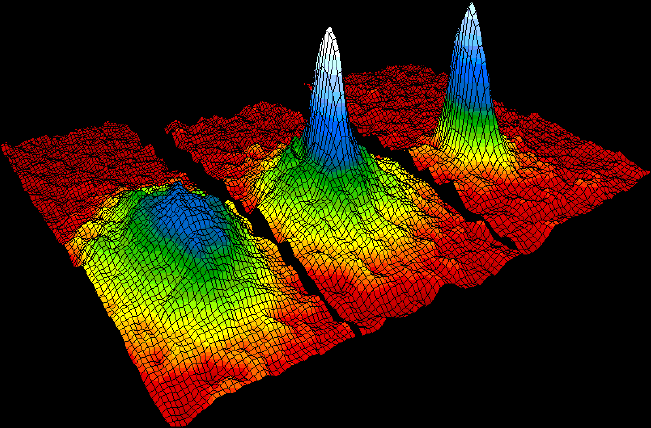
Physicists at the University of Cambridge have taken the first direct, three-dimensional images of a tangled knot of quantum vortices unraveling inside an ultracold atomic gas, confirming a decades-old theoretical prediction about one of the stranger forms of turbulence in nature. The work, led by Sebastian J. Morris of the university's Cavendish Laboratory, was published November 5 in Physical Review Letters and was selected by the American Physical Society as an Editors' Suggestion.
The gas in question was a cloud of potassium-39 atoms cooled to within a fraction of a degree of absolute zero. At that temperature, the atoms can merge into a Bose-Einstein condensate, a state of matter in which a large collection of particles stops behaving as individuals and instead shares a single quantum identity. First achieved in the lab in 1995, the condensate state had never been watched, directly and in three dimensions, as it filled with and then shed the dense web of spinning vortex lines that theorists have long predicted should appear along the way.
Photographing a knot of spinning threads
To see the vortices, the Cambridge team trapped the potassium gas in a uniform, cylindrical optical container less than a tenth of a millimeter across, then deliberately scrambled the gas into a disordered, far-from-equilibrium state before letting it relax. As the cloud settled, the researchers released it, magnified it several-fold using matter-wave optics, and photographed thin slices of the expanded cloud. Each vortex line running through a given slice showed up as a dark streak, letting the team count and measure the total length of tangled vortex line per unit volume at different moments after the gas was disturbed.
Repeating the experiment many times under identical conditions, the researchers tracked how quickly that vortex tangle thinned out. They found that the density of vortex line fell off exactly as predicted by a model of turbulence proposed by the British physicist William F. Vinen roughly 70 years ago: a chaotic, randomly oriented web of vortices with no large-scale swirling flow, as opposed to the more familiar cascade of eddies seen in ordinary fluids. Notably, the decay rate did not depend on how strongly the atoms interacted with one another, and once rescaled for the particles' mass, it closely resembled decay rates long measured in an entirely different quantum fluid, superfluid helium. The vortices also became distinctly countable in the images at almost the same moment the gas developed the long-range quantum coherence that defines a true condensate, tying the untangling of the vortex web directly to the birth of the condensed state itself. The preprint underlying the published paper was first posted to arXiv at the end of April.
Two kinds of chaos in a quantum fluid
Ordinary turbulence, the kind that rattles an airplane or churns a river, is already one of the hardest unsolved problems in classical physics. Quantum fluids such as superfluid helium and ultracold atomic gases add a further twist: because of quantum mechanics, such fluids cannot spin smoothly. Rotation can only appear as thin, quantized vortex lines, each carrying a fixed, indivisible amount of circulation. When a quantum fluid is driven hard enough, those vortices can multiply and tangle into the kind of disorganized mess the Cambridge group photographed.
Physicists distinguish two broad flavors of this quantum turbulence. One resembles classical turbulence, with vortex bundles mimicking the cascade of energy from large eddies down to small ones. The other, the Vinen or "ultraquantum" variety the new paper addresses, has no such large-scale organized flow at all. Evidence for Vinen turbulence had previously come only indirectly, inferred from how superfluid helium damps sound waves, or from two-dimensional, pancake-shaped atomic clouds where only a flat slice of vortex behavior could be seen. A quantitative, three-dimensional picture of an isotropic vortex tangle decaying according to Vinen's prediction had remained elusive until now, which is why the American Physical Society's in-house review, Physics, flagged the paper as a notable advance for a broad physics readership.
Why a tangle of cold atoms matters beyond the lab
The immediate audience for the finding is the community of physicists who study quantum fluids and the behavior of matter far from equilibrium, rather than any affected industry or public-health population. But the result carries beyond the specific apparatus. The Cambridge group that produced it, led by Professor Zoran Hadzibabic, has been using the same ultracold-potassium platform to probe other universal limits on how order emerges in quantum systems. In a companion paper published last year in Nature, the group reported that quantum coherence itself spreads at a fixed maximum rate as a condensate forms, a result the researchers described, in their own laboratory's Cavendish Laboratory magazine, as tied to "the decay of a turbulent spaghetti-like tangle of vortex filaments," the very phenomenon the new study has now imaged directly.
Our work shows that, at least when coherence is generated by relaxation in an isolated system, its growth is subject to an intrinsic many-body constraint.
Researchers in the field have long drawn analogies between vortex tangles in laboratory quantum fluids and the superfluid neutron matter thought to exist inside neutron stars, where tangled, pinned vortices are implicated in the sudden spin-up events called glitches. Ultracold gases, unlike neutron stars or helium baths, let experimenters dial the interaction strength, density and geometry of the fluid independently, making them a uniquely controllable testbed for ideas about turbulence and far-from-equilibrium physics generally.
What comes next
The Cambridge authors note that their measurements do not yet pin down which microscopic process drives the universal behavior they observed, or whether the vortex-tangle picture and the wave-based picture of coherence growth are two views of the same underlying mechanism. Planned follow-up work, according to the group's own account of the broader research program, includes testing whether similar universal decay laws hold in gases confined to fewer dimensions, in mixtures of different atomic species, or in lattice geometries rather than smooth optical boxes. More direct imaging of vortices and other phase defects is already underway at Cambridge and in rival ultracold-atom laboratories elsewhere, aimed at settling exactly how a disordered quantum gas finds its way to a single, coherent state.

Europe's Hera Probe Sends Back First Close-Up Images of Asteroid DART Deliberately Struck

Thousands of tiny animals found living inside deep-sea mining's target rocks

Scientists May Have Solved the 40-Year Mystery Behind Uranus and Neptune's Lopsided Magnetic Fields
