Europe's Hera Probe Sends Back First Close-Up Images of Asteroid DART Deliberately Struck
Four years after NASA's DART mission rammed into a small moonlet asteroid and measurably altered its orbit, ESA's Hera spacecraft has arrived to survey the aftermath and determine whether the technique could work again.
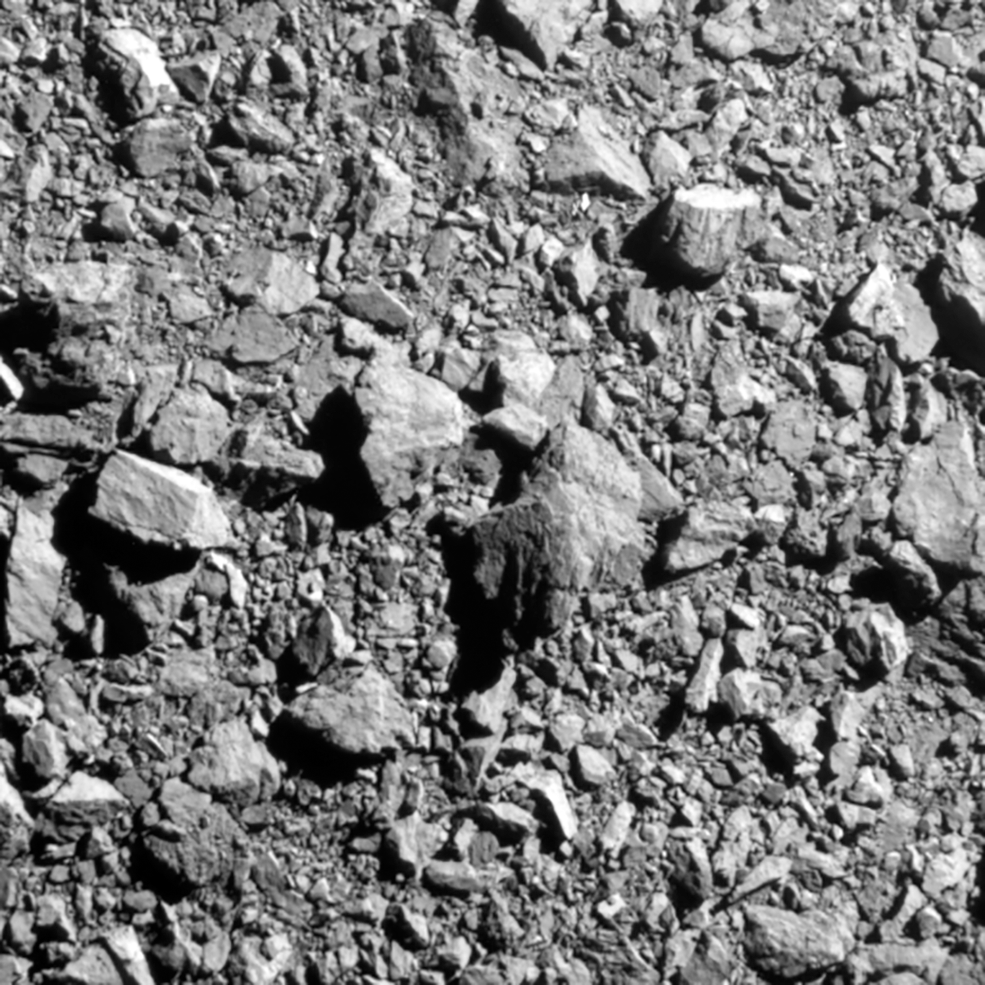
A European spacecraft sent to inspect the scene of humanity's first deliberate attempt to alter the path of another world has returned images of a face of that asteroid no one has seen in such detail before. The European Space Agency's Hera probe, which reached the Didymos binary asteroid system last month, has begun beaming back close-up pictures that mission scientists say look almost unrecognizable compared with the side NASA's DART spacecraft photographed just before it slammed into the smaller of the two bodies four years ago.
The image, released by ESA on November 12, was taken from about 56 kilometers away and shows one face of Didymos, the larger of the pair, with a sliver of its small moonlet, Dimorphos, peeking out near the top. Didymos measures roughly 780 meters across; Dimorphos, which orbits a little more than a kilometer away, is about 151 meters wide. The picture shows large boulders, smoother patches of terrain, and what ESA describes as a surprisingly sharp ridge running around the asteroid's equator, a feature that may form because Didymos spins once every 2.2 hours, fast enough that loose surface material could be flung toward its midsection. Some scientists think Dimorphos itself may have formed from material shed by Didymos in exactly that way.
A spacecraft that cannot simply orbit its target
Hera's current vantage point, about 25 to 30 kilometers from the asteroid pair, is itself part of the story. Because Didymos's gravity is roughly 40,000 times weaker than Earth's, and Dimorphos's is about 200,000 times weaker still, a conventional circular orbit is not practical. Instead, according to an ESA account of the operation published November 11, Hera is flying a series of straight-line "rectangular orbits" around the pair's shared center of gravity, drifting at roughly 12 centimeters per second — about the pace of a fast-crawling insect — and firing its thrusters every three or four days to turn 90 degrees. The approach, adapted from experience flying ESA's Rosetta comet mission, means that if a thruster ever failed, the spacecraft would drift safely away from the asteroids rather than toward them. Hera is currently about 197 million kilometers from Earth and is controlled from ESA's operations center in Darmstadt, Germany, which contacts the spacecraft roughly eight hours a day through deep-space antennas in Argentina, Spain and Australia.
Revisiting the scene of a 2022 impact
Hera's target is the site of one of the more consequential experiments in spaceflight history. On September 26, 2022, NASA's Double Asteroid Redirection Test, or DART, a 580-kilogram spacecraft, struck Dimorphos head-on at roughly 6.1 kilometers per second. Weeks later, NASA confirmed the impact had shortened Dimorphos's 11-hour, 55-minute orbit around Didymos by about 32 minutes, far more than engineers had modeled beforehand. At the time, NASA's planetary science division director, Lori Glaze, called it the first time humanity had deliberately changed the orbit of a celestial object. Johns Hopkins University's Applied Physics Laboratory, which built and ran the spacecraft for NASA's planetary defense office, managed the mission and continues to analyze its aftermath.
What DART's own cameras could not do was linger to examine what the collision actually did to the asteroid's surface, interior or mass — information needed to turn a single dramatic demonstration into a technique that could reliably be used again if a genuinely hazardous asteroid were ever found on a collision course with Earth. Hera, which launched in October 2024, was built specifically to answer those follow-up questions: whether the impact left a discrete crater or reshaped Dimorphos more broadly, what the moonlet is actually made of and how it is structured internally, and why the deflection it produced exceeded the range of outcomes that pre-impact computer simulations had predicted.
Why the follow-up survey matters
No known asteroid currently threatens Earth, and neither Didymos nor Dimorphos poses any danger to the planet. The value of the Hera mission lies in what it can tell planetary defense researchers about small, rubble-strewn asteroids generally, since Dimorphos is considered a reasonable stand-in for the broader population of smaller near-Earth objects that an early-warning system would most plausibly need to deflect. Measuring Dimorphos's mass and internal structure precisely, something DART's brief flyby could not do, is central to knowing how much force a future kinetic-impactor mission would need and how predictable its effects would be.
Scientists working on the mission have described the new imagery as an emotional moment after years of preparation. Hera's principal investigator, Patrick Michel of the French research agency CNRS and the Côte d'Azur Observatory, was quoted by Space.com reacting to the spacecraft's first close-up view of the previously unphotographed side of Didymos:
"The first thing we said was, 'Wow.' This is the other side of Didymos from the one that DART's camera showed us shortly before impact, so this feels like looking at a whole new world."
ESA mission scientist Michael Kueppers has said the team is not yet trying to answer its hardest questions. The current phase of the mission, he noted, is meant to gather broad, big-picture findings before Hera moves closer for detailed study. Some surface features visible on Didymos, he has suggested, may be debris thrown off by the DART impact that later settled back onto the larger body.
What comes next
ESA has said it plans to release more detailed images of both Didymos and Dimorphos on November 25, as Hera moves from its current "early characterization" phase into a closer survey roughly 20 kilometers from the pair. In the coming months, the spacecraft is expected to carry out what mission planners describe as a close-up "crash site investigation" of Dimorphos using its full instrument suite, followed by the deployment of two shoebox-sized CubeSats designed to fly even nearer to the asteroids, with an eventual landing attempt under consideration later in the mission. Those steps, rather than the images released so far, are expected to produce the mass and composition measurements that will determine whether DART's result can be generalized into a repeatable planetary defense strategy.
European Space Agency — Hera spies a half-hidden asteroid moonlet
European Space Agency — Hera spacecraft in 'rectangular orbit' around target asteroids
NASA — NASA Confirms DART Mission Impact Changed Asteroid's Motion in Space
Space.com — Hera probe gets 1st good look at asteroid system clobbered by NASA's DART mission

Thousands of tiny animals found living inside deep-sea mining's target rocks

Scientists May Have Solved the 40-Year Mystery Behind Uranus and Neptune's Lopsided Magnetic Fields
Cambridge physicists capture first 3D images of a decaying quantum vortex tangle
