Deep-Sea Neutrino Hunt Finds No Cracks in Einstein's Relativity
A first large batch of data from a neutrino telescope buried beneath the Mediterranean seabed turns up no sign that space itself breaks down into discrete grains, physicists report, tightening the limits on one of nature's most fundamental symmetries.
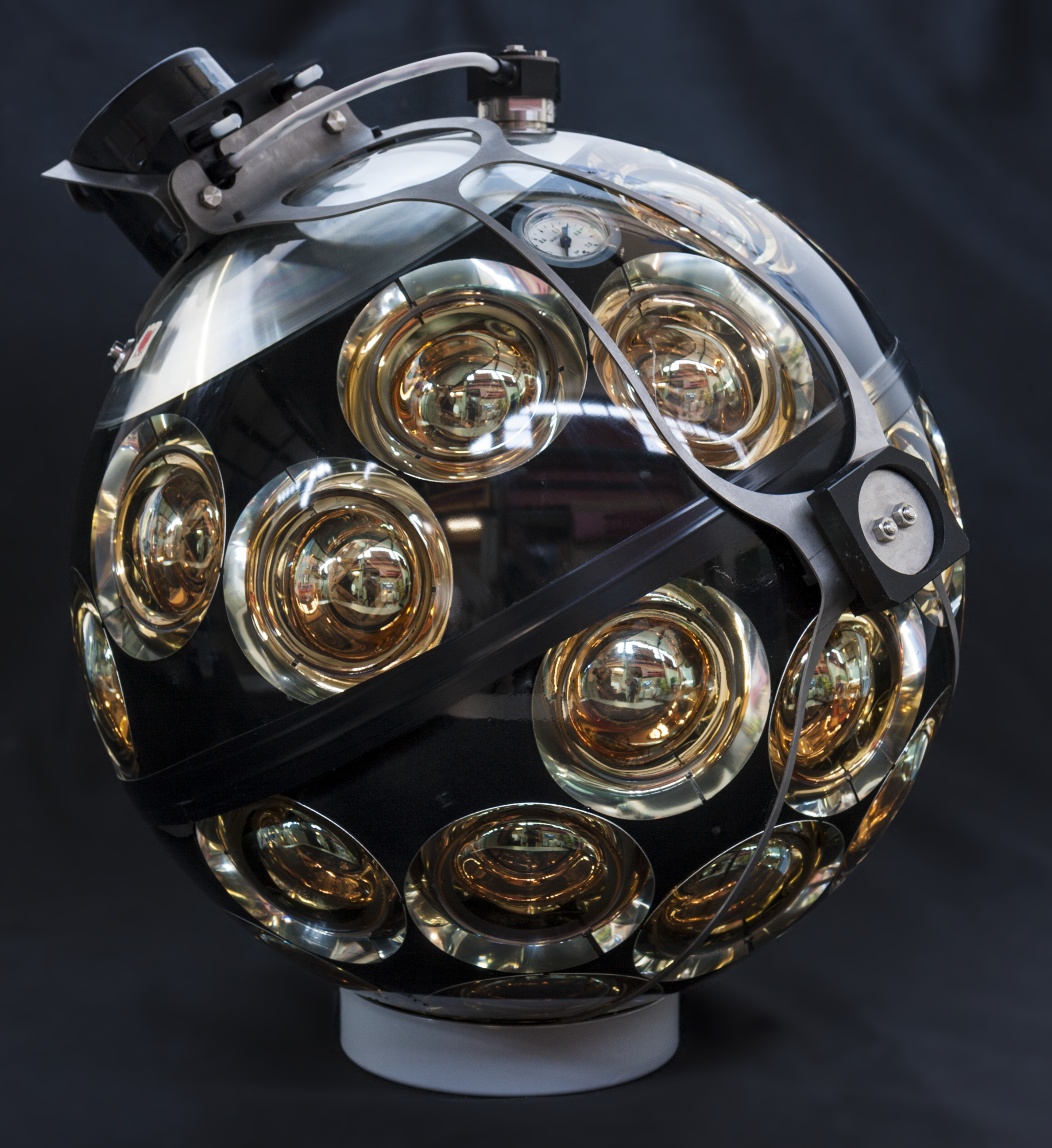
Physicists working with a neutrino telescope anchored nearly a mile and a half beneath the Mediterranean Sea have completed one of the most direct tests yet of whether Albert Einstein's description of space and time holds up at the smallest scales nature allows. The result, reported this week, is a negative one: no evidence that the symmetry underlying relativity breaks down.
The finding comes from the KM3NeT collaboration, an international group that operates a pair of underwater neutrino telescopes in the Mediterranean. In a paper the collaboration submitted to the Journal of Cosmology and Astroparticle Physics and posted to the arXiv preprint server, researchers describe scouring 1.4 years of data from ORCA, the France-based half of the detector, for tiny irregularities in how atmospheric neutrinos change identity as they pass through the planet. Using only the first six of a planned 115 detector strings, the team found no sign that Lorentz invariance — the principle that physics looks the same in every direction and at every speed, a cornerstone of both the Standard Model and general relativity — fails.
The dataset, collected between January 2020 and November 2021, amounted to 510 days of usable observing time and an exposure of 433 kiloton-years, during which the detector's models predicted 5,828 atmospheric neutrino events split across three categories of particle tracks. None of the three neutrino flavors showed oscillation patterns inconsistent with standard physics. That allowed the team to set new upper limits, some as tight as a few parts in 10^23 GeV, on a set of coefficients that describe, in the mathematics of effective field theory, how severely Lorentz symmetry could be violated. Several of the limits are the first of their kind for effects that mix muon and tau neutrinos, and, notably, they do not depend on assumptions about the makeup of distant cosmic-neutrino sources the way some earlier bounds did.
Why physicists keep hunting for cracks in spacetime
Lorentz invariance is not an abstract nicety; it is baked into nearly every successful theory in physics. But some proposals for unifying gravity with quantum mechanics suggest that at the almost unreachably tiny Planck scale, spacetime might not be perfectly smooth — it could be granular, like pixels on a screen, which would show up as minuscule violations of the symmetry at measurable energies. Neutrinos make unusually sensitive probes for this because they barely interact with matter, travel enormous distances largely undisturbed, and their flavor-oscillation behavior is predicted with high precision, so even faint deviations stand out. Physicists have run similar searches for decades with other instruments, including Japan's Super-Kamiokande and the IceCube detector buried in Antarctic ice; the KM3NeT team compared its new limits against roughly 12 years of Super-Kamiokande data and two years of IceCube data and found them competitive despite ORCA's far smaller size and shorter run time.
A sparse telescope made of seawater and light
ORCA sits roughly 2,450 meters down off the coast of Toulon, France, as one node of the broader KM3NeT infrastructure, whose sister array, ARCA, is being built off Sicily to hunt higher-energy neutrinos from distant astrophysical sources. Both use strings of glass spheres packed with light sensors, lowered into the dark water to catch the faint blue flashes, called Cherenkov light, produced when a neutrino occasionally collides with a water molecule. The six-string configuration used in this analysis is a small fraction of ORCA's planned total; by October 2026 the array had already grown to 44 detection units, with 115 eventually planned. That growth is why a result built on a relatively modest, several-year-old dataset is being reported only now, years after the data were collected — the analysis itself took time to refine, and the formal write-up followed.
A cautious, incremental result
No particles, planets or people are directly affected by a null result in fundamental symmetry testing; its audience is other physicists building and testing theories of quantum gravity, who now have a few more coefficients pinned down more tightly than before. The researchers were careful not to oversell the finding. Alba Domi of the Erlangen Centre for Astroparticle Physics at Friedrich-Alexander-Universität Erlangen-Nürnberg, a corresponding author on the study, framed the motivation plainly in comments carried by Phys.org, which covered the study this week.
"We still don't know whether our spacetime is continuous or might be discrete. Looking for violations of Lorentz invariance is one way to investigate this possibility."
Her co-corresponding author, Lukas Hennig, also at the Erlangen centre, pointed to what the result demonstrates about the instrument rather than about spacetime itself: "These results show the potential of KM3NeT/ORCA to test fundamental principles of physics." He added that the collaboration expects to do better as the detector grows: "With more data and an expanding detector, we will be able to search for even smaller effects."
What comes next
The team's next step is to extend the same style of search to ARCA, which is tuned to catch far higher-energy neutrinos arriving from deep space rather than from Earth's atmosphere. Domi noted that ARCA has not yet accumulated enough of the relevant events to run a comparable analysis, but that this is expected to change as construction continues. The broader field has had a prominent few weeks: the 2026 Nobel Prize in Physics went to Francis Halzen, the architect of the IceCube Neutrino Observatory, for the discovery of high-energy astrophysical neutrinos, a decision the Royal Swedish Academy of Sciences announced last month. That award has put a brighter spotlight on neutrino astronomy generally, including rival and complementary efforts such as KM3NeT, which researchers say will keep refining its constraints on Lorentz invariance — and on the deeper question of whether spacetime itself has a grain to it — as its underwater array continues to expand toward its full, cubic-kilometer-scale design.
Hubble survey finds dwarf galaxies keep only a sliver of the oxygen their stars make

NASA's Swift Observatory set to fall to Earth after failed rescue mission

Museum Frogs Solve a 50-Year Mystery Behind a Brazilian Die-Off
