Hubble survey finds dwarf galaxies keep only a sliver of the oxygen their stars make
A Hubble-based survey of 37 nearby dwarf galaxies finds they retain only a small fraction of the oxygen forged inside their own stars, a shortfall researchers say points to supernova-driven winds that scour small galaxies more thoroughly than current models assume.
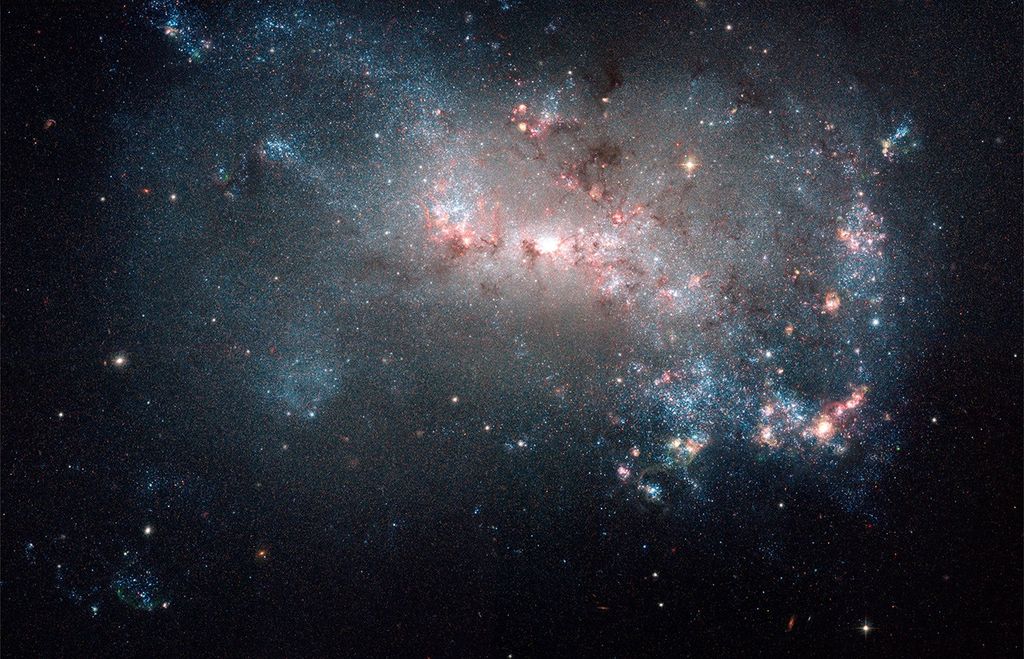
Dwarf galaxies scattered across the nearby universe appear to be missing most of an element they should have in abundance. A survey using archival observations from the Hubble Space Telescope, released by NASA on November 2, found that 37 small, gas-rich galaxies within roughly 20 million light-years of Earth hold onto only a fraction of the oxygen produced by their own stars, with most of the rest apparently blown out into surrounding space.
The project, called Galaxies Losing Oxygen via Winds, or GLOW, combined decades of archival Hubble imaging with data from the retired Spitzer Space Telescope, the Very Large Array and the Australian Telescope Compact Array to measure, galaxy by galaxy, how much oxygen theory says should be present versus how much observers can actually find. The results, according to NASA's announcement, show a persistent and substantial gap between prediction and observation across nearly all of the galaxies studied.
A galaxy-scale accounting problem
Oxygen is forged inside massive stars and scattered into a galaxy's surrounding gas when those stars explode as supernovae. Because it is the third most abundant element in the universe after hydrogen and helium, relatively easy to detect in starlight, and well understood in terms of how and where it forms, astronomers use it as a tracer for how galaxies cycle material through their lifetimes.
Kristen Wingfield McQuinn, the GLOW project's principal investigator and an astronomer who also leads mission science operations for NASA's newly launched Nancy Grace Roman Space Telescope at the Space Telescope Science Institute, said the choice of element was practical. "It's really for practical reasons that we've chosen oxygen," she said, adding that tracking its production and distribution "helps us understand galaxy evolution" and shows "where and how much galaxies are enriching the space between galaxies, called the intergalactic medium."
The study's core finding, detailed in a paper published in The Astrophysical Journal, is that low-mass galaxies in the sample retain only a small share of the oxygen their stars have produced over their histories — far less than standard galaxy-formation simulations predict. A companion data paper, which catalogs the 37 galaxies used in the analysis, compiled Hubble imaging resolved down to individual stars, radio measurements of hydrogen gas, infrared Spitzer data and distance estimates to build what the team describes as a uniformly processed atlas spanning galaxies from roughly a million to several billion times the mass of the sun.
Winds stronger than the models assume
The team's full oxygen accounting, laid out in a second paper reporting the project's census of the element, found that the low-mass galaxies studied retain on average only about one-tenth of the oxygen their stars have made, with individual galaxies ranging roughly from 4 to 25 percent retention. Most of what remains sits in diffuse gas rather than being locked up in stars. The paper reports that retention becomes more erratic in crowded environments and near more massive neighboring galaxies, suggesting that a dwarf galaxy's surroundings — not just its own mass — shape how much enriched material it keeps or loses.
Notably, the amount of oxygen a galaxy retains does not line up neatly with its position on the mass-metallicity relation, a long-studied correlation in which more massive galaxies tend to have higher concentrations of heavy elements. That mismatch, combined with the finding that simulations reproducing the mass-metallicity relation predict substantially higher oxygen retention than what GLOW observed, suggests existing models underestimate how effectively stellar winds and supernova explosions can clear material out of small galaxies.
"We know that the oxygen had to be inside of the galaxies at some point in the past, so the oxygen must have been ejected, and to do that, you need energy from massive stars and supernova explosions to drive material out of the host galaxies and into the space between galaxies," said Grace Telford, a co-investigator on the study and assistant professor of physics and astronomy at the University of Utah.
Exactly where the missing oxygen has gone remains unresolved. The researchers cannot yet determine whether it is sitting in the circumgalactic medium — the halo of diffuse gas that surrounds a galaxy — or whether it has been expelled entirely into the intergalactic medium between galaxies. Simple modeling in the study points to the mass and metal content of a galaxy's outflowing winds as the key variables controlling how much oxygen escapes, and the team's calculations suggest these low-mass galaxies may also be pulling in less raw material from their surroundings than the universe's overall ratio of normal matter would predict.
Next steps with Roman and Webb
Because the galaxies in the GLOW sample are all close enough that Hubble can resolve their individual stars, the study relies entirely on relatively nearby, well-studied systems. McQuinn said she plans to use the Roman Space Telescope, which reached orbit at the end of August, to search for fainter and more distant dwarf galaxies that could extend the census, with Hubble and the James Webb Space Telescope then following up on the ones Roman finds. Telford said her own next step is to use Hubble to directly observe the individual massive stars thought to be driving the outflows, rather than inferring their effects indirectly from the surrounding gas.
The findings matter beyond the galaxies studied directly. Dwarf galaxies are thought to be the small building blocks from which larger galaxies, including the Milky Way, assembled over cosmic time, and similar low-mass systems were far more common in the early universe. If small galaxies systematically eject more of their enriched material than current simulations assume, that has implications for models of how heavy elements have spread through the cosmos and seeded the gas from which later generations of stars and planets formed.

Deep-Sea Neutrino Hunt Finds No Cracks in Einstein's Relativity

NASA's Swift Observatory set to fall to Earth after failed rescue mission

Museum Frogs Solve a 50-Year Mystery Behind a Brazilian Die-Off
