NASA's Swift Observatory set to fall to Earth after failed rescue mission
The Neil Gehrels Swift Observatory, a 22-year-old NASA telescope that tracked thousands of gamma-ray bursts, is expected to reenter the atmosphere early Wednesday after a privately contracted rescue mission failed to reach it in time.

A 22-year-old NASA space telescope is expected to fall back to Earth in the predawn hours of Wednesday, after a privately contracted rescue mission failed to reach it in time to extend its life in orbit.
The Neil Gehrels Swift Observatory, a roughly 1.5-ton satellite launched on Nov. 20, 2004, spent more than two decades scanning the sky for gamma-ray bursts and exploding stars, logging more than 2,000 gamma-ray bursts and 1,400 supernovas over its working life, according to CBS News. Its defining feature, and the source of its name, was an ability to swivel quickly toward newly detected bursts, often serving as a first responder that alerted the Hubble and James Webb space telescopes to follow up with deeper observations.
Unusually intense solar activity over the past few years dragged the spacecraft's orbit down faster than engineers had anticipated. NASA hired a company called Katalyst Space roughly a year ago to attempt an emergency rescue, sending up a three-armed robot named Link in July to try to boost Swift back to a higher, more stable orbit. Link never got closer than seven to nine miles from the telescope, however, and fell back to Earth itself in September, forcing NASA to abandon the rescue attempt. Swift kept making observations until late October, when its orbit grew too low and unstable to continue, and NASA formally ended the spacecraft's science mission ahead of reentry.
The U.S. Space Force now predicts reentry around 3:30 a.m. Eastern time Wednesday, though NASA has cautioned that estimate carries an uncertainty window of roughly 11 hours in either direction. Most of the spacecraft is expected to burn up in the atmosphere, but NASA mission chief scientist Brad Cenko said some denser components, including tungsten parts and pieces of its mirrors, could survive the descent. Any surviving debris would most likely land in the ocean; the predicted reentry corridor passes over parts of Africa, Australia, India, Southeast Asia and Central and South America. NASA has put the odds of the debris causing harm to anyone on the ground at roughly 1 in 2,100, and said in a statement that the "risk of harm coming to anyone on Earth is unlikely."
For the scientists who built and operated Swift, the end was long expected but still difficult. "We've known this day would come since before Swift was launched," said John Nousek, the Pennsylvania State University astronomer who led the mission's control team, who described the reentry itself as "catastrophic" for the spacecraft. Shawn Domagal-Goldman, director of NASA's Astrophysics Division, said the scale of the phenomena Swift was built to study remains difficult to convey: "A nuclear weapon going off doesn't even compare to the magnitude of energy that comes out of these things," he said of gamma-ray bursts.
Replacing Swift's particular role, as an always-ready early warning system for the broader astronomical community, is not straightforward, and researchers are still working out how other instruments might fill the gap it leaves in tracking the universe's most violent and fleeting events. NASA and the Space Force said they would continue to refine their reentry predictions as Wednesday's window approaches.

Deep-Sea Neutrino Hunt Finds No Cracks in Einstein's Relativity
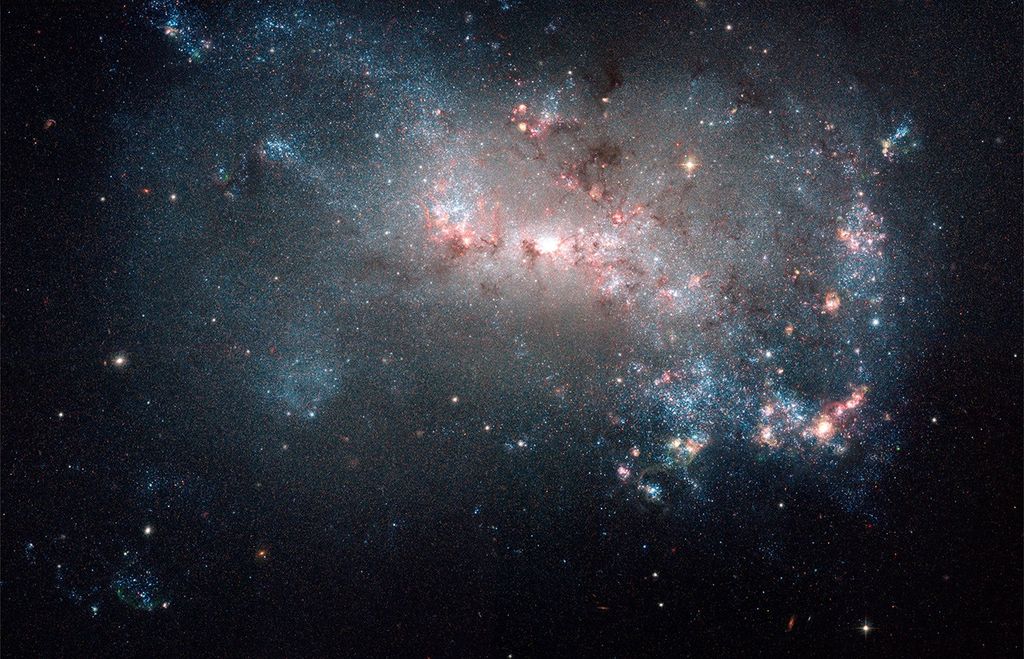
Hubble survey finds dwarf galaxies keep only a sliver of the oxygen their stars make

Museum Frogs Solve a 50-Year Mystery Behind a Brazilian Die-Off
