Earth's Next Ice Age Had Already Begun. Then Humans Stopped It.
Buried Arctic plants show North America's last great ice sheet started regrowing 2,000 years ago, only for greenhouse warming to reverse the trend by the 1960s.
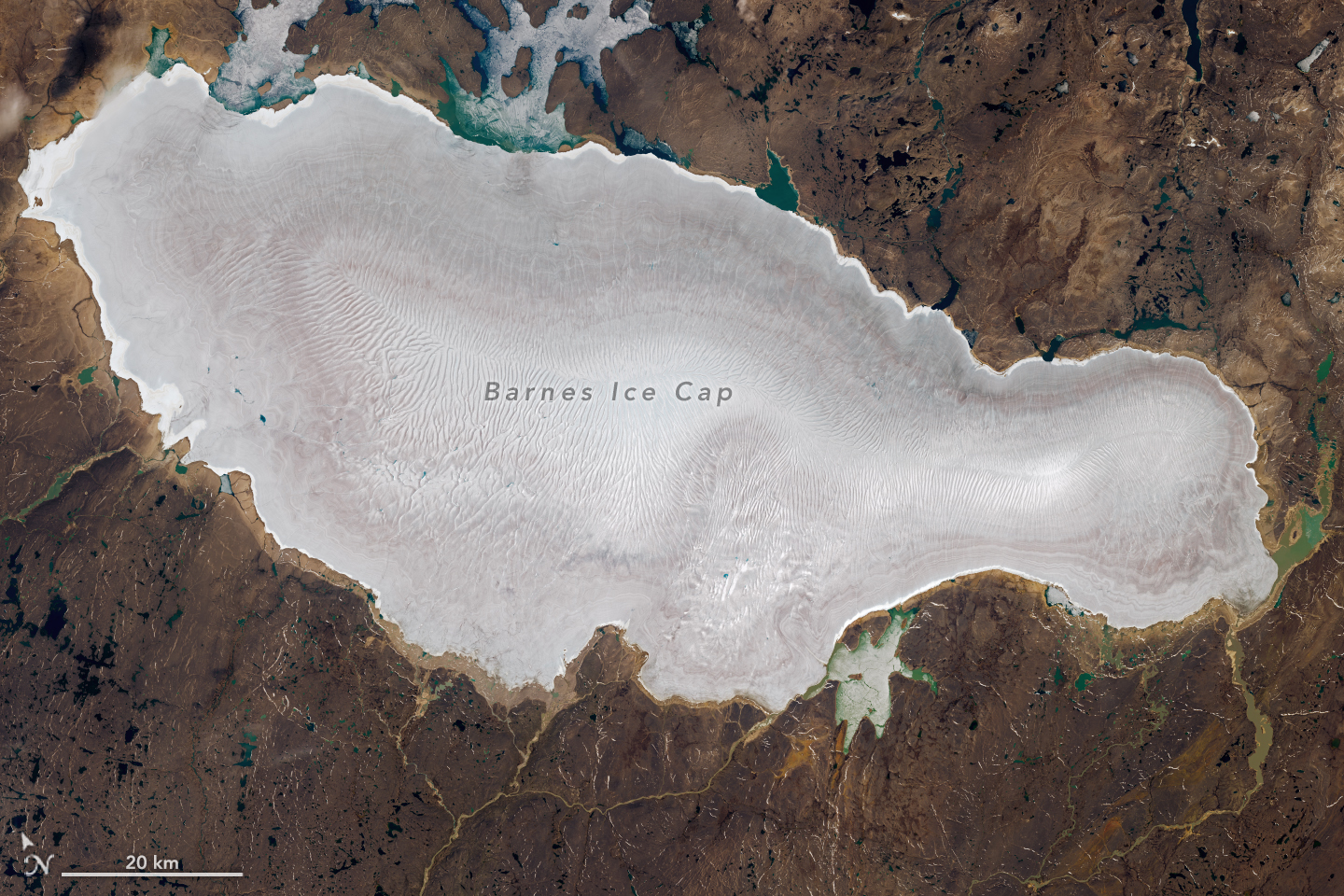
For about 2,000 years, a remnant of the vast ice sheet that once buried most of Canada had been quietly doing what ice sheets do when a planet cools: growing. Then, sometime around 1960, it stopped — and started shrinking instead. According to a study published Oct. 22 in the journal Science, that reversal was not a geological footnote. It was the interruption of a new glacial period already underway, cut off in its earliest stages by human-driven warming.
The research, led by geochemist Nicolás Young of Columbia University's Lamont-Doherty Earth Observatory along with Gifford Miller of the University of Colorado Boulder, focuses on the Barnes Ice Cap, a slab of ice on Baffin Island in Nunavut, Canada, that is the last surviving piece of the Laurentide Ice Sheet. At its peak between roughly 95,000 and 20,000 years ago, the Laurentide covered most of Canada and reached as far south as Illinois and Indiana, in places more than three kilometers thick. Today only the Barnes Ice Cap — an ice sheet now about the size of Delaware — remains.
What the buried plants revealed
Because the Barnes Ice Cap is frozen directly to the bedrock beneath it rather than sliding across the landscape, it doesn't scour away the ground it covers the way most glaciers do. Instead, it entombs whatever was growing there — mosses and dwarf shrubs — at the moment the ice advanced over them, preserving them in a kind of cold storage.
Starting with fieldwork in 2022, Young's team collected plant material exposed at the ice margin as it has retreated in recent decades and used radiocarbon dating to determine when each sample was overrun and killed by advancing ice. The logic was straightforward: if the ice cap had been regrowing for the past two millennia, the kill dates of buried plants should cluster within the last few thousand years, and should get progressively younger the closer a sample sat to the current ice edge. According to coverage of the paper, both predictions held up, and the team supplemented the Barnes Ice Cap data with samples from smaller, now-vanished ice caps nearby to reconstruct the broader pattern of advance and retreat across the region.
A glaciation that got interrupted
The reconstruction shows the ice cap reached a minimum size roughly 3,000 to 3,600 years ago, then began expanding again about 2,000 years ago — during the span of the Roman Empire, as several accounts of the study have noted. That growth continued for nearly two thousand years until approximately 1960, when rising summer temperatures pushed melt beyond what winter snowfall could replace, and the ice cap began retreating instead. Since the 1980s, researchers say, its margins have pulled back by an average of roughly 4 meters a year.
The researchers argue that this counts as more than a regional curiosity. Earth remains, technically, within the Late Cenozoic Ice Age that began roughly 34 million years ago; the present mild stretch is simply an interglacial period within it, one that began when the last glacial period ended about 11,700 years ago. Climate models have generally suggested the next full glacial period was still thousands to tens of thousands of years away. Young's team contends that the renewed ice growth on Baffin Island should itself be counted as the leading edge of that next glaciation — one that, under natural conditions, might have taken on the order of 30,000 years to build back into a continent-spanning ice sheet, before it was stopped less than a century into its run.
"It was just getting started, everything was normal, the next glaciation was about to happen — and yet it stopped," Young said, according to a Columbia Climate School account of the findings.
Why a Delaware-sized ice patch matters
The finding reframes a familiar but sometimes fuzzy talking point in climate science — that industrial-era warming has delayed the onset of the next ice age — by attaching it to a specific, dated, physical signal rather than a model projection. "People always say that it disappeared, but that's not true," Young said of the Laurentide Ice Sheet, noting that its last sliver survived, and was in fact rebuilding, right up until mid-20th-century warming intervened. Miller, in comments reported by outlets covering the paper, called the episode "an illustration of the real power of greenhouse gases."
That power is visible on the ground today. NASA's Earth Observatory reported that by mid-July 2026, the Barnes Ice Cap had lost its snow cover earlier and faster than at any point in the satellite record, exposing bare, darker ice that absorbs more solar energy and accelerates further melting. Landsat 9 imagery from that survey shows turquoise meltwater ponds and channels threading across the ice cap's surface — a direct, visual counterpart to the long-term retreat documented in the new study.
What's next
Researchers caution that the plant kill-dates track the position of the ice margin, not the total mass the ice cap gained during its two-millennium regrowth, and that attributing the post-1960 reversal specifically to human-caused warming rests on the timing lining up with broader industrial-era warming trends rather than on a direct mechanistic measurement at the site. The study's authors also note that reconstructing past ice-margin behavior is inherently difficult, since renewed glacial growth tends to override and erase the geological evidence of what came before — which is part of why the Barnes Ice Cap, frozen to its bed, is such a rare archive.
Looking ahead, current models project that the Barnes Ice Cap — already reduced to a fraction of its past extent — will melt away entirely within the next few centuries. Because the Laurentide's last remnant may have served as a "seed," or nucleation point, around which past continental glaciations re-formed, its disappearance raises an open question the researchers have not yet answered: whether a future ice age, whenever conditions might allow one, would have anywhere left to start from. "What has been an extremely natural and predictable phenomenon," Young said, "is now gone."
Columbia Climate School / State of the Planet — Climate Change Stopped the Next Ice Age
NASA Earth Observatory — A Bare Summer for Barnes Ice Cap
Science — Late Holocene reexpansion of the Laurentide Ice Sheet (DOI: 10.1126/science.aed3379)
Martin Cid Magazine — The next ice age began 2,000 years ago, then global warming stopped it

NASA's Dragonfly Rotorcraft Completes Its First Full Simulated Flight Toward Titan

NASA's Swift Observatory Ends 22-Year Mission Hunting the Universe's Brightest Explosions

Japan launches spacecraft to bring home the first-ever samples from a moon of Mars
