NASA's Dragonfly Rotorcraft Completes Its First Full Simulated Flight Toward Titan
Engineers at Johns Hopkins APL ran the nuclear-powered rotorcraft through a complete, software-simulated landing sequence for Saturn's moon Titan, testing the autonomy it will need a quarter-billion miles from mission control.
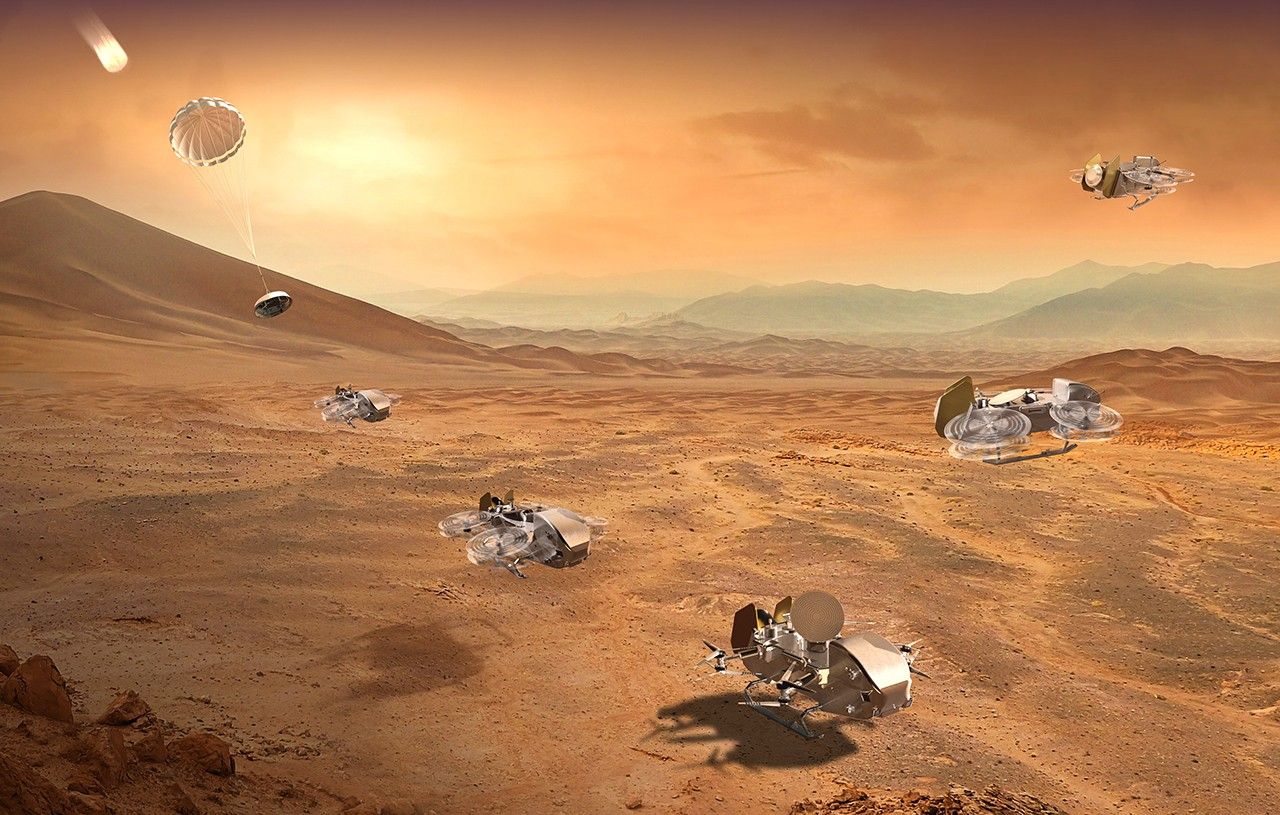
Engineers at the Johns Hopkins Applied Physics Laboratory in Laurel, Maryland, ran NASA's Dragonfly rotorcraft through its most demanding rehearsal yet this week, flying the entire landing sequence it must execute on Saturn's moon Titan — not in the air, but inside a bank of flight computers wired together on a lab bench. NASA reported the test on Friday, calling it the first full run-through of what mission engineers call "first flight": the maneuver in which Dragonfly separates from its protective shell after parachuting through Titan's thick atmosphere, scans the ground below for a safe spot, and sets itself down.
Nothing physically flew. The test ran on what APL calls a testbed, a set of computers loaded with the same flight software and avionics that will fly to Titan, fed a stream of synthetic data standing in for what the real spacecraft's cameras, inertial sensors and lidar would see. According to NASA, the team built custom graphics hardware to render fake camera images of Titan's dune fields in real time, matching the 20-to-70-millisecond exposure windows the actual navigation cameras will use, while a separate system generated artificial lidar terrain for the rotorcraft to read as it searched for a landing site.
What the rehearsal covered
In the sequence NASA described, the simulated vehicle separated from its backshell, flew across a simulated dune field, scanned the terrain, circled back toward a site it judged safe, descended and landed — all without a human operator guiding it in real time. That autonomy is not optional. A radio signal from Earth takes more than an hour to reach Saturn's system, so Dragonfly has to fly, assess hazards and choose where to put its eight rotors down entirely on its own.
"The cool thing about first flight is that it's our most challenging flight," said Zach Putnam, Dragonfly's mobility subsystem lead engineer at APL, adding that the maneuver "uses every piece of flight sensor hardware on the lander." Putnam also noted the stakes of the autonomy requirement: "Everything we do on Titan has to happen autonomously," a point echoed in independent coverage of the test, which noted that a one-way radio signal to Titan takes well over an hour.
"The cool thing about first flight is that it's our most challenging flight." — Zach Putnam, Dragonfly mobility subsystem lead engineer, Johns Hopkins Applied Physics Laboratory
NASA said the team did not attempt the full sequence outright. Engineers built up to it in stages, starting with a single rotor spin, then a short repositioning hop, then a partial scouting flight, adding sensors and complexity at each step before running the complete descent-to-landing profile this month.
A mission six years in the making before it even launches
Dragonfly is a car-sized, nuclear-powered rotorcraft designed to hop between dozens of sites on Titan, the only moon in the solar system with a dense atmosphere and the only body besides Earth known to have stable liquid on its surface, in Titan's case lakes and rivers of liquid methane and ethane. The mission is built around the idea that Titan's organic-rich chemistry could illuminate the kinds of reactions that preceded life on early Earth. NASA's mission page lists a launch window no earlier than 2028, a roughly six-year cruise, and arrival at Titan in 2034, followed by more than three years of surface exploration.
The spacecraft has been working toward this week's test for years. NASA's Dragonfly team completed its critical design review in April 2025, then cut the rotorcraft's first flight rotors that November and spent five weeks last year running rotor aeromechanical trials inside the 16-by-16-by-20-foot Transonic Dynamics Tunnel at NASA's Langley Research Center in Virginia, where engineers can fill the tunnel with heavy gas to mimic Titan's dense air. Separately, engineers at Lockheed Martin have been testing the "pose" mechanism that will lower the stowed rotorcraft out of its entry capsule during descent, running both static load tests and deployment tests at various tilt angles to simulate how the capsule may swing under its parachute.
Why the autonomy test matters
Titan's distance from Earth is the central engineering problem the simulation was built to address. Communications lag of well over an hour each way rules out joystick-style control of any kind; by the time a warning reached Earth and a correction was sent back, the rotorcraft would already have landed, crashed, or run out of flight time. That is why Dragonfly's team has focused heavily on proving out the spacecraft's ability to interpret sensor data and make landing decisions entirely onboard, a capability NASA says this month's test exercised more completely than any previous trial.
- The test combined flight software, avionics and simulated sensor inputs in a single real-time run for the first time.
- It covered backshell separation, terrain scanning for hazard avoidance, a return turn, descent and touchdown.
- Earlier test stages isolated single elements, such as one rotor spinning or a short repositioning flight, before engineers combined them.
Independent of Earth-bound software testing, hardware verification is running on a parallel track. Technicians at APL installed one of Dragonfly's two navigation cameras in August, and the rotorcraft's structural testing campaign — including the heavy-gas wind tunnel work at Langley — has been aimed at confirming that the physical vehicle can survive the aerodynamic loads the simulation assumes.
What comes next
NASA said the team's next step is to run the same first-flight sequence not on a ground testbed but on Dragonfly's actual flight hardware, closing the gap between software simulation and the real spacecraft that will fly to Titan. Engineers also plan to test additional flight profiles beyond the baseline landing sequence and to deliberately inject faults into the system, checking whether the rotorcraft can recognize a problem and respond on its own rather than simply failing the maneuver. No date has been set for either milestone.
With launch still roughly two years away and arrival at Titan not expected until 2034, the stakes of this week's exercise are mostly about retiring risk early. Every maneuver Dragonfly will need on Titan — separating from its shell, reading unfamiliar terrain, choosing a landing site under a communications delay that makes real-time correction impossible — is one NASA wants proven in simulation and in ground testing long before the rotorcraft gets a single chance to do it for real, a quarter-billion miles from the nearest engineer.

NASA's Swift Observatory Ends 22-Year Mission Hunting the Universe's Brightest Explosions

Earth's Next Ice Age Had Already Begun. Then Humans Stopped It.

Japan launches spacecraft to bring home the first-ever samples from a moon of Mars
