NASA's Swift Observatory Ends 22-Year Mission Hunting the Universe's Brightest Explosions
NASA says its Neil Gehrels Swift Observatory has stopped collecting data after nearly 22 years, a mission that outlasted its two-year design life more than tenfold and reshaped the study of gamma-ray bursts.

NASA's Neil Gehrels Swift Observatory has stopped collecting scientific data after nearly 22 years in orbit, bringing to a close a mission designed to last just two years but which ended up reshaping astronomers' understanding of the universe's most violent explosions.
The space agency said in a statement published October 23 that Swift made its final observation on October 20, after its orbit decayed to an altitude of about 171 miles (275 km), where atmospheric drag made it impossible to hold the spacecraft's telescopes steady on their targets. NASA expects the observatory to re-enter and burn up within the coming weeks. An earlier attempt to extend the mission by boosting Swift into a higher orbit, using a commercial servicing spacecraft built by Katalyst Space, did not succeed after the servicing vehicle suffered reaction-wheel and thruster problems that left it unable to complete a rendezvous.
Two decades of gamma-ray bursts
Launched on November 20, 2004, Swift was built to detect gamma-ray bursts, the most luminous explosions in the universe, and swing its co-aligned X-ray and ultraviolet telescopes onto a burst's location within about a minute of detection. Over nearly 22 years, the observatory logged more than 2,000 gamma-ray bursts and studied more than 1,400 supernovae, generating a public data archive of roughly 12 terabytes that has underpinned close to 7,000 published scientific papers, according to NASA. The spacecraft was renamed in 2018 to honor Neil Gehrels, its original principal investigator, who died the previous year.
"Swift delivered an incredible, lasting return on investment for the nation," said Shawn Domagal-Goldman, director of NASA's Astrophysics Division, in the agency's statement. Mission operations were run jointly by NASA's Goddard Space Flight Center and a team based at Pennsylvania State University, whose Mission Operations Center coordinated the observatory's day-to-day science scheduling.
NASA said it is now exploring other ways to respond quickly to short-lived cosmic events, including relying on existing space telescopes, newer missions and commercial launch providers capable of reaching orbit fast enough to catch a burst's afterglow. The agency said Swift's data archive, maintained by its science team at Goddard, is expected to continue generating new discoveries for decades. No firm date has been set for Swift's atmospheric re-entry, which NASA said depends on unpredictable factors including solar activity, though the agency does not expect any surviving debris to pose a risk given the spacecraft's relatively small size.
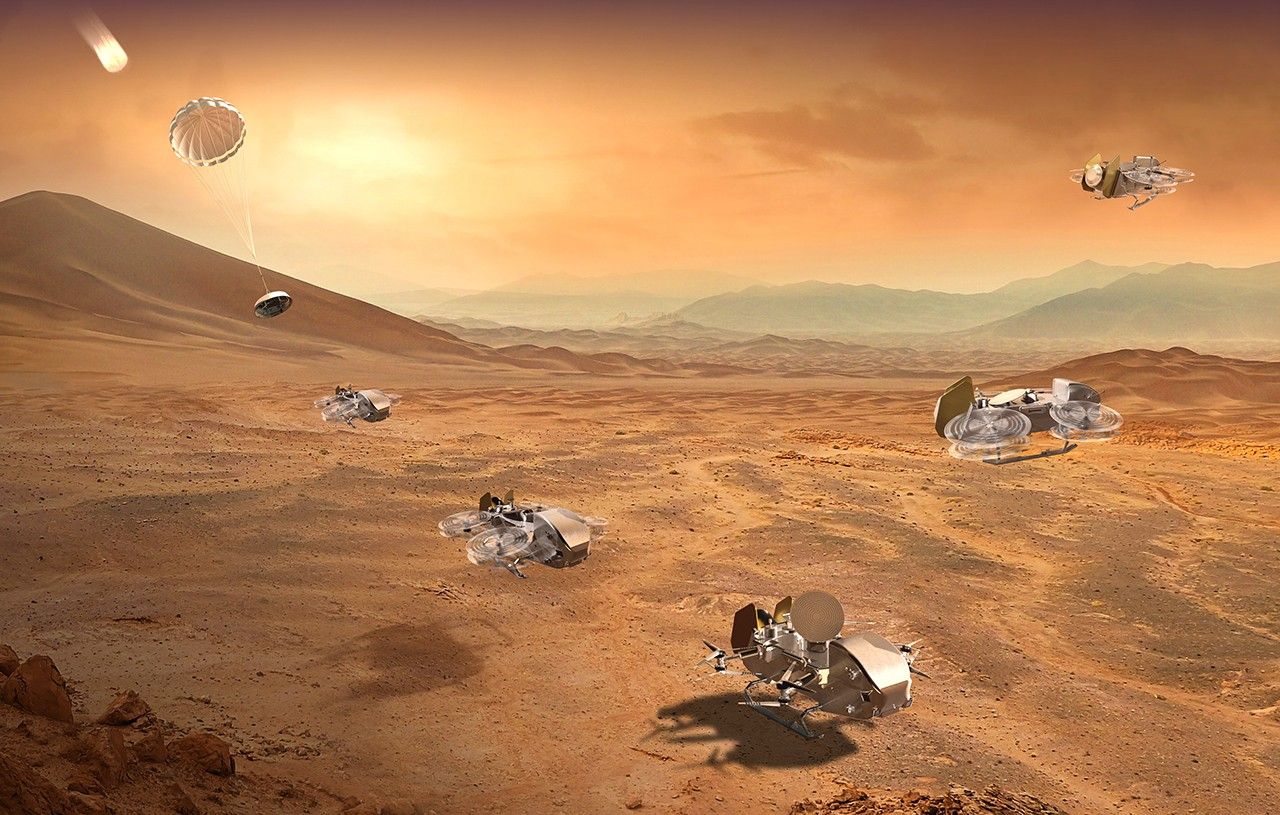
NASA's Dragonfly Rotorcraft Completes Its First Full Simulated Flight Toward Titan

Earth's Next Ice Age Had Already Begun. Then Humans Stopped It.

Japan launches spacecraft to bring home the first-ever samples from a moon of Mars
