Google Cuts a Key Quantum-Computing Error 40-Fold in First Real Hardware Test
A technique called magic state cultivation, tested on Google's Willow chip, chips away at a bottleneck that has driven up the cost of fault-tolerant quantum computing for two decades.
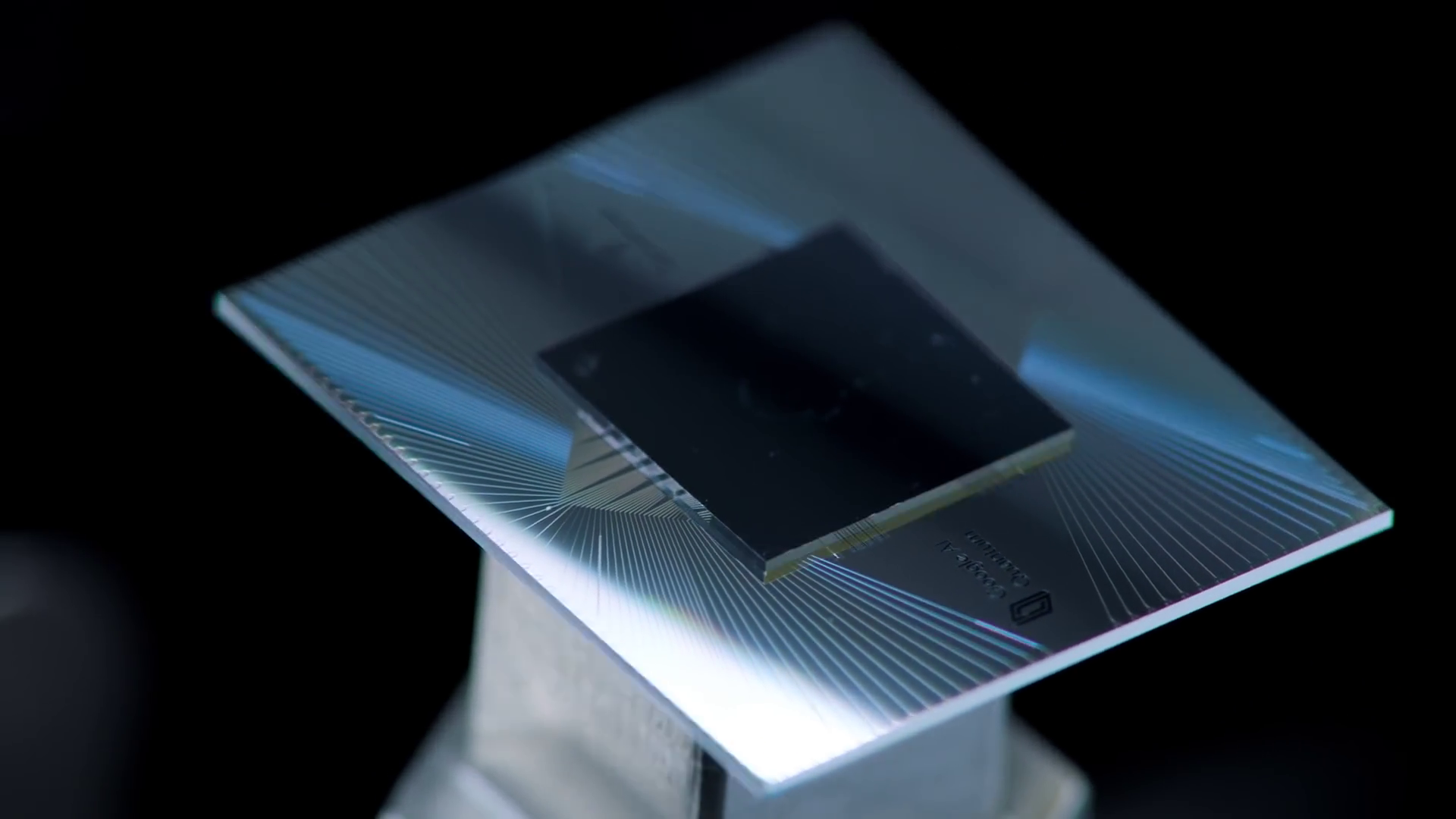
Google's quantum computing division has demonstrated a technique that cuts the error rate of one of the most expensive ingredients in quantum computation by roughly 40 times, a result the company says chips away at a bottleneck that has constrained the field for two decades. The work, carried out on Google's 105-qubit Willow processor, was published Thursday in the journal Science, with a preprint version that had circulated among specialists since late last year.
The ingredient in question is known as a "magic state," a carefully prepared quantum resource that fault-tolerant quantum computers need in order to run the full range of operations required for useful calculations. Magic states are destroyed the moment they are used, so a machine running a long computation must constantly manufacture fresh ones. Researchers have estimated that producing them reliably could consume up to 95 percent of a future quantum computer's hardware and time, leaving little capacity for the actual computation. The new technique, called magic state cultivation, does not eliminate that cost, but the Google team's hardware test is the first to show it working on a real processor rather than in simulation.
A two-decade bottleneck
Fault-tolerant quantum computers work by spreading information across many physical qubits to form a single, more reliable "logical" qubit, a scheme called quantum error correction. That protection handles most of the operations a quantum program needs. But a handful of operations, including the ones required for general-purpose computation, cannot be built from error-corrected qubits alone. Supplying those operations is the job of magic states, specifically a type called T-states.
Since 2004, when physicists Sergei Bravyi and Alexei Kitaev first proposed the standard method for producing clean magic states, known as distillation, researchers have been trying to bring down its cost. Distillation works by combining many noisy magic states and extracting fewer, cleaner ones, a process that has to be repeated in layers and that consumes enormous numbers of physical qubits relative to the rest of a computation.
In 2024, three Google Quantum AI researchers, Craig Gidney, Noah Shutty and Cody Jones, proposed an alternative on paper: cultivation. Instead of combining and refining many noisy states, cultivation injects a single noisy state into a small patch of error-correcting code, then uses a round of measurements to check it for errors. Any attempt that fails a check is simply thrown away. The attempts that survive are, statistically, far cleaner than what went in. Theoretical estimates suggested the approach could need a small fraction of the hardware that distillation requires. The question was whether it would survive contact with a real, noisy chip.
Teaching a chip to grade its own work
Willow itself is not new. Google introduced the 105-qubit chip in December 2024, with Hartmut Neven, the founder and lead of Google Quantum AI, describing it then as a step toward a useful, large-scale quantum computer after more than a decade of work at the company. The magic state cultivation experiment is the clearest sign yet of what the company intends to do with that hardware: not just show that error rates fall as more qubits are added to a logical qubit, which Willow had already demonstrated, but start assembling the other pieces, like magic states, that a working fault-tolerant machine would actually need.
The team, led by research scientist Emma Rosenfeld, ran the cultivation protocol on Willow, a superconducting processor fabricated at Google's quantum computing campus in Santa Barbara, California. Cultivated states came out roughly 40 times more accurate than states produced without the technique, reaching a measured logical fidelity of 99.99 percent. The cost of that accuracy is a steep rejection rate: only about 8 percent of attempts passed every check and were kept, with the rest discarded as flawed.
The researchers then went a step further, moving a cultivated state out of its small starting code, a distance-3 color code, and "grafting" it into a larger distance-5 surface code, the architecture most fault-tolerant quantum computing designs are built around. That transfer, carried out using up to 54 of Willow's 105 qubits, showed that a purified magic state produced through cultivation could be handed off intact to the kind of larger error-correcting structure an eventual full-scale machine would use.
- Roughly 40-fold reduction in error rate compared with uncultivated magic states
- 99.99 percent measured logical fidelity, with uncertainty of about 0.01 percentage points
- About 8 percent of cultivation attempts retained after error checks; the rest discarded
- Up to 54 of Willow's 105 superconducting qubits used in the largest, code-switching experiment
Getting there required solving a problem that, for a time, looked like it might undermine the whole experiment. Early measurements of the cultivated states appeared to show error rates that didn't make physical sense given the team's model of the processor. Rosenfeld and colleagues eventually traced the discrepancy to drift in the lab's electrical control equipment and small temperature fluctuations, both of which were throwing off the benchmark the team was using to judge its own results. The fix involved both added hardware controls to stabilize the processor and a new benchmarking method, which the researchers describe as using cultivation itself to measure cultivation's own accuracy without overstating it. Separately, the team used several hours of reinforcement-learning-based calibration to improve the processor's logical error rate and retention rate by roughly an order of magnitude.
"On Google Quantum AI's Willow processor, our protocol achieved an extraordinary 40-fold reduction in errors relative to un-cultivated states," Rosenfeld and Craig Gidney, a quantum software engineer on the team, wrote in a Google Quantum AI blog post accompanying the paper.
The published paper lists eight authors in total: Rosenfeld, Gidney, Gabrielle Roberts, Alexis Morvan, Dvir Kafri, Nathan Lacroix, Alexandre Bourassa and Kevin Satzinger, all affiliated with Google Quantum AI. Early coverage of the result noted that independent experts had not yet published detailed outside assessments of the paper in the first day after its release, and the authors themselves were careful to frame the result as a step rather than a solution. In a separate storage test, logical error rates came in about seven times higher than simulations had predicted, a gap the team attributes mainly to a hard-to-model error process called leakage, in which a qubit slips out of the two states it is supposed to occupy.
What happens next
Google's own framing is that cultivation still has to be demonstrated at a larger scale before it changes what quantum computers can practically do. The current experiment used roughly half of Willow's qubits for its most demanding test; a useful fault-tolerant machine running real algorithms would need to produce a steady stream of magic states across a much bigger processor, with error rates low enough to sustain long calculations. For context, cryptographically relevant tasks such as factoring a 2,048-bit RSA key are estimated to require per-operation error rates near one in 10 billion, several orders of magnitude beyond what has been shown here, though Google researchers have separately published estimates that such a factoring attack could eventually require under a million physical qubits, down from earlier estimates of 20 million.
The immediate next steps described by the team include scaling cultivation to more qubits, refining the grafting process so that moving between codes doesn't introduce as many new errors, and continuing to drive down the hardware noise that currently limits both fidelity and retention rate. The authors note that halving current hardware noise levels could push the magic-state error rate down further still, toward roughly two in 100,000, though that remains a projection rather than a measured result. More broadly, the paper is likely to be read by other groups working on superconducting and trapped-ion quantum hardware as a test of whether cultivation-style filtering, as opposed to bulk distillation, is a viable path for any fault-tolerant architecture, not just Google's own. Google has said it sees the result as part of a longer effort, dating back more than a decade at the company, toward a quantum computer that can tackle problems classical machines cannot.
Rosenfeld, E. et al., "Magic state cultivation on a superconducting quantum processor," Science (2026).
Rosenfeld, E. and Gidney, C., "Bringing the magic: Google breaks open a bottleneck in quantum computing," Google Quantum AI blog, Oct. 15, 2026.
Magic state cultivation on a superconducting quantum processor, Google Research publication page.
The Quantum Insider, "Google Demonstrates Method to Cut Errors in Quantum Computing's 'Magic States'," Oct. 16, 2026.

September Ranks as Earth's Second-Warmest on Record

A common salt mineral could preserve signs of life inside Enceladus's ocean, study finds

NASA's Roman telescope sharpens its focus, outperforming its own design requirements
