MIT team upends a 20-year rule for building materials from nanoparticles
Researchers found that flexible, rather than rigid, molecular connectors let nanoparticles settle on their own into crystal structures never seen before.
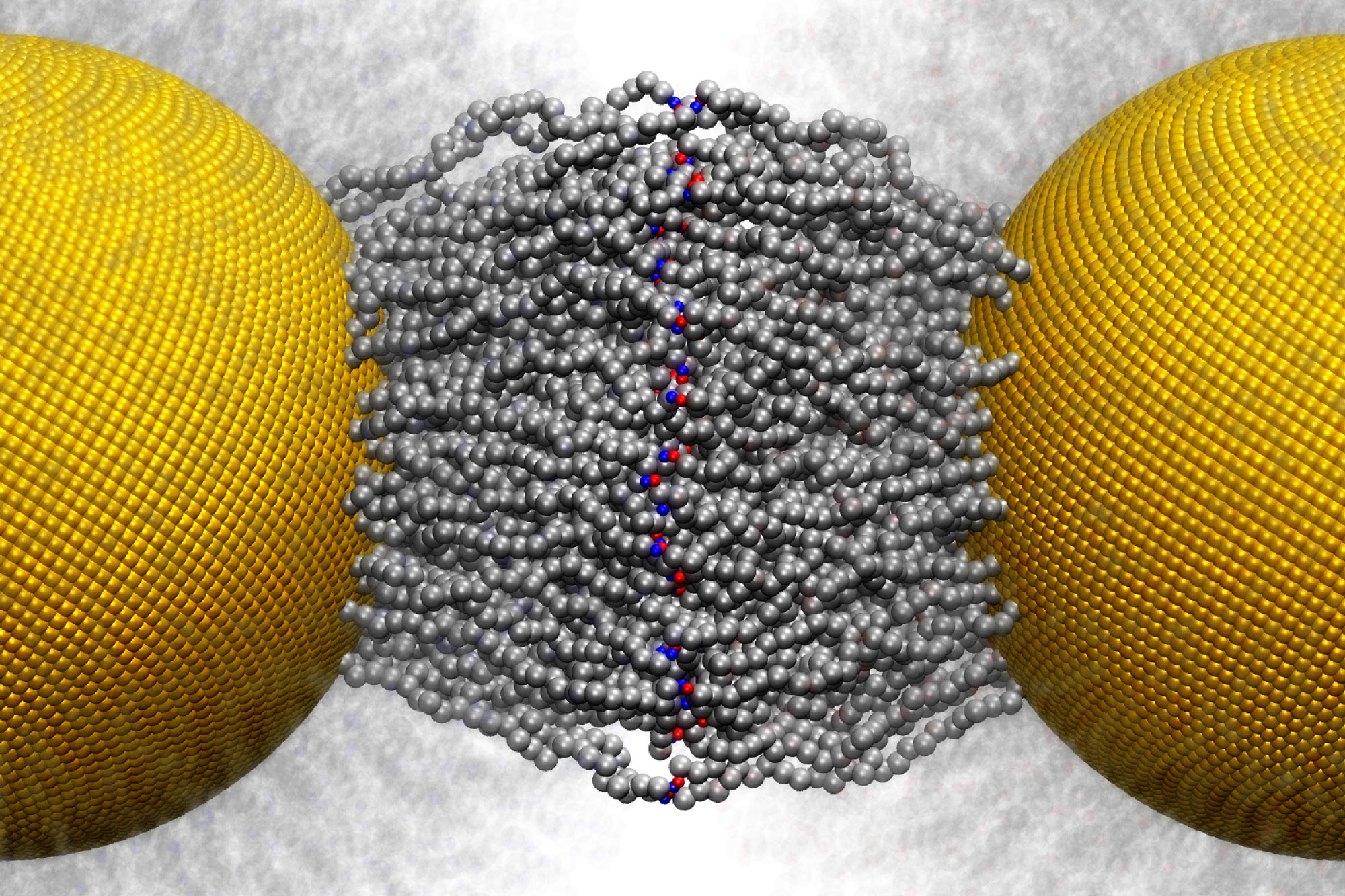
Materials scientists at the Massachusetts Institute of Technology, working with collaborators at the University of Delaware, have found that loosening up the molecular connectors used to bind nanoparticles together, rather than keeping them rigid, produces crystal structures that have never been seen before. The findings, published Nov. 2 in Nature Materials, upend an assumption that has guided the field of self-assembled nanomaterials for roughly two decades.
A rule reversed
For about 20 years, researchers building ordered structures out of nanoparticles have relied on stiff connector molecules, often strands of DNA or rigid polymers, to fix the geometry of the resulting lattice, in much the same way a fixed bond angle determines the shape of a molecule. The MIT-led team instead attached highly flexible polymer ligands, tipped with positive or negative electrical charges, to the surface of gold nanoparticles. Because opposite charges attract, the floppy ligands bend toward partners carrying the opposite charge, and because they are flexible, the direction any individual ligand initially points turns out not to matter.
What does matter, the researchers found, is how many bonds each particle ultimately forms, a property they call "spontaneous valency." By varying the size of the nanoparticles and the length of the polymer chains, the team could tune that bond count up or down, steering the particles into new, more open and less densely packed lattice arrangements than those produced by conventional rigid-ligand methods. "It's the exact opposite of what the dogma has been for 20 years," said senior author Robert J. Macfarlane, a professor of materials science and engineering at MIT, in an MIT News account of the work. The approach, he said, was to "make the bonds so flexible it doesn't matter what direction they're initially pointing," letting the particles themselves settle on an arrangement that "lower[s] the number of bonds each particle has and make[s] lattices we have never seen before."
The paper's lead author, MIT doctoral candidate Nicholas Sbalbi, ran the particle-size and ligand-length experiments underpinning the result, alongside co-authors Hana Shinzawa and Matthew Ye at MIT and Stephen Kronenberger and Arthi Jayaraman, who contributed modeling work from the University of Delaware. The research was supported in part by the National Science Foundation, the Department of Energy, and the U.S. Army and Navy, and used MIT's shared nanofabrication facilities.
What comes next
The looser, more open lattices the team produced are of particular interest because that kind of spacing, difficult to achieve with rigid linkers, is where many proposed uses of nanoparticle superlattices are thought to lie. The researchers point to possible long-term applications in photonics, chemical catalysis, electronics, medicine, agriculture and energy technologies, though they caution the work is fundamental materials science rather than an applied product, and that practical devices remain years off. ScienceDaily's summary of the study likewise notes the result as a basic-science advance rather than a near-term technology.
Next steps for the group include working out more precisely what governs the spontaneous valency effect in different particle and ligand combinations, and testing whether the resulting structures deliver the optical or catalytic benefits the open architectures are predicted to enable. The team says the method could in principle be extended beyond gold nanoparticles to other materials, broadening the toolkit available for building so-called designer materials from the bottom up.
X-ray experiment delivers direct evidence for a third form of magnetism

Study finds permanent daylight saving time would add 2 billion dark school commutes a year

A hidden companion star appears to be disturbing Betelgeuse's atmosphere, new radio images show
