NASA orbiter finds Moon's largest fresh crater, formed just two years ago
A rare, powerful impact carved a 222-meter crater into the lunar surface sometime in the spring of 2024, and NASA's Lunar Reconnaissance Orbiter did not catch it until researchers reviewing images noticed the scar more than a year later.
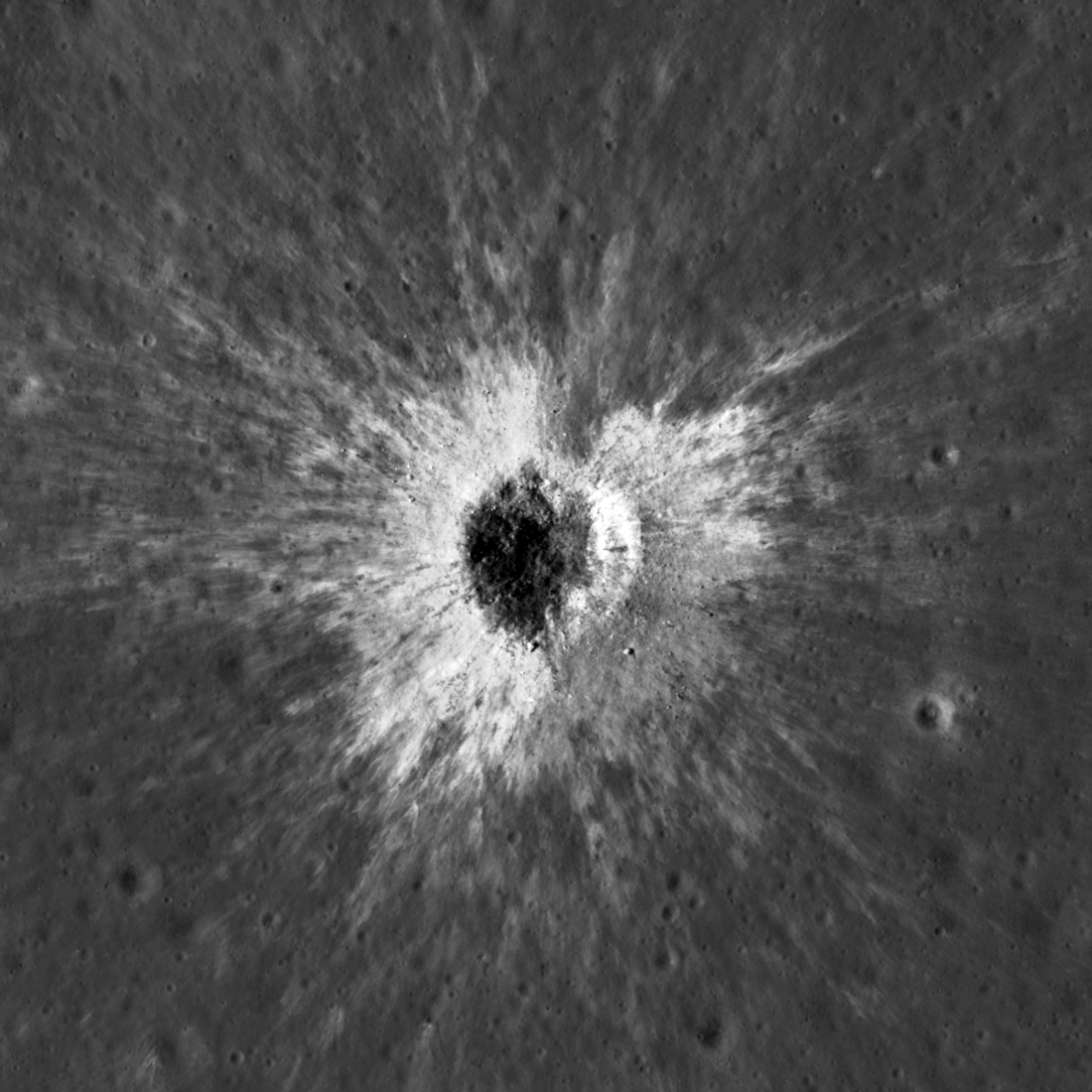
A comet or asteroid fragment slammed into the Moon sometime in the spring of 2024, gouging out a crater wider than two football fields and deeper than three school buses stacked end to end. NASA did not notice for more than a year. The agency's Lunar Reconnaissance Orbiter had been photographing the same patch of the lunar nearside for years, but it took a researcher scrolling through freshly downlinked images in October 2025 to notice that a bright new scar had appeared where none had been before.
The crater, since named McGetchin after a former director of the Lunar and Planetary Institute, is now officially the largest fresh impact scar ever documented on the Moon in the nearly two decades that NASA has been watching. Scientists who studied it estimate that an impact powerful enough to leave a mark this size happens on the Moon only about once every 130 years, making the discovery, in effect, a rare live look at geology usually measured in eons rather than months.
The orbiter has circled the Moon since 2009, methodically rephotographing the same terrain year after year specifically so that scientists can spot exactly this kind of change. Most of the fresh craters it has previously identified this way have been modest, a few dozen meters across at most. McGetchin dwarfs them, and its sheer size, combined with how recently it formed, has made it one of the most closely studied lunar surface features in years.
The numbers
The crater measures 222 meters across and 43 meters deep, more than three times the diameter of the previous record-holder found during the orbiter's mission. Researchers led by Mark Robinson of Intuitive Machines, the principal investigator for the orbiter's camera system, and Julie Stopar of the Universities Space Research Association's Lunar and Planetary Institute narrowed the impact to a roughly six-week window between April 11 and May 22, 2024, by comparing archived images taken before and after that period.
- Crater diameter: 222 meters (728 feet), about the length of two football fields
- Crater depth: 43 meters (141 feet), enough to swallow three school buses stacked vertically
- Estimated impactor size: comparable to a three- to six-story building
- Size relative to the previous record-holder found by the orbiter: more than three times larger
- Estimated recurrence rate for an impact this size: roughly once every 130 years
Beyond the crater itself, the team detected a thermal anomaly stretching several kilometers across the surrounding terrain, several degrees cooler than the undisturbed regolith nearby. The findings, drawn from repeat imaging by the orbiter's camera and thermal instrument, were published in two companion papers in the journal Science Advances.
How scientists found it
The discovery began, somewhat unglamorously, with routine image review. Robert Wagner, an image-processing specialist working with the orbiter's camera data, was paging through new frames when an unfamiliar bright halo caught his eye in a region the spacecraft had photographed many times before.
"I just stopped, dropped everything, and started looking into what that spot was," Wagner said, describing the moment he noticed the anomaly in the imagery.
That tip sent the team back through the orbiter's extensive photographic archive, comparing frames from before and after the suspected impact window to bracket exactly when the crater formed. A formal announcement distributed by the Universities Space Research Association credits the same repeat-imaging technique NASA has used for years to hunt for fresh craters, though none previously found this way have approached McGetchin's size. Close-up frames later released by the mission's camera team show the crater's raw, unweathered rim and a surrounding blast pattern that has not yet been softened by micrometeorite bombardment or solar radiation, giving scientists an unusually fresh specimen to study.
Who is affected, and why it matters
For planetary scientists, a crater this size and this fresh is a rare opportunity to study impact physics without the complicating effects of billions of years of space weathering. Researchers say the debris field disturbed surface material across a wide radius, and the associated cold spot suggests the impact loosened and exposed looser, more insulating regolith than what typically blankets the lunar surface.
The finding also carries implications for how quickly the Moon's surface renews itself, a question relevant to future crewed missions under NASA's Artemis program, which plans to send astronauts back to the lunar surface this decade. Impacts of this scale, however infrequent, are a reminder that the Moon remains geologically active in the sense that meteor strikes continually resurface it, even though it lacks the volcanism or plate tectonics that reshape Earth. Coverage of the discovery by outlets including Phys.org and NBC News noted that researchers are now revisiting older orbiter data to see whether other large, recent craters were previously overlooked.
What happens next
The orbiter's camera team plans continued monitoring of the McGetchin site, along with a broader review of the mission's seventeen-year image archive to search for other impacts of comparable scale that may have gone unnoticed. Because the crater is so fresh, researchers expect it will serve as a natural laboratory for testing models of how impact ejecta spreads and how quickly newly exposed material begins to weather under constant exposure to solar wind and micrometeorite strikes.
The Lunar and Planetary Institute, which co-led the naming process with the International Astronomical Union, said the crater's name honors Thomas McGetchin, a former institute director whose early work on impact-crater ejecta models remains in use today. Scientists involved in the study say the timing is notable for another reason: NASA and international partners are preparing new robotic and crewed lunar landings in the coming years, and an unusually fresh, well-documented crater gives mission planners an additional data point for assessing surface hazards and the pace of regolith turnover across candidate landing zones.
NASA Science — NASA's Moon Orbiter Spots New, 'Once-in-Century' Moon Crater
Science Advances — New lunar crater reveals extensive distal regolith modification
PR Newswire / USRA — NASA's Lunar Reconnaissance Orbiter Discovers a New 222-m Diameter Lunar Crater
Phys.org — NASA spacecraft discovers a huge new crater on the moon

Astronomers confirm youngest planet ever found, still forming around its star

Swedish physicists cut quantum computing operation times by more than 1,000-fold

Scientists map more than 1,000 overlooked brain proteins, tying one to Alzheimer's
