NASA turns a doomed cargo ship into a test bed for next-generation heat shields
Twelve capsules built largely by University of Kentucky students rode a Northrop Grumman cargo ship that undocked from the space station Friday, and will test heat-shield materials for future Mars and Titan missions as the spacecraft burns up next week.
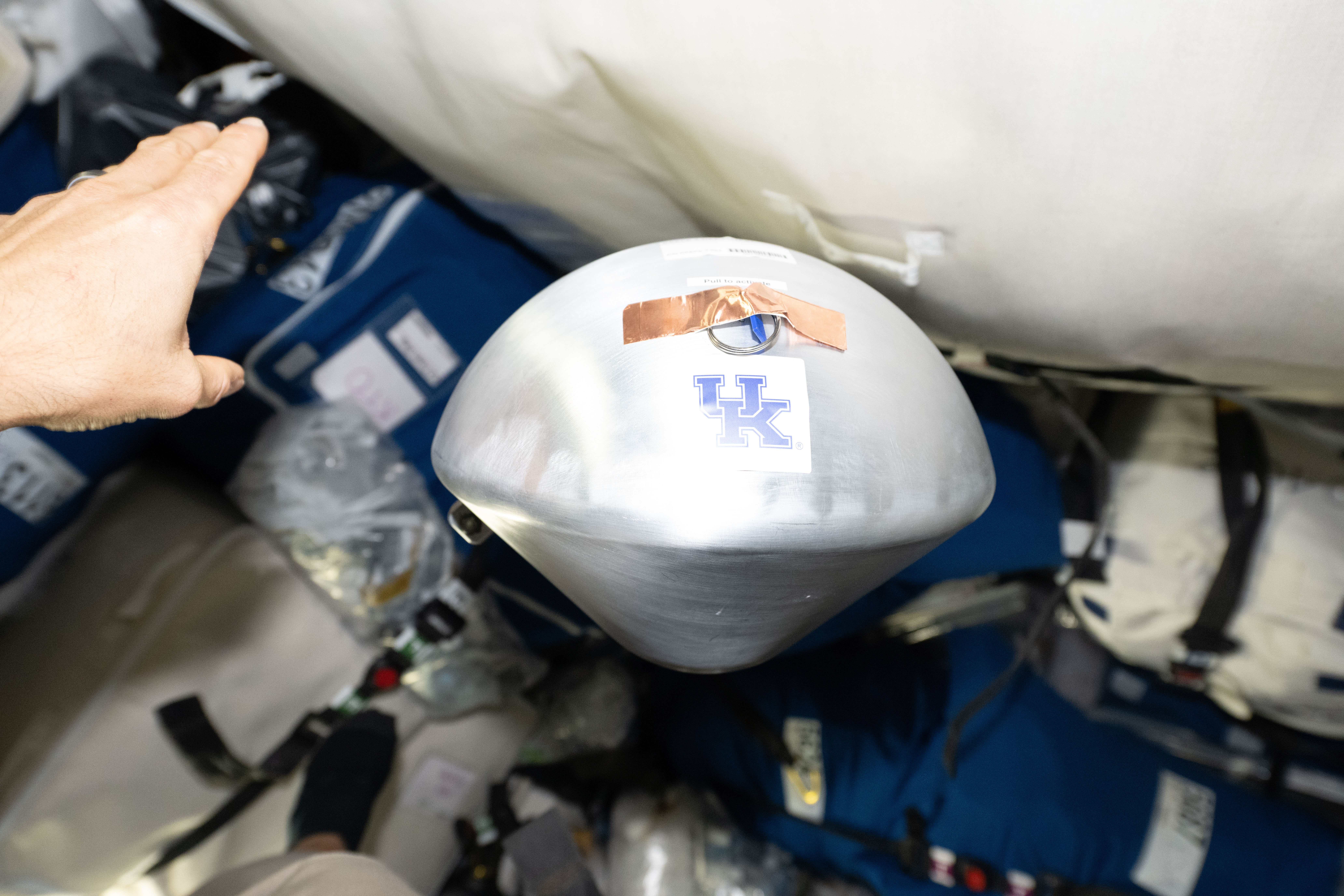
A cargo freighter that undocked from the International Space Station on Friday is carrying an unusual scientific payload into its own destruction: a dozen small capsules designed to test heat-shield materials that could one day protect astronauts returning from the moon or Mars.
Northrop Grumman's Cygnus XL spacecraft released from the station's Canadarm2 robotic arm at 12:45 p.m. EDT, after delivering more than 11,000 pounds of supplies and research hardware on its 24th cargo run for NASA, according to a NASA media advisory. The spacecraft is not built to survive re-entry. Instead, engineers are using its final days in orbit, and its destruction, to gather flight data that is otherwise expensive and difficult to obtain.
Tucked inside the Cygnus XL before it left the station are 12 experimental capsules built largely by University of Kentucky students, part of an experiment called the Kentucky Reentry Probe Experiment, or KREPE-3. As the spacecraft breaks apart in the atmosphere on its planned trajectory, the capsules are designed to eject, survive the plunge on their own, and radio back data on how a range of candidate heat-shield materials performed under real hypersonic heating, NASA's Ames Research Center said in a release describing the experiment.
The hardware going into the fire
Each of the 12 capsules is wired with sensors tracking temperature, pressure, motion, magnetic field and light during descent, with satellite links relaying data to researchers in close to real time. The materials and shapes vary widely. One capsule carries ceramic tile similar to what protected the space shuttle. Another carries a 3D-printed heat shield developed through a joint project between NASA's Johnson Space Center and Oak Ridge National Laboratory.
Two capsules fly a newer material developed at NASA Ames called MERINO, short for Materials Engineered for Re-entry using Innovative Needling Operations, made of carbon and phenolic fibers stitched together like felt. NASA says the material is cheaper and faster to produce than older ablative shields and could suit the lighter heat loads of a landing on Mars. A third capsule combines MERINO with a tungsten-tipped, dual-cone shape meant to validate computer models against real flight data, and another is built as a scale model of the aeroshell planned for NASA's Dragonfly rotorcraft mission to Saturn's moon Titan, wrapped in the same carbon ablator material that flew on the Stardust, Mars Science Laboratory and Mars 2020 missions. A separate capsule tests a deployable, umbrella-shaped shield called ADEPT that unfolds to slow a larger payload than a rocket's own fairing could otherwise carry. A heat-flux sensor built at the University of Stuttgart in Germany rides along on another capsule, measuring how heat moves across a surface during entry.
A low-cost habit built over a decade
KREPE-3 is the third flight in a series that began in 2021, when two University of Kentucky-built capsules survived re-entry aboard an earlier Cygnus mission and transmitted temperature data for roughly nine minutes as they fell at more than 20 times the speed of sound. A second flight, KREPE-2, flew five capsules in 2024. The project grew out of the university's decade-old Kentucky Re-Entry Universal Payload System, or KRUPS, program, a research effort the university's engineering school lists as having involved more than 100 students since 2013.
The approach is deliberately cheap. Rather than building a dedicated reentry vehicle, the Kentucky team and its partners piggyback on cargo ships that are already headed for a fiery, uncontrolled destruction at the end of their working lives. The experiment is organized under NASA's Established Program to Stimulate Competitive Research, which funds research infrastructure in states that have historically received less federal science funding, according to the agency's EPSCoR program materials.
Students built the hardware that will burn up
The capsules were built mostly by University of Kentucky aerospace engineering students over roughly a year, under mechanical and aerospace engineering professor Alexandre Martin, before launching to the station on April 11. In February, as the hardware was being finished, local television coverage of the team's preparations quoted graduate student Alexander Barrera calling the chance to build real flight hardware "a dream come true," while fellow student Eric Adams pointed to the demanding paperwork behind it: "There's mechanical design, of course, but there's a lot of safety regulations."
Once the capsules reached the station, astronauts needed only to confirm each one was intact and pull an activation tab before loading them, along with disposal trash, back into the Cygnus XL for its final flight.
What NASA and partner engineers are saying
NASA officials framed the mission as a model for squeezing research value out of hardware that would otherwise be wasted. "KREPE-3 is a great example of the goals of NASA's EPSCoR program," David Berger, the program's manager at NASA Headquarters, said in the agency's release. "We are supporting the next generation of scientists and engineers as they develop unique projects that benefit their education and NASA's mission goals."
"We're essentially hitching a ride on a vehicle that's already coming back to Earth," said Keith Peterson, a materials engineer at NASA's Ames Research Center. "We're pushing the boundaries of what heat shields can do, and we're testing them in a way that's fast, affordable and incredibly effective."
The findings matter well beyond Kentucky. Heat shields are among the hardest parts of any spacecraft to validate on the ground, because wind tunnels cannot fully replicate the heat, pressure and plasma chemistry of true atmospheric entry. Flight data from disposable test capsules gives engineers designing hardware for NASA's Artemis moon program, future Mars landers and Dragonfly a cheap way to check their models against reality before committing to a crewed or billion-dollar mission.
What happens next
Cygnus XL is scheduled to deorbit on Monday, Oct. 12, breaking apart over a remote ocean area for what NASA calls a safe, destructive re-entry; the agency said it will not provide live coverage of that final descent, unlike Friday's undocking, which aired on NASA's streaming channels. Instead, the KREPE-3 capsules themselves, and the ground stations tracking their satellite transmissions, are expected to be the only witnesses, a pattern confirmed in an independent tracking of NASA's published schedule.
Assuming the capsules perform as designed, researchers at NASA Ames, Johnson Space Center, Oak Ridge National Laboratory, the University of Stuttgart and the University of Kentucky will spend the coming months comparing the transmitted sensor readings against their pre-flight simulations. NASA has not set a date for releasing the resulting data or analysis. Given the pace of the KREPE series so far, any public results are likely to surface first in conference papers and university announcements rather than in a single formal report, with a fourth flight plausible if Northrop Grumman continues flying Cygnus cargo missions to the station in the years ahead.

A Rail System Built From Single Atoms Could Make Superconductors Leak Less Energy

Astronomers Confirm Third "Wandering" Black Hole Caught Shredding a Star Far From Its Galaxy's Core

Lab-Grown Brain Cells Learn to "Read" Braille, Pointing Toward Biohybrid Computers
