Princeton's new AI framework lets machines control fusion reactor plasma in milliseconds
A modular AI system called PACMAN ran five live experiments on a California tokamak, reacting to unstable plasma roughly every 20 milliseconds — faster than any human operator — and predicting a damaging instability 200 milliseconds before it could form.
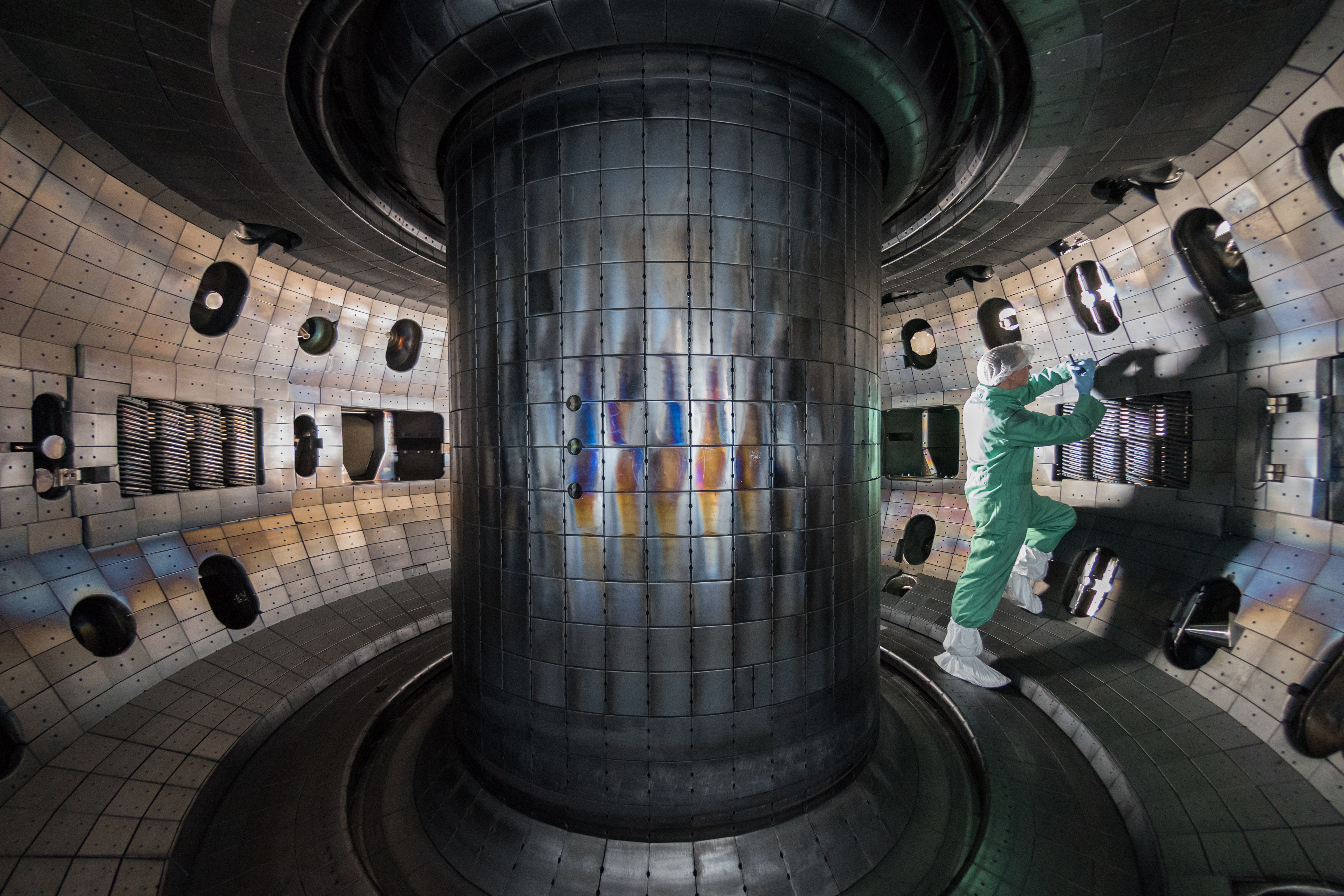
Princeton researchers have built an artificial intelligence system that can watch a fusion reactor's superheated plasma and issue corrective commands roughly every 20 milliseconds, a reaction speed no human operator can match. The framework, called PACMAN, was tested in five live experiments this year on the DIII-D National Fusion Facility in San Diego and is described in a paper published in the journal Nuclear Fusion.
The system, whose name stands for Prediction And Control using MAchiNe learning, is not a single trained model but a modular platform that lets many machine-learning tools plug into a tokamak's control system at once, according to a Princeton Plasma Physics Laboratory announcement. It was developed by researchers at PPPL and Princeton University, working with the Department of Energy-run DIII-D facility, which is operated by General Atomics.
What the experiments showed
Fusion reactors confine plasma heated to well over 100 million degrees Celsius inside magnetic fields, and that plasma is inherently unstable. Left unchecked, disturbances can grow within tens of milliseconds into disruptions that halt an experiment or, at larger scale, stress reactor components. PACMAN was built to catch these problems before they escalate.
In one of the five test runs described in the Department of Energy's Office of Science summary of the work, the framework forecast a damaging plasma instability known as a tearing mode roughly 200 milliseconds before it would have formed, then adjusted the plasma to keep it from appearing at all. In other runs, the system took over coordination of all six of DIII-D's high-power microwave heating units, known as gyrotrons, a task that normally requires careful manual tuning, and separately steered the plasma's density and rotation toward targets set in advance by the research team.
- Full sense-decide-act cycle: about 20 milliseconds
- Instability predicted and averted: roughly 200 milliseconds ahead of formation
- Live experiments completed on DIII-D: five
- Heating systems brought under simultaneous AI control: all six gyrotrons
Andy Rothstein, a co-lead author of the study in Princeton's Department of Mechanical and Aerospace Engineering, described the pace of the system in the laboratory's release. "The whole PACMAN framework typically runs in about 20 milliseconds, and it's running again and again and again," he said.
How the system is built
PACMAN works as a kind of assembly line. Sensors on the tokamak stream in raw measurements of temperature, density and magnetic field behavior; a first stage checks and cleans that data; a second stage runs machine-learning models that predict what the plasma is about to do and decide what response is needed; and a final stage reconciles any conflicting instructions, applies hard safety limits, and converts the result into commands the hardware can execute. Each stage can be swapped out or upgraded independently, which the developers say is the point of the design.
Hiro Farre Kaga, a graduate student in the Princeton Program in Plasma Physics and the study's other co-lead author, said the timescales involved leave little alternative to machine learning. "Machine learning models can describe the plasma behavior very well, and importantly, they are the only way we have to model the plasma in millisecond times," he said in the PPPL release.
"The whole PACMAN framework typically runs in about 20 milliseconds, and it's running again and again and again."
The project was led by Egemen Kolemen, an associate professor of mechanical and aerospace engineering at Princeton who holds a joint appointment with the Andlinger Center for Energy and the Environment and PPPL. Co-authors on the paper include PPPL researchers Ricardo Shousha, Keith Erickson and SangKyeun Kim; Princeton researchers Jalal-ud-din Butt, Peter Steiner and Azarakhsh Jalalvand; and Takuma Wakatsuki of Japan's National Institutes for Quantum Science and Technology, reflecting the increasingly international character of tokamak research.
Why plasma control has resisted automation
Tokamaks like DIII-D, which has operated as a national user facility since the 1980s, generate plasma behavior that is notoriously difficult to model with the equations of classical plasma physics alone, because the fluid is turbulent and its state can shift in a fraction of a second. Engineers have historically relied on preprogrammed responses and trained operators watching instrument feeds, an approach that works for research-scale experiments but becomes harder to sustain as reactors grow larger and instabilities become more consequential.
Earlier machine-learning efforts at PPPL and elsewhere, including a widely reported 2024 collaboration that used reinforcement learning to shape plasma more efficiently, generally trained one model to handle one narrow task. PACMAN's contribution, according to the researchers, is a shared piece of infrastructure that different AI tools, including but not limited to reinforcement-learning agents, can use without each requiring a bespoke integration with the reactor's control system.
Significance for the push toward fusion power
Fusion has long been pursued as a potential source of abundant, low-carbon electricity, but every major design still confronts the same practical obstacle: plasma that is difficult to keep stable for any length of time. As government and private fusion programs plan pilot power plants meant to run continuously rather than in short research pulses, the ability to detect and correct instabilities automatically, and fast enough that a human is not in the loop for the split-second decisions, is regarded within the field as a prerequisite rather than a convenience.
DIII-D's role as a proving ground matters here because it is one of the facilities the Department of Energy uses to test hardware and control approaches intended to inform the design of future reactors. A framework validated there carries more weight for eventual use on other machines than results produced only in simulation. Disruptions of the kind PACMAN is designed to head off can end an experimental run in an instant and, in a full-scale power reactor, would place unwanted mechanical and thermal stress on the vessel itself, which is one reason control systems that can act ahead of an instability, rather than merely react to it, are considered valuable well beyond DIII-D.
The result also lands at a moment when interest in fusion, both public and private, has grown well beyond the government laboratories that have run tokamaks for decades. A widening field of private fusion companies has set its own timelines for demonstration plants, and most of those designs share the same underlying requirement: plasma that can be sustained, monitored and corrected continuously rather than in the short, carefully staged pulses typical of research reactors. Software that can generalize across different control problems, rather than being rebuilt for each one, addresses a bottleneck that has as much to do with engineering practice as with plasma physics itself.
What comes next
The Princeton team says PACMAN's modular structure is meant to let other laboratories add their own predictive or control models into the same framework rather than rebuilding a control system from scratch, an approach Kolemen has framed as building infrastructure the broader fusion community can use. The researchers plan further tests on DIII-D aimed at handling a wider range of instabilities and at extending the framework's autonomy, while keeping researchers able to set the reactor's overall objectives and override the system's decisions. Whether the approach can scale to the far larger plasmas planned for future power-generating reactors remains to be demonstrated, but the results published this year mark one of the more concrete steps yet toward automated, millisecond-scale plasma control.

Antarctica's 'Doomsday Glacier' could add double the forecast sea-level rise, new model finds

Satellites Reveal a Deeper Human Fingerprint on the World's Water
Century of Records Shows Europe's Wild Bees Losing Ground
