The Same 'Glue' That Holds Tissue Together Also Helps Cells Swallow Their Dead Neighbors
A Barcelona research team finds that E-cadherin, the adhesion protein that seals epithelial tissue into watertight barriers, is repurposed at the site of a dying cell to grip, deform around and engulf it — a mechanical requirement for clearance that had gone largely unexamined.
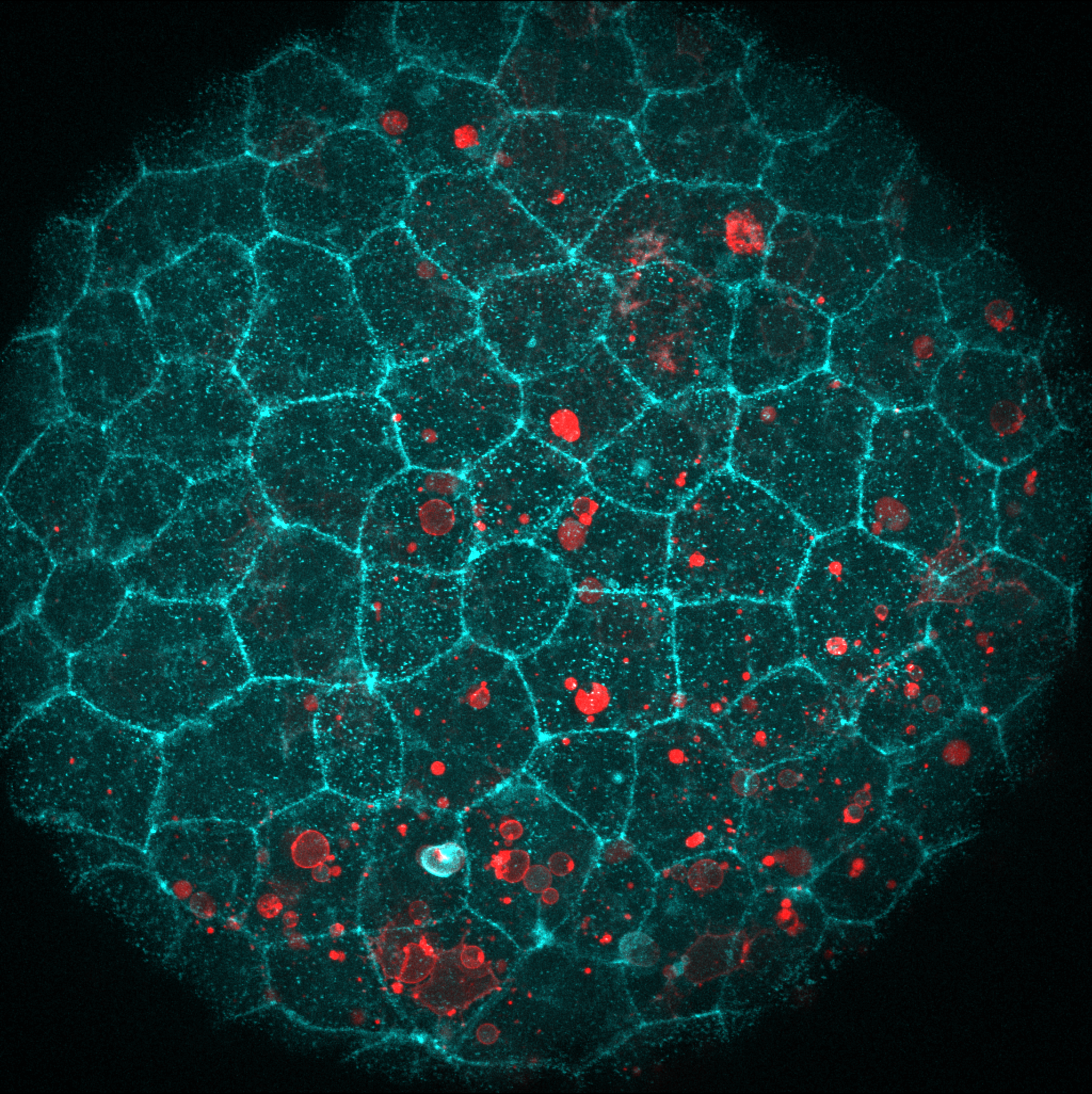
The same molecular "glue" that holds the body's surface tissues together also does double duty as the machinery cells use to swallow their dead neighbors, according to a study published August 27 in Nature Communications. Researchers at the Centre for Genomic Regulation in Barcelona found that E-cadherin, the adhesion protein best known for sealing epithelial cells into watertight sheets of skin, gut lining and other barrier tissue, is repurposed at the site of a dying cell to grip it, deform around it and pull it inside — all without breaking the seal that keeps the rest of the tissue intact.
The team, led by senior author Verena Ruprecht, tracked living zebrafish embryos between roughly four and a half and eight hours after fertilization, a window in early development when large numbers of cells routinely die and must be cleared. When researchers blocked E-cadherin production, embryos showed a sharply reduced ability to engulf dying cells, a difference the study reports as statistically significant. The same adhesion complex, and the same clearance defect when it was disrupted, appeared in early mouse embryos as well, indicating the mechanism is conserved across vertebrates rather than being a quirk of fish development.
How the "glue" turns into a grip
E-cadherin normally works by binding directly to E-cadherin molecules on a neighboring cell, then anchoring that connection to the internal skeleton through a set of partner proteins, including alpha-catenin, beta-catenin and p120-catenin. The new study shows that when an epithelial cell touches a dying cell instead of a healthy one, this same complex assembles at the contact point on the underside of the tissue and switches roles. Alpha-catenin acts as a physical tether, transmitting pulling force from the cell's actin cytoskeleton so the engulfing cell can wrap around its target — a function the researchers found works independently of E-cadherin's usual cell-to-cell binding. Separately, p120-catenin recruitment reins in myosin II, the motor protein that drives cell contraction; without that restraint, cells became too stiff to fold around and absorb the dying cell.
"We were intrigued to find out that epithelial cells repurpose their molecular adhesion machinery — the 'glue' that normally holds them together — to engulf dying cells," said Verena Ruprecht, an ICREA research professor who led the study.
Ruprecht described the underlying physics as "the same dancer with a different choreography": the upper surface of the epithelial sheet stays rigid to preserve the tissue's barrier function, while the lower surface stretches and deforms extensively during engulfment, all without letting the barrier leak. To test whether the effect depended on E-cadherin specifically, the researchers presented tissue with two kinds of targets — dying cells stripped of E-cadherin, and fat droplets coated only with the chemical signals that mark a cell as dead — and found that engulfment still proceeded through the same mechanical pathway in both cases.
Why a stalled cleanup crew matters
The process of clearing dead cells, known as efferocytosis, is a routine part of daily biology: billions of cells die and are removed in a healthy adult body every day, in embryonic development, wound healing and normal tissue turnover alike. When that removal fails or slows, dead cell material lingers and can trigger or prolong inflammation, a mechanism implicated in a range of chronic inflammatory and autoimmune conditions. Most prior research on efferocytosis has focused on how phagocytic cells recognize the chemical "eat me" signals displayed on a dying cell's surface. The new findings add a second, physical requirement: even a cell that correctly recognizes a dying neighbor still needs the right mechanical machinery — a tether to pull with and a brake to keep from over-contracting — to actually complete the job without damaging the surrounding tissue.
Most cells capable of this kind of cleanup are "non-professional" phagocytes — ordinary epithelial cells that clear debris as a side task, unlike immune cells such as macrophages that are dedicated full-time to consuming dead material. Because E-cadherin and its partner catenins are present in epithelial tissue lining nearly every internal and external surface of the body, from skin to airway to intestinal lining, the mechanism described in the study is not confined to any single organ. The researchers frame the discovery as evidence that ordinary tissue-cohesion proteins can be conscripted for an entirely different cellular task on short notice, without cells needing to manufacture new specialized machinery for the job.
What the researchers are watching next
The CRG team says the next step is examining whether the same E-cadherin-based clearance mechanism operates, or breaks down, in adult tissues affected by chronic inflammatory disease, where efferocytosis is known to be impaired. Understanding how the tether-and-brake system is regulated could point toward ways to boost dead-cell clearance therapeutically in conditions where it stalls, though the researchers caution that the current findings come from embryonic zebrafish and mouse tissue rather than adult human disease models, and translating the mechanism into a treatment strategy would require substantially more work.
The study was carried out using the CRG's core facilities for advanced light microscopy, tissue engineering and protein technologies, and was funded by Spain's Ministry of Science and Innovation, the Human Frontier Science Program, the European Union's Horizon Europe programme, the "la Caixa" Foundation and the European Social Fund. The paper's joint first authors are Hanna-Maria Häkkinen, Marta Batet Palau and Laura F. Bianchi, working in the Ruprecht laboratory at the CRG, a research center focused on the mechanics and dynamics of cells and tissues.
Deadly hospital fungus survives antifungal drugs by duplicating its whole genome, study finds

China's Chang'e-6 moon rocks suggest a new explanation for the lunar far side's thick crust

NASA Telescopes Trace a Ghostly Radio 'Treble Clef' to a Galaxy-Cluster Collision Hidden Behind the Milky Way
