Voyager 1 becomes first human-made object to reach one light-day from Earth
NASA's 49-year-old interstellar probe crossed the 16-billion-mile mark early Wednesday, a distance so great that a radio signal now takes a full day to reach it — even as engineers fight to keep its fading power supply alive.
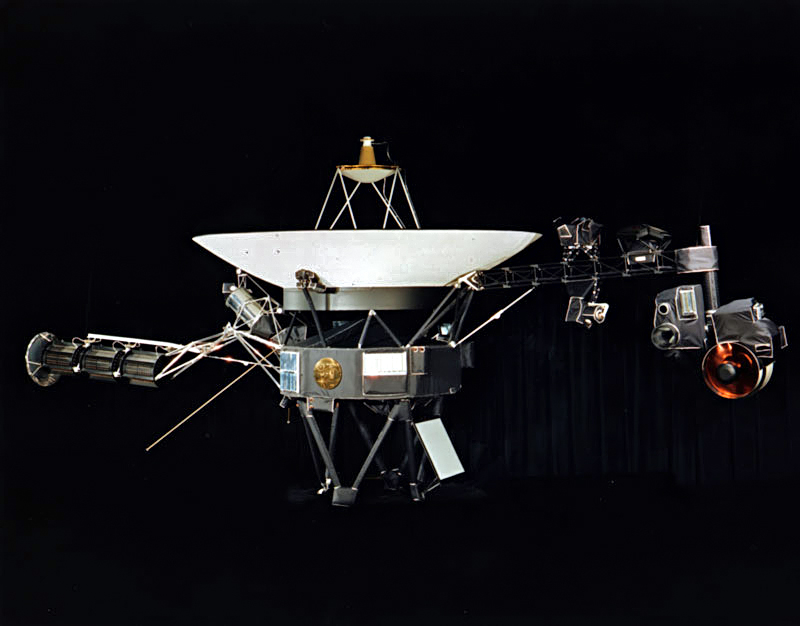
NASA's Voyager 1 spacecraft crossed a distance of one light-day from Earth at 5:16:07 a.m. EST on Wednesday, becoming the first human-made object ever to travel that far from the planet that launched it, according to NASA's own account of the milestone. The agency's Jet Propulsion Laboratory, which has operated the spacecraft since its 1977 launch, marked the distance with a public campaign and a round of interviews in the days leading up to the crossing.
A light-day is the distance light travels in 24 hours: 16,094,799,096 miles, or 25,902,068,356 kilometers, NASA's Goddard Space Flight Center detailed in an explainer video timed to the event. At that remove, a radio command sent from mission control now takes a full day to reach the spacecraft, and any reply takes another full day to return — a round trip of roughly 48 hours, longer than any spacecraft in history has made its operators wait. Voyager 1 is moving away at nearly 38,000 mph, or 61,000 kph, NASA said.
Nearly half a century past the planets
Voyager 1 launched from Cape Canaveral on Sept. 5, 1977, on a mission originally planned to last four years and cover Jupiter and Saturn. By the time it swept past those planets, it had found active volcanoes erupting on Jupiter's moon Io — the first eruptions humans had observed on a world other than Earth — and confirmed that Jupiter's Great Red Spot is a vast, rotating storm. In 1990, as it left the planets behind, its cameras turned back for one last look, producing the "Pale Blue Dot" portrait of Earth that became one of the most reproduced images in the history of spaceflight.
The spacecraft crossed the heliopause, the boundary where the sun's influence gives way to interstellar space, in 2012, making it the first human-made object to leave the solar system in that sense. Its twin, Voyager 2, launched weeks earlier on a different trajectory and followed it into interstellar space in 2018. According to NASA, Voyager 2 is not expected to reach the same one-light-day distance until November 2035, nine years behind its sibling.
A fading power supply
The milestone arrives as engineers at JPL work to stretch a dwindling power budget that will ultimately decide how much longer either spacecraft can keep transmitting. Both probes rely on radioisotope thermoelectric generators that convert the heat of decaying plutonium into electricity, and both lose about four watts of available power every year as that fuel decays. Earlier this year, after a power drop recorded on Feb. 27, JPL engineers sent commands shutting down one of Voyager 1's remaining science instruments, the Low-Energy Charged Particle experiment, to preserve power for the systems that keep the spacecraft flying and communicating, JPL said in a news release announcing the shutdown. Only a plasma-wave instrument and a magnetometer remain active for science on Voyager 1 today.
Dr. Tiffany Kataria, a research scientist at JPL, said the spacecraft's instruments are still detecting conditions no probe had sampled before it left the solar system's protective bubble. "Now actually V1 is experiencing influences from material outside of our solar system," Kataria told a North Carolina television station in an interview ahead of the milestone, published Tuesday. "So the gas and dust and other material that exists between stars."
Mission planners have said they hope the power-saving measures, including tests of further shutdowns planned first on the less power-constrained Voyager 2, will keep both spacecraft within range of NASA's Deep Space Network into the next decade. An earlier JPL estimate put that horizon at around 2036, a date that assumes the remaining power systems continue performing as expected.
A worldwide send-off
For most of the people following the milestone, the significance was symbolic rather than scientific: nothing changes aboard the spacecraft itself when it crosses an arbitrary line drawn by the speed of light. NASA leaned into that symbolism anyway, inviting the public to take part in a campaign called "Shine Bright for Voyager's Light-Day," asking people worldwide to point flashlights, phone lights, glow sticks or porch lights skyward after sunset on Tuesday and flash the spacecraft's three-letter call sign, V-G-R, in Morse code, or use an automated online flasher NASA built for the occasion.
The Planetary Society, a nonprofit space-advocacy group with no formal role in the mission, marked the occasion with its own event, unveiling what it described as a never-before-seen illustration of Voyager 1 at its new distance and previewing an upcoming NASA-produced documentary on the mission, according to the group's press release.
Scientists who have spent careers on the mission described the moment in more personal terms. Linda Spilker, Voyager's project scientist, pointed to the Golden Records both spacecraft carry — gold-plated discs loaded with music, photographs and greetings meant to represent humanity to anyone who might someday find them.
"Those records, once the Voyagers can no longer communicate with Earth, then they become our silent ambassadors," Spilker said, according to a report citing her remarks. "We don't know for sure if those stars have planets, much less inhabited planets" — but the records offer, she said, "a chance for us to send our message in a bottle out into the cosmos."
What's next
JPL had scheduled a moderated discussion with mission team members and NASA leadership for Thursday at noon Eastern time, a day after the crossing, to mark the milestone publicly and take questions about the spacecraft's future. Engineers will continue monitoring the power supply instrument by instrument, deciding case by case which systems to sacrifice to keep the spacecraft transmitting as long as possible.
Voyager 1 is not stopping. NASA says it is headed, in a very loose sense, toward a star cataloged as AC +79 3888, also known as Gliese 445, more than 17 light-years away, and is expected to pass within about 1.7 light-years of it in roughly 40,000 years — long after its instruments have gone silent and long after anyone on Earth could still be listening. Until then, mission controllers plan to keep talking to it for as long as the plutonium holds out, one day-long round trip at a time.
NASA — How Far Away Is Voyager 1? One Light-Day, Explained
NASA/JPL — NASA Shuts Off Instrument on Voyager 1 to Keep Spacecraft Operating
Space.com — What exactly is a light-day? Here's what Voyager 1's latest milestone means
IFLScience — It's Official: Voyager 1 Will Cross The 1-Light-Day Threshold On November 18, 2026
Webb telescope data confirm a rare, fully tracked stellar merger in the Andromeda galaxy

Stem Cell Particles Delay Type 1 Diabetes in Mice, UCLA Study Finds

Australian physicists send a message through a brick wall using only gravity
