Webb telescope data confirm a rare, fully tracked stellar merger in the Andromeda galaxy
Five years of observations culminating in data from NASA's James Webb Space Telescope let astronomers measure, for the first time in detail, how two stars merged in a binary system nicknamed Bao, giving them a rare before-and-after view of a process central to stellar evolution.
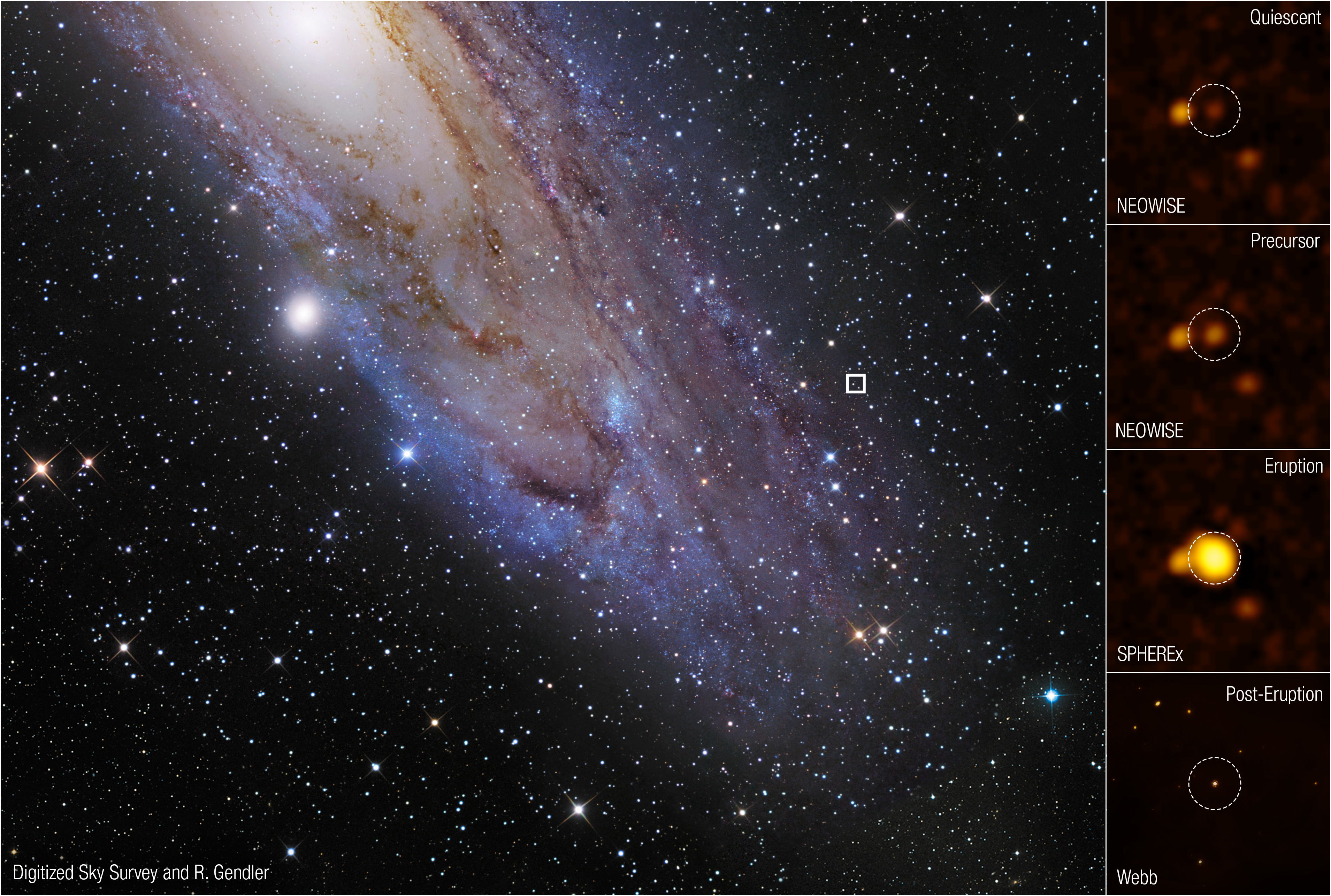
Astronomers have reconstructed, in unusually fine detail, the final years of a doomed double star: a companion only slightly lighter than the sun that spiraled for roughly seven years into a vastly larger companion before the two stars merged in a burst of light bright enough to be tracked from across the Andromeda galaxy. The reconstruction, built from nearly three years of observations and capped by data from NASA's James Webb Space Telescope, was published in the journal Nature on November 18, 2026. The research team says it is the first time astronomers have measured, directly and in detail, how efficiently this kind of stellar merger ejects material into space, rather than inferring it after the fact from the wreckage alone.
A lopsided pair, caught in the act
The system, nicknamed Bao and formally catalogued as AT 2025abao, sits in the outer disk of the Andromeda galaxy, roughly 2.5 million light-years from Earth. Before the merger, the larger of the two stars, which the team called Big Bao, was about seven times as massive as the sun, roughly 350 times its radius and about 18,000 times as luminous. Its companion, Little Bao, was comparatively modest, at about 0.7 times the mass of the sun. By the team's calculations, the two stars completed only about seven orbits after they first made contact before merging outright, a tiny fraction of the thousands of orbits typically recorded when two smaller, more evenly matched stars spiral together.
Mergers of this kind are thought to begin when the more evolved, swollen star in a close binary expands enough that its outer layers engulf its companion, a process astronomers call common envelope evolution. The smaller star then spirals inward through its companion's gas, losing orbital energy and heating the surrounding material until much of the envelope is blown outward in a flash known as a luminous red nova. Astronomers have cataloged only a handful of confirmed luminous red novae, and in most past cases researchers have had to work backward from the eruption's afterglow to guess at what the system looked like beforehand.
Five years of watching, then a 47-day sprint
What sets Bao apart is that telescopes had already been watching the system for more than two years before it erupted, giving researchers a rare "before" picture to set against Webb's "after" picture. NASA's NEOWISE mission, since retired, first flagged unusual variability in the system in February 2023. The ground-based WINTER survey recorded the star brightening and shedding dust in September 2024. The following July, NASA's SPHEREx mission happened to catch the system fading rapidly at visible wavelengths while brightening in the infrared, a signature of a star wrapping itself in the dusty debris of an impending merger.
- February 2023 — NASA's NEOWISE mission flags unusual variability in the system
- September 2024 — Ground-based WINTER survey detects brightening and dust production
- July 2025 — NASA's SPHEREx mission catches the system fading in visible light, brightening in infrared
- October 17, 2025 — The Zwicky Transient Facility, at Palomar Observatory, detects the eruption itself
- November 2025 — NASA's Swift observatory and the Gemini North telescope carry out rapid follow-up
- December 24, 2025 — Webb observes Bao, 47 days after the eruption peaked
That last observation, the researchers say, was the earliest follow-up ever obtained for an event of this kind.
"Webb observed Bao only 47 days after the stars' eruption peaked, the earliest-ever follow-up of an event like this," said Viraj Karambelkar, the study's lead author and a NASA Hubble Fellow at Columbia University.
The paper's co-authors include Kishalay De, also at Columbia University; Nadia Blagorodnova, of the University of Barcelona; and Karel Temmink, a doctoral student at Radboud University in the Netherlands who led the computer simulations used to model the merger. Temmink described Big Bao, the engulfing star, as "an absolute beast of a star, completely outshining its companion in the data." De compared the violence of the encounter to something "almost like a bomb exploding inside a living star." The same research group had already published an earlier study of extragalactic stellar mergers before Bao's 2025 eruption, background work that helped them recognize what they were looking at once the system flared.
Why a single star's death matters to a whole field
The comparison between the pre-eruption and post-eruption data let the researchers calculate how much mass the system shed during the merger with a precision that was not available for earlier luminous red novae, a measurement with implications that reach well beyond this one star system. Common envelope mergers are thought to produce many of the tight binary systems that later become sources of gravitational waves, including merging white dwarfs and neutron stars, as well as unusual single stars left behind after a merger consumes a companion entirely. Pinning down how efficiently a given system loses mass helps astrophysicists model which binaries eventually detonate as supernovae, which fade quietly into single merged stars, and which survive long enough to be picked up decades later by gravitational-wave observatories. The finding is also a data point for the broader population of massive binary stars, a large share of which are thought to interact or merge at some point in their lives rather than evolving in isolation.
A sample size about to grow
The work was partly funded by a NASA Astrophysics Data Analysis Program grant, and the research team expects Bao not to remain an isolated case for long. NASA's Nancy Grace Roman Space Telescope, due to begin science operations in the coming years, will run a dedicated Galactic Bulge Time-Domain Survey built to repeatedly scan dense star fields for exactly this kind of transient brightening. Researchers expect that survey to catch mergers like Bao's by the dozens rather than one at a time, turning what is now a single, unusually well-documented case study into a statistical sample large enough to test theories of binary star evolution at scale. Coverage of the finding by independent outlets, including Phys.org, has emphasized the same point researchers made in the paper: catching a merger with a five-year paper trail, rather than reconstructing one from an afterglow alone, is what made the new measurement possible.
NASA — NASA Data Clinches First-of-Its-Kind Stellar Merger
Nature — An inspiral of a star inside a common envelope with its giant companion
Phys.org — Webb confirms first-of-its-kind merger of a supergiant and smaller sun-like star
The Astrophysical Journal — Earlier study of extragalactic stellar mergers by the same team
Voyager 1 becomes first human-made object to reach one light-day from Earth

Stem Cell Particles Delay Type 1 Diabetes in Mice, UCLA Study Finds

Australian physicists send a message through a brick wall using only gravity
