NASA's TRACERS satellites find Earth's magnetic shield breaks open in shifting spots, not shifting intensity
First published results from NASA's TRACERS mission indicate that the explosive process linking the solar wind to Earth's magnetic field moves around in location more than it changes in intensity over time — a distinction that matters for predicting space weather.
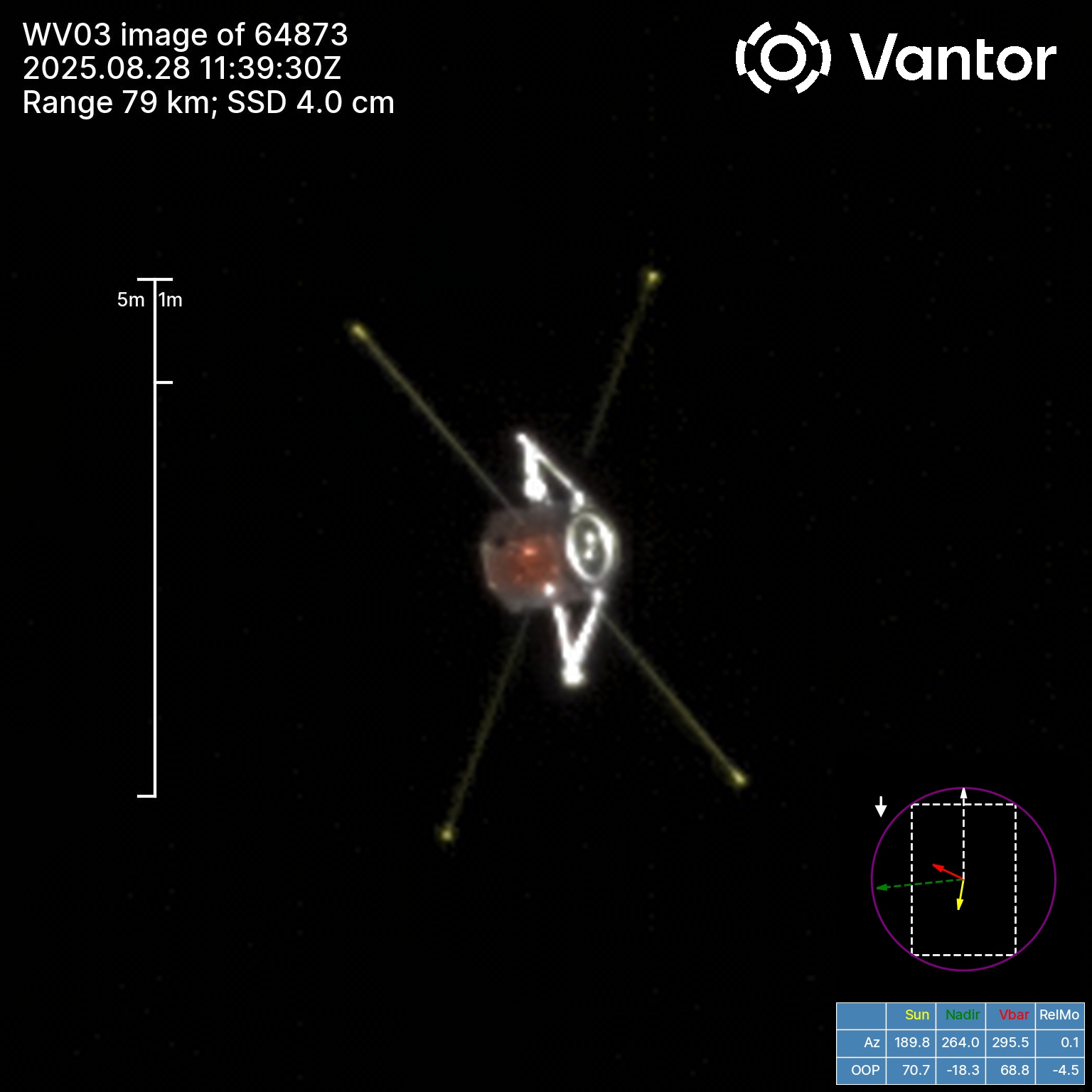
NASA's TRACERS mission, a pair of small satellites built to watch the spot where the solar wind collides with Earth's magnetic shield, has produced its first published scientific results, the space agency said Thursday. The findings bear on a decades-old question in space physics: when Earth's magnetic field snaps and reconnects with the Sun's, does the violence of that process mostly change over time at a fixed spot, or does the spot itself wander while the process stays roughly as intense?
The new analysis, which appears in a paper in the Journal of Geophysical Research: Space Physics, points toward the second answer. Using data from the mission's Analyzers for Cusp Ions instruments, the TRACERS science team found that magnetic reconnection is "largely a spatial process" — meaning the location where field lines break and reconnect shifts around over time, rather than the reconnection process itself growing more or less violent while staying put. NASA's own writeup of the results was explicit that the finding is provisional: the team says additional measurements are needed to confirm it.
A Process That Drives Space Weather
Magnetic reconnection happens where the Sun's magnetic field, carried outward by the solar wind at speeds over a million miles per hour, presses against Earth's magnetosphere at a boundary called the magnetopause. When field lines from the two systems connect and violently reconfigure, they fling nearby charged particles toward Earth at high speed. Some of that energy funnels down through narrow regions near the poles called the polar cusps — the same cusps TRACERS was designed to fly through.
Reconnection is the mechanism that links solar activity to the geomagnetic storms that can distort satellite orbits, disrupt radio communications and electrical grids, and expose astronauts to extra radiation. Pinning down whether the process varies mainly in space or in time has been difficult because most previous spacecraft missions have used a single satellite, which cannot easily distinguish a reconnection site moving past a fixed observation point from a reconnection site staying in place but changing in strength.
Two Satellites Built to Answer One Question
TRACERS — formally the Tandem Reconnection and Cusp Electrodynamics Reconnaissance Satellites — was built specifically to resolve that ambiguity. The mission's two nearly identical spacecraft launched together on July 23, 2025, on a SpaceX Falcon 9 from Vandenberg Space Force Base in California, and fly in the same sun-synchronous orbit separated by anywhere from about 10 seconds to two minutes. By comparing what each satellite measures as it passes through the same cusp region in quick succession, scientists can tell whether conditions changed because the reconnection site moved or because the process itself evolved in place.
The mission is led by David Miles, a physicist at the University of Iowa, with mission management and instrument development from the Southwest Research Institute in San Antonio, Texas, and field-measuring instruments led by teams at UCLA and UC Berkeley. Together, those four institutions' instrument teams track changes in Earth's magnetic and electric fields as the spacecraft pass through the cusp, the dataset the new paper draws on from the mission's first year in orbit. NASA's Heliophysics Explorers Program Office at the Goddard Space Flight Center in Greenbelt, Maryland, oversees the mission for the agency's Heliophysics Division.
Stephen Fuselier, the mission's deputy principal investigator and the scientist who leads the ion-measuring instruments at Southwest Research Institute, framed the finding as an early marker rather than a final word.
"This is an important first step in understanding how magnetic reconnection works and how these processes can affect Earth," Fuselier said.
Miles, the mission's principal investigator, pointed to further data collection ahead. "I am excited to see what is revealed by future measurements," he said, according to NASA's mission page.
A Mission That Nearly Faltered
The results come after a rocky start for the two-satellite mission. Shortly after the July 2025 launch, one of the two spacecraft experienced a problem that paused the normal commissioning process while engineers investigated. The team eventually re-established contact and recovered routine operations, and the spacecraft now pass through the southern polar cusp several times a day, collecting the tandem measurements the mission depends on.
That recovery appears to have paid off with NASA's decision, announced in September, to extend the mission's prime science phase through the spring of 2027, giving the two spacecraft more time to accumulate the thousands of cusp crossings the science team originally planned to gather over a single year.
Why It Matters, and What Comes Next
The practical stakes of the spatial-versus-temporal question are tied to forecasting. Models that treat reconnection as a steady process at a fixed location behave differently, and make different predictions, than models that treat the reconnection site as something that migrates along the magnetopause. Getting that distinction right feeds directly into efforts to anticipate geomagnetic storms before they disrupt satellites, power infrastructure or communications networks — an increasingly consequential problem as both the number of satellites in orbit and the public's reliance on GPS and communications infrastructure have grown.
For now, the TRACERS team is treating its first result as a hypothesis to be tested rather than a settled conclusion. With the mission's run extended into 2027 and the twin satellites continuing to sample the cusp multiple times daily, the team expects a larger body of measurements — originally planned to number in the thousands over the mission's first year — to either reinforce or complicate the picture of reconnection as a wandering, rather than merely pulsing, phenomenon.

Photonic chip combines starlight from two telescopes in milestone test at California observatory
Astronauts complete 100th U.S. spacewalk, install station's seventh new solar wing
